

Snow Goose vs Greater White-fronted Goose
Anser caerulescens versus Anser albifrons
Play a quiz with Snow Goose and Greater White-fronted Goose
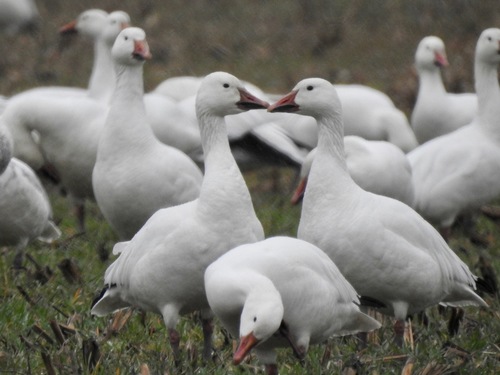 Snow Goose
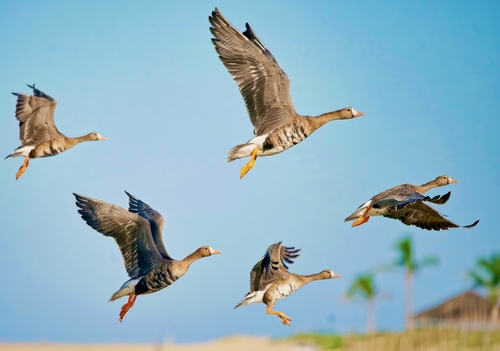 Greater White-fronted Goose
In short
The most reliable field mark for separating Snow Goose from Greater White-fronted Goose is overall plumage: adult Snow Geese are either pure white with black wingtips (white morph) or mostly bluish-gray with a white head (blue morph), while Greater White-fronted Geese are always gray-brown with a white face patch at the bill base and variable dark belly barring. Juvenile Snow Geese (especially blue morph) are drab gray and lack the white facial blaze of Greater White-fronted. Bill color and shape also differ: Snow Goose has a pink bill with a distinct black 'grin patch,' while Greater White-fronted has a pinkish or orange bill without such a patch. In flight, Snow Geese show black primaries contrasting with white (or blue-gray) wings, while Greater White-fronted show uniform gray-brown wings with subtle pale wing bars. Both species can be found together in large flocks in migration and winter, but careful attention to these marks will separate them.
Identification tips
- Plumage morphs (all ages): Snow Goose comes in two morphs—white (all white with black wingtips) and blue (bluish-gray body with white head/neck). Greater White-fronted Goose is always gray-brown with a white face patch and never shows the pure white or blue-gray patterns of Snow Goose.
- Juvenile/immature contrast: Juvenile Snow Geese (especially blue morph) are drab gray with no white facial blaze, while juvenile Greater White-fronted Geese are gray-brown but already show the white patch at the bill base.
- Facial pattern: Greater White-fronted Goose always has a white patch at the base of the bill ('white front'), even in juveniles. Snow Goose never shows this feature.
- Bill color and pattern: Snow Goose has a pink bill with a distinct black 'grin patch' (the dark edge of the bill), visible at close range. Greater White-fronted Goose has a pinkish or orange bill, sometimes with a dark nail but never a black grin patch.
- Leg color: Both have reddish or orange legs, but Snow Goose's are rose-red, while Greater White-fronted's are bright orange. This is subtle and not always reliable in the field.
- Belly barring: Adult Greater White-fronted Geese often show dark blotches or bars on the belly, but this is variable and not always present. Snow Geese never show belly barring.
- Flight pattern (all ages): In flight, Snow Geese show black primaries sharply contrasting with white (or blue-gray) wings; Greater White-fronted Geese have uniform gray-brown wings with subtle pale wing bars and no strong contrast between primaries and coverts.
- Head and neck color: Blue-morph Snow Geese have a white head and neck contrasting with a blue-gray body; Greater White-fronted Geese have a uniform gray-brown head and neck with a white face patch.
- Rusty head staining: Snow Geese may show rusty staining on the head from feeding in iron-rich soils, but this is not a mark of Greater White-fronted.
- Size and structure: Both are similar in size and shape; do not rely on size to separate them in the field.
- Vocalizations: Snow Goose calls are loud, nasal honks; Greater White-fronted Goose gives high-pitched cackling notes ('he-he'). Listen for these differences in flocks.
- Flock composition: Snow Geese often form massive, dense flocks; Greater White-fronted Geese may be present in smaller numbers or mixed flocks.
- Bill shape: Snow Goose bill is more triangular with a pronounced grin patch; Greater White-fronted bill is shorter, more tapered, and lacks the grin patch.
- Tail pattern: Not diagnostic between these two in North America, as both have dark tails with white edges, but Greater White-fronted's white is broader on some subspecies.
- Season and context: Both species occur together in migration and winter; always check for the combination of plumage, bill, and face pattern, especially in mixed flocks.
Size
Both species are similar in size, with Snow Goose averaging about 2630 g [wikidata] and Greater White-fronted Goose ranging from 1.93–3.31 kg [wikipedia]. Length and wingspan overlap: Snow Goose stands 64–79 cm tall with a 135–165 cm wingspan, while Greater White-fronted is 64–81 cm long with a 130–165 cm wingspan. In the field, size alone is not a reliable separator, as both can appear similar, especially at a distance or in mixed flocks.
Plumage
Juvenile and immature Snow Geese, especially blue morphs, are drab or slate-gray overall with little to no white on the head, neck, or belly, and lack the white facial blaze of Greater White-fronted Goose. Adult Snow Geese are either all white with black wingtips (white morph) or have a white head and neck with a bluish-gray body (blue morph); both morphs have pink bills and legs, with a black 'grin patch' on the bill. Greater White-fronted Geese, regardless of age, are grayish-brown with a white patch at the base of the bill (the 'white front'), orange or pinkish legs, and a pinkish or orange bill without a black grin patch. Adults have variable dark barring on the belly, which can be extensive but is not always present. In flight, Snow Geese (all ages) show black primaries contrasting sharply with the rest of the wing, while Greater White-fronted show uniform gray-brown wings with subtle pale wing bars and no strong contrast between primaries and coverts. Juvenile Greater White-fronted Geese lack the belly barring but still show the white facial blaze.
Behaviour
Both species are highly gregarious, often seen in large flocks, especially during migration and winter. They feed in open fields and wetlands, usually on leftover grain or natural vegetation. Snow Geese are particularly known for forming massive, noisy flocks, sometimes numbering in the thousands. Greater White-fronted Geese also form large groups but are often somewhat less dense and may mix with other goose species, including Snow Geese.
Habitat
Both species share similar habitats in migration and winter: open agricultural fields, wetlands, and marshes. Snow Geese tend to be more numerous and are often the dominant species in large flocks, especially in agricultural areas. Greater White-fronted Geese may be found in the same areas but are generally less abundant and may prefer slightly wetter or less disturbed sites within the same landscape.
Voice
Snow Geese are extremely vocal, producing loud, nasal honking calls that can be heard from a great distance. Greater White-fronted Geese have a distinctive high-pitched cackling call, often described as 'he-he,' with a noticeable break between notes. The calls are quite different in tone and rhythm, with Snow Goose being more raucous and Greater White-fronted more musical and cackling.