

Motmot

Snow Goose vs Coscoroba Swan

Anser caerulescens versus Coscoroba coscoroba

Play a quiz with Snow Goose and Coscoroba Swan
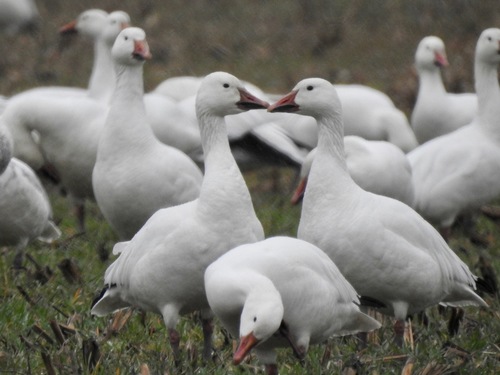
Snow Goose (Anser caerulescens) Snow Goose
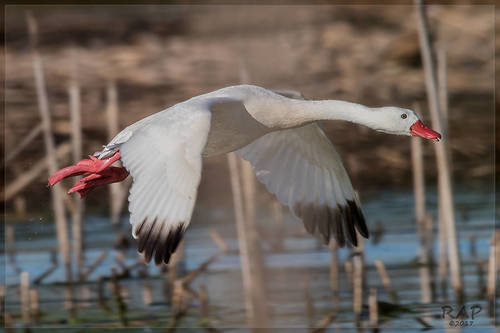
Coscoroba Swan (Coscoroba coscoroba) Coscoroba Swan

Media

Loading…

In short

The most reliable field mark between Snow Goose and Coscoroba Swan is the bill and head structure: Snow Goose has a shorter, stubbier pink bill with a distinct black 'grin patch,' while Coscoroba Swan shows a longer, more swan-like pink bill lacking this patch. Both species are largely white with black wingtips, but Coscoroba Swan is pure white as an adult except for the black on the outer primaries, while Snow Goose can be either all white with black wingtips or a blue-gray morph. Juvenile Snow Geese, especially in the blue morph, can appear grayish, unlike the always white adult Coscoroba Swan. In flight, both show black wingtips, but Coscoroba Swan's longer neck and swan-like posture are distinctive. Size and structure also differ: Coscoroba Swan is heavier, longer-legged, and has a shorter neck than true swans but longer than Snow Goose. Watch for habitat and range as well—Coscoroba Swan is strictly South American, while Snow Goose is North American.

Identification tips

  1. Bill shape and color: Snow Goose has a short, stout pink bill with a prominent black 'grin patch' (the dark cutting edge), visible at close range. Coscoroba Swan's bill is longer, more swan-like, and pink but lacks the black grin patch. This is a key mark at any age.
  2. Neck length and posture: Coscoroba Swan has a longer neck than Snow Goose, though shorter than true swans. In flight or on water, Coscoroba Swan's neck is more extended and swan-like; Snow Goose is always shorter-necked and more compact.
  3. Legs and walking stance: Coscoroba Swan has longer, brighter pink legs and walks with an upright, swan-like gait. Snow Goose's legs are shorter and its gait is more goose-like. This is most obvious when birds are on land.
  4. Plumage morphs: Snow Goose comes in two morphs: white (all white with black wingtips) and blue (grayish-blue body with white head/neck/tail tip and black wingtips). Coscoroba Swan is always pure white as an adult, except for black tips to the outer primaries visible only in flight.
  5. Juvenile/immature plumage: Juvenile Snow Geese, especially blue morphs, are drab gray or slate with little white on the head, neck, or belly, and duller bill/leg colors. Coscoroba Swan immatures are not described as grayish, so a gray or blue-toned juvenile is Snow Goose.
  6. Wing pattern in flight: Both species show black wingtips, but Coscoroba Swan's black is limited to the outer six primaries and is less extensive than the black on Snow Goose. In Snow Goose, the black is more prominent and covers more of the primaries, especially visible in white morphs.
  7. Head staining: Snow Geese often have rusty brown staining on the head from feeding in mineral-rich soils. Coscoroba Swan does not show this staining.
  8. Size and bulk: Coscoroba Swan is heavier and bulkier (4200 g average) than Snow Goose (2630 g average), with a more elongated body and longer legs. Snow Goose is more compact and lighter.
  9. Flock size and behavior: Snow Geese are typically seen in very large, noisy flocks, especially in migration and winter. Coscoroba Swan is usually in pairs or small groups.
  10. Vocalizations: Snow Goose is extremely vocal, with loud honks. Coscoroba Swan's calls are softer, more swan-like, and less far-carrying.
  11. Range and context: Coscoroba Swan is found only in South America; Snow Goose is only in North America. If you are in the wrong continent, reconsider the ID.
  12. Feeding behavior: Snow Geese often graze in fields and feed on leftover grain, while Coscoroba Swan forages mainly in shallow water, rarely upending, and sometimes grazes on land.
  13. Interbreeding and morphs: Snow Goose morphs can interbreed, so mixed flocks with both white and blue morphs are possible. Coscoroba Swan does not show this variation.
  14. Sex differences: Coscoroba Swan males are larger than females, but both sexes look alike in plumage. Snow Goose sexes are similar in both size and plumage.
  15. Confusion with domestics: Snow Goose's pink bill with black grin patch and rose-red feet/legs help separate it from white domestic geese, but Coscoroba Swan's pure white plumage and swan-like bill/neck are distinctive.

Size

Coscoroba Swan is significantly heavier (average 4200 g) than Snow Goose (average 2630 g), and is among the largest South American waterfowl, though still smaller than true swans. Snow Goose is more compact, with a shorter neck and legs. Coscoroba Swan's longer legs and upright stance are noticeable when walking on land, and it stands taller than Snow Goose. In direct comparison, Coscoroba Swan appears bulkier and more elongated, especially in the body and neck, while Snow Goose is stockier and shorter-necked.

Plumage

Juvenile Snow Geese, especially in the blue morph, are drab or slate-gray with little to no white on the head, neck, or belly, and their bill and leg colors are duller. Adult Snow Geese come in two morphs: the white morph is all white with black wingtips, while the blue morph has bluish-gray body plumage with white only on the head, neck, and tail tip. Both morphs have black wingtips visible in flight. Coscoroba Swan adults are pure white except for the black tips to the outer six primary feathers, which are only visible in flight; otherwise, they show no gray or blue tones. Coscoroba Swan's legs and feet are bright pink, as are those of adult Snow Geese, but immature Snow Geese have duller colors. Snow Geese often show rusty staining on the head from feeding, which Coscoroba Swan does not. In summary: Coscoroba Swan is always white as an adult (except for black outer primaries in flight), while Snow Goose can be white or blue-gray, and juveniles can be quite dusky.

Behaviour

Coscoroba Swan walks more upright and easily on land due to its longer legs, and can take off quickly from land or water. Its posture is more swan-like, with a longer neck than Snow Goose, though shorter than true swans. Snow Geese are more goose-like in their movement and often feed in large, noisy flocks. Coscoroba Swan is typically seen in pairs or small groups, and its feeding is more swan-like—mainly swimming or wading, rarely upending. Snow Goose, especially outside the breeding season, is often seen grazing in fields or feeding on leftover grain in large aggregations.

Habitat

Coscoroba Swan is restricted to South America (Argentina, Bolivia, Brazil, Chile, Paraguay, Uruguay, Falkland Islands) and is found in wetlands, shallow lakes, and marshes. Snow Goose is native to North America, breeding in the Arctic and wintering in southern U.S. and Mexico, often in agricultural fields, lakes, and marshes. Overlap in range is not expected, so geographic context is a strong clue. Snow Geese are more likely to be found in very large, dense flocks, especially in migration or winter.

Voice

Snow Goose is very vocal, with loud honking calls that can be heard from over a mile away. Coscoroba Swan produces an onomatopoeic 'cos-cor-oo' as a threat and a monosyllabic hooting note as a contact call; immatures make chirps and trills. Coscoroba Swan's calls are less goose-like and more swan-like, softer and less far-carrying than the raucous Snow Goose.

Submit a better description

Use the same sections as the comparison. Your text is published immediately.

The most reliable field mark between Snow Goose and Coscoroba Swan is the bill and head structure: Snow Goose has a shorter, stubbier pink bill with a distinct black 'grin patch,' while Coscoroba Swan shows a longer, more swan-like pink bill lacking this patch. Both species are largely white with black wingtips, but Coscoroba Swan is pure white as an adult except for the black on the outer primaries, while Snow Goose can be either all white with black wingtips or a blue-gray morph. Juvenile Snow Geese, especially in the blue morph, can appear grayish, unlike the always white adult Coscoroba Swan. In flight, both show black wingtips, but Coscoroba Swan's longer neck and swan-like posture are distinctive. Size and structure also differ: Coscoroba Swan is heavier, longer-legged, and has a shorter neck than true swans but longer than Snow Goose. Watch for habitat and range as well—Coscoroba Swan is strictly South American, while Snow Goose is North American.

  1. Bill shape and color: Snow Goose has a short, stout pink bill with a prominent black 'grin patch' (the dark cutting edge), visible at close range. Coscoroba Swan's bill is longer, more swan-like, and pink but lacks the black grin patch. This is a key mark at any age.
  2. Neck length and posture: Coscoroba Swan has a longer neck than Snow Goose, though shorter than true swans. In flight or on water, Coscoroba Swan's neck is more extended and swan-like; Snow Goose is always shorter-necked and more compact.
  3. Legs and walking stance: Coscoroba Swan has longer, brighter pink legs and walks with an upright, swan-like gait. Snow Goose's legs are shorter and its gait is more goose-like. This is most obvious when birds are on land.
  4. Plumage morphs: Snow Goose comes in two morphs: white (all white with black wingtips) and blue (grayish-blue body with white head/neck/tail tip and black wingtips). Coscoroba Swan is always pure white as an adult, except for black tips to the outer primaries visible only in flight.
  5. Juvenile/immature plumage: Juvenile Snow Geese, especially blue morphs, are drab gray or slate with little white on the head, neck, or belly, and duller bill/leg colors. Coscoroba Swan immatures are not described as grayish, so a gray or blue-toned juvenile is Snow Goose.
  6. Wing pattern in flight: Both species show black wingtips, but Coscoroba Swan's black is limited to the outer six primaries and is less extensive than the black on Snow Goose. In Snow Goose, the black is more prominent and covers more of the primaries, especially visible in white morphs.
  7. Head staining: Snow Geese often have rusty brown staining on the head from feeding in mineral-rich soils. Coscoroba Swan does not show this staining.
  8. Size and bulk: Coscoroba Swan is heavier and bulkier (4200 g average) than Snow Goose (2630 g average), with a more elongated body and longer legs. Snow Goose is more compact and lighter.
  9. Flock size and behavior: Snow Geese are typically seen in very large, noisy flocks, especially in migration and winter. Coscoroba Swan is usually in pairs or small groups.
  10. Vocalizations: Snow Goose is extremely vocal, with loud honks. Coscoroba Swan's calls are softer, more swan-like, and less far-carrying.
  11. Range and context: Coscoroba Swan is found only in South America; Snow Goose is only in North America. If you are in the wrong continent, reconsider the ID.
  12. Feeding behavior: Snow Geese often graze in fields and feed on leftover grain, while Coscoroba Swan forages mainly in shallow water, rarely upending, and sometimes grazes on land.
  13. Interbreeding and morphs: Snow Goose morphs can interbreed, so mixed flocks with both white and blue morphs are possible. Coscoroba Swan does not show this variation.
  14. Sex differences: Coscoroba Swan males are larger than females, but both sexes look alike in plumage. Snow Goose sexes are similar in both size and plumage.
  15. Confusion with domestics: Snow Goose's pink bill with black grin patch and rose-red feet/legs help separate it from white domestic geese, but Coscoroba Swan's pure white plumage and swan-like bill/neck are distinctive.

Coscoroba Swan is significantly heavier (average 4200 g) than Snow Goose (average 2630 g), and is among the largest South American waterfowl, though still smaller than true swans. Snow Goose is more compact, with a shorter neck and legs. Coscoroba Swan's longer legs and upright stance are noticeable when walking on land, and it stands taller than Snow Goose. In direct comparison, Coscoroba Swan appears bulkier and more elongated, especially in the body and neck, while Snow Goose is stockier and shorter-necked.

Juvenile Snow Geese, especially in the blue morph, are drab or slate-gray with little to no white on the head, neck, or belly, and their bill and leg colors are duller. Adult Snow Geese come in two morphs: the white morph is all white with black wingtips, while the blue morph has bluish-gray body plumage with white only on the head, neck, and tail tip. Both morphs have black wingtips visible in flight. Coscoroba Swan adults are pure white except for the black tips to the outer six primary feathers, which are only visible in flight; otherwise, they show no gray or blue tones. Coscoroba Swan's legs and feet are bright pink, as are those of adult Snow Geese, but immature Snow Geese have duller colors. Snow Geese often show rusty staining on the head from feeding, which Coscoroba Swan does not. In summary: Coscoroba Swan is always white as an adult (except for black outer primaries in flight), while Snow Goose can be white or blue-gray, and juveniles can be quite dusky.

Coscoroba Swan walks more upright and easily on land due to its longer legs, and can take off quickly from land or water. Its posture is more swan-like, with a longer neck than Snow Goose, though shorter than true swans. Snow Geese are more goose-like in their movement and often feed in large, noisy flocks. Coscoroba Swan is typically seen in pairs or small groups, and its feeding is more swan-like—mainly swimming or wading, rarely upending. Snow Goose, especially outside the breeding season, is often seen grazing in fields or feeding on leftover grain in large aggregations.

Coscoroba Swan is restricted to South America (Argentina, Bolivia, Brazil, Chile, Paraguay, Uruguay, Falkland Islands) and is found in wetlands, shallow lakes, and marshes. Snow Goose is native to North America, breeding in the Arctic and wintering in southern U.S. and Mexico, often in agricultural fields, lakes, and marshes. Overlap in range is not expected, so geographic context is a strong clue. Snow Geese are more likely to be found in very large, dense flocks, especially in migration or winter.

Snow Goose is very vocal, with loud honking calls that can be heard from over a mile away. Coscoroba Swan produces an onomatopoeic 'cos-cor-oo' as a threat and a monosyllabic hooting note as a contact call; immatures make chirps and trills. Coscoroba Swan's calls are less goose-like and more swan-like, softer and less far-carrying than the raucous Snow Goose.

Discard your changes?

You have unsaved edits. If you leave now, those changes will be lost.

Snow Goose · Coscoroba Swan · My Tricky Birds