

Smooth-billed Ani vs Great Kiskadee
Crotophaga ani versus Pitangus sulphuratus
Play a quiz with Smooth-billed Ani and Great Kiskadee
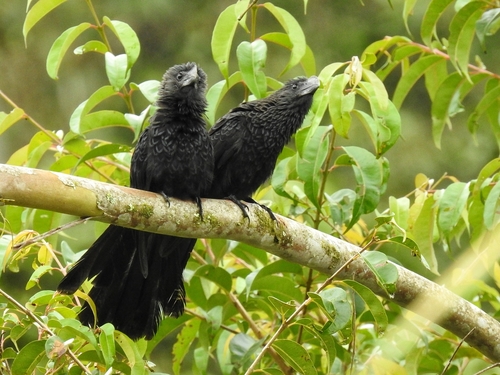 Smooth-billed Ani
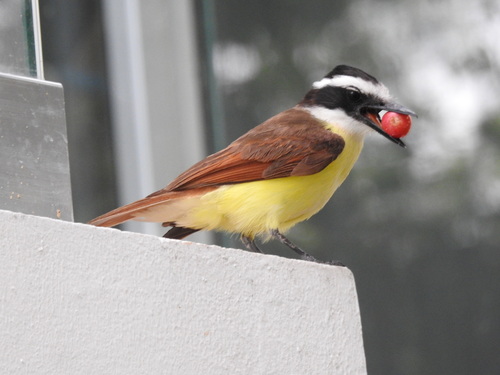 Great Kiskadee
In short
The most reliable field mark is plumage: Great Kiskadee is boldly patterned with a black-and-white head and bright yellow underparts, while Smooth-billed Ani is entirely glossy black. Even at a distance or in flight, the Ani’s long, floppy tail and all-black appearance contrast sharply with the Kiskadee’s striking head pattern and yellow belly. Structurally, the Ani is larger and more elongated, with a long, deeply ridged bill, whereas the Kiskadee is stockier with a short, thick bill. Both are noisy and conspicuous, but their calls and social behavior differ markedly.
Identification tips
- Plumage: All-black vs. yellow and patterned – Smooth-billed Ani is glossy black all over; Great Kiskadee has a bright yellow belly, brown upperparts, and a boldly patterned black-and-white head. This is the most immediate and reliable difference at any age or season.
- Head pattern – Ani’s head is plain black with a brown iris; Kiskadee has a black crown and mask, white supercilium, and sometimes a yellow crown stripe (often concealed). No Ani ever shows this head pattern.
- Bill shape and size – Ani has a long, deep, and strongly ridged bill (smooth, arched culmen); Kiskadee’s bill is short, thick, and straight, lacking the Ani’s deep grooves.
- Tail length and shape – Ani’s tail is long, floppy, and often held low or fanned; Kiskadee’s tail is shorter, straighter, and more typical of flycatchers.
- Flight style – Ani’s flight is weak and wobbly, with the tail swinging; Kiskadee flies strongly and directly, often sallying from a perch.
- Group behavior – Ani is almost always in tight, noisy groups, especially on the ground; Kiskadee is usually alone or in pairs, perching high and calling.
- Foraging style – Ani runs on the ground, often near livestock, searching for insects and ticks; Kiskadee hunts from perches, flycatching or pouncing, and will take a wide range of prey including small vertebrates and even fish.
- Habitat context – Ani prefers open, grassy, or shrubby areas, especially with livestock; Kiskadee is more common in open woodland, urban parks, gardens, and near water.
- Vocalizations – Ani’s call is a nasal, whining 'ooo-leeek'; Kiskadee’s is a loud, ringing 'BEE-tee-WEE' or 'bem-te-vi'.
- Size in context – Ani is larger and longer (97 g, 35 cm) than Kiskadee (74 g, 25–28 cm), but size can be hard to judge without direct comparison.
- Iris color – Ani has a brown iris; Kiskadee’s iris color is not noted as distinctive.
- Wing and tail color – Ani’s wings and tail are glossy black; Kiskadee’s are brown with rufous fringes, especially obvious in good light or flight.
- Juvenile/immature confusion – No age-specific wing or flight pattern overlap: juvenile Anis are still all-black, and young Kiskadees retain the same basic color pattern as adults.
- Feeding associations – Ani may be seen removing ticks from livestock; Kiskadee is more likely to be seen at feeders or catching prey from perches.
- Perched posture – Ani often appears hunched and elongated, especially when running; Kiskadee is upright and alert, with a more compact silhouette.
Size
Smooth-billed Ani is the heavier and longer bird (97 g, ~35 cm) compared to Great Kiskadee (74 g, 25–28 cm). The Ani looks lankier and has a proportionally longer tail, while the Kiskadee is robust and compact. In the field, the Ani’s greater length and tail are obvious, especially when perched or running on the ground. Kiskadee, though large for a flycatcher, is still noticeably smaller and chunkier than the Ani.
Plumage
There is no age-specific upperwing or flight pattern confusion between these species: all ages of Smooth-billed Ani are entirely glossy black, lacking any pale or rufous markings. Great Kiskadee, at all ages, shows a bold black-and-white head pattern (black crown and mask, white supercilium, sometimes a hidden yellow crown stripe), brown upperparts, and bright yellow underparts. Its wings and tail are brown with strong rufous fringes, most noticeable in good light or flight. The Ani’s uniform black plumage, including wings and tail, is unique among these two, and the Kiskadee’s yellow belly and head pattern are never matched by the Ani. No seasonal or sex-based differences are noted for either species.
Behaviour
Smooth-billed Ani is highly gregarious, almost always seen in noisy groups, often foraging on the ground or running among grazing animals. Its flight is weak and wobbly, with a floppy tail. In contrast, Great Kiskadee is usually seen singly or in pairs, perching conspicuously and sallying out to catch insects or pounce on prey. Kiskadees rarely join mixed flocks and are more likely to be seen hunting from a high perch or visiting feeders. Ani’s ground-based, group foraging is distinctive compared to the Kiskadee’s flycatching and omnivorous habits.
Habitat
Both species favor open or semi-open habitats, but Smooth-billed Ani is most often found in open country, cultivated areas, and pastures, especially where livestock are present. Great Kiskadee prefers open woodland with tall trees, urban parks, and gardens, often near water or human habitation. While their ranges overlap, the Ani is more closely associated with ground-level activity in grassy or shrubby areas, whereas the Kiskadee is more arboreal and urban-adapted.
Voice
Smooth-billed Ani gives a whining, drawn-out 'ooo-leeek' call, often repeated by the whole group. Great Kiskadee is extremely vocal, with a loud, exuberant 'BEE-tee-WEE' or 'bem-te-vi' call that is distinctive and often the first clue to its presence. The Ani’s calls are more nasal and less musical, while the Kiskadee’s are sharp, ringing, and easily imitated.