

Smoky Warbler vs Japanese Leaf Warbler
Phylloscopus fuligiventer versus Phylloscopus xanthodryas
Play a quiz with Smoky Warbler and Japanese Leaf Warbler
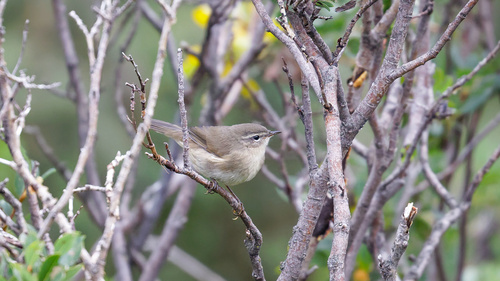 Smoky Warbler
 Japanese Leaf Warbler
In short
The most reliable way to separate Smoky Warbler from Japanese Leaf Warbler is by overall plumage tone and facial pattern: Smoky Warbler is much duller and darker, lacking the bright olive-green and strong yellowish-white eyebrow of Japanese Leaf Warbler. In the field, Japanese Leaf Warbler stands out with its bright olive upperparts, clear supercilium, and white wingbar, while Smoky Warbler appears sooty, plain, and lacks these contrasting marks. Juveniles of Japanese Leaf Warbler are duller but still show the facial pattern, whereas Smoky Warbler remains uniformly dingy. Structure and behavior are similar, so focus on color and face pattern, especially in perched or close views.
Identification tips
- Eyebrow (supercilium): Japanese Leaf Warbler always shows a clear yellowish-white eyebrow above the eye, even in dull juveniles. Smoky Warbler lacks a strong supercilium, appearing plain-faced.
- Upperparts color: Japanese Leaf Warbler is bright olive-green above (adults), while Smoky Warbler is uniformly sooty or dark brownish, lacking any green or olive tones.
- Wingbar: Japanese Leaf Warbler adults show a distinct white wingbar, visible both perched and in flight. Smoky Warbler has no wingbar at any age.
- Juvenile plumage: Even dull juvenile Japanese Leaf Warblers retain a contrasting face pattern and some olive tones; Smoky Warbler juveniles are plain and dingy throughout.
- Underparts: Japanese Leaf Warbler has paler, lighter underparts compared to its upperparts. Smoky Warbler is more uniformly dark below as well as above.
- Bill and legs: Japanese Leaf Warbler has a short, blackish bill with a hint of yellow and pale yellow to orange-brown legs. These features are not described for Smoky Warbler, but are not highlighted as distinctive.
- Facial contrast: The combination of a dark eye and pale eyebrow gives Japanese Leaf Warbler a striking face. Smoky Warbler's face is much less contrasting.
- Tail and wing pattern in flight: Japanese Leaf Warbler's greenish tail and white wingbar may be visible in flight; Smoky Warbler lacks these features and appears uniformly dark.
- Habitat context: If observed at high elevation in the Himalayas or Tibetan Plateau, Smoky Warbler is more likely. In lowland forests or during migration in East Asia, Japanese Leaf Warbler is expected.
- Song and call: If you hear a repeated, short-phrased, low-pitched song or a dry 'brrt' call, Japanese Leaf Warbler is likely. Smoky Warbler's voice is not described here.
- Season: Japanese Leaf Warbler is migratory and may be present only at certain times of year; Smoky Warbler is more resident in its range.
- Sex differences: Both species are sexually monomorphic (males and females look alike), so sex is not a useful field mark.
- Size: Both are similar in size; do not use size to separate them.
- Behavior: Both forage actively in foliage; behavior is not a reliable separator.
- Pitfalls: Dull juvenile Japanese Leaf Warblers can look less bright but still show the eyebrow and some contrast; Smoky Warbler is always plainer and darker overall.
Size
Both species are similar in size, typical of Phylloscopus warblers. Japanese Leaf Warbler is reported at 12–13 cm in length [wikipedia], but no direct size data is available for Smoky Warbler in the notes. In the field, neither species is likely to appear noticeably larger or smaller than the other, so size is not a reliable separator.
Plumage
- Juveniles and immatures: Japanese Leaf Warbler juveniles are duller than adults (more grey-brown), but still show a yellowish-white eyebrow and some contrast between upperparts and underparts. Smoky Warbler, by contrast, is uniformly sooty or dark, lacking a strong eyebrow or wingbar at any age.
- Adults: Japanese Leaf Warbler adults are bright olive-green above, with a clear yellowish-white supercilium, white wingbar, and greenish tail. Smoky Warbler adults are much plainer and darker, with a generally smoky or sooty appearance and no strong facial or wing markings.
- Upperwing pattern in flight: Japanese Leaf Warbler shows a white wingbar (visible in adults and, to a lesser extent, in juveniles), while Smoky Warbler lacks any wingbar or contrasting wing pattern.
- Bill and legs: Japanese Leaf Warbler has a short, blackish bill with a hint of yellow and pale yellow to orange-brown legs. Smoky Warbler's bill and legs are not described in the notes, but are not highlighted as distinctive.
Behaviour
Both species behave like typical Phylloscopus warblers, foraging actively in foliage. No behavioral differences are described in the notes that would reliably separate them in the field.
Habitat
Smoky Warbler is found in the eastern Himalayas and Tibetan Plateau, occasionally reaching Myanmar. Japanese Leaf Warbler breeds in Japan and migrates through eastern China and nearby islands, wintering in Taiwan, the Philippines, Borneo, and Java. While their ranges may overlap during migration or as vagrants, Smoky Warbler is a high-altitude specialist, whereas Japanese Leaf Warbler is more often found in lowland and forested areas during migration and winter. Habitat can be a supporting clue, but is not diagnostic if both species are possible.
Voice
Japanese Leaf Warbler has a distinctive song: a series of short phrases repeated several times, lasting 1.5–2 seconds, lower in pitch than some related species and with a slower rhythm than Arctic Warbler. Its call is a dry, soft 'brrt.' No vocal description is provided for Smoky Warbler in the notes, so voice is not a reliable separator unless Japanese Leaf Warbler's song is heard.