

Slaty Finch vs Wedge-tailed Grass-Finch
Haplospiza rustica versus Emberizoides herbicola
Play a quiz with Slaty Finch and Wedge-tailed Grass-Finch
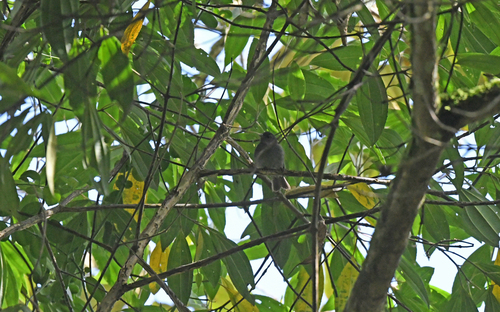 Slaty Finch
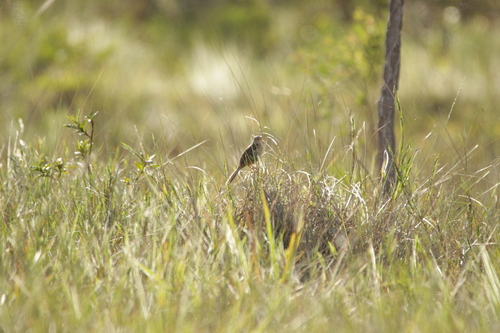 Wedge-tailed Grass-Finch
In short
The most reliable field mark between Slaty Finch and Wedge-tailed Grass-Finch is overall shape and tail: Wedge-tailed Grass-Finch is distinctly larger, with a very long, pointed tail and a streaked, earthy-brown plumage, while Slaty Finch is smaller, compact, and lacks obvious streaking. Juvenile Wedge-tailed Grass-Finch shows a rusty yellow wash and breast streaks, which Slaty Finch never shows at any age. Habitat is also a strong clue: Slaty Finch keeps to montane forest edges, while Wedge-tailed Grass-Finch is a grassland and savanna specialist. If you see a streaky, long-tailed bird in open grassy areas, it's almost certainly Wedge-tailed Grass-Finch.
Identification tips
- Tail shape and length: Wedge-tailed Grass-Finch has a very long, pointed, wedge-shaped tail, often held cocked or flicked; Slaty Finch has a short, square tail. This is visible both perched and in flight.
- Overall size and structure: Wedge-tailed Grass-Finch is much larger and more elongated, with a heavier build and longer body; Slaty Finch is compact and small.
- Upperpart streaking: Wedge-tailed Grass-Finch (all ages) shows bold brown and blackish streaks on the back and crown; Slaty Finch is plain and lacks streaking.
- Juvenile plumage: Juvenile Wedge-tailed Grass-Finch has a rusty yellow wash to upperparts, yellowish face and underparts, and breast streaks. Slaty Finch juveniles are plain and never show yellow or breast streaks.
- Facial pattern: Wedge-tailed Grass-Finch has a pale supercilium, pale lores, and sometimes a faint whitish eye-ring; Slaty Finch's face is plain and lacks these contrasts.
- Wing pattern: Wedge-tailed Grass-Finch has wings with broad olive-green edges; Slaty Finch's wings are uniform and lack contrasting edges.
- Underparts: Wedge-tailed Grass-Finch has creamy white underparts with buff flanks and vent; Slaty Finch is more uniformly colored below.
- Bill: Wedge-tailed Grass-Finch has a moderately thick, yellow to yellow-orange bill with a blackish culmen; Slaty Finch's bill is less colorful and more uniform.
- Habitat: Grassland, savanna, or tall grass = Wedge-tailed Grass-Finch; montane forest edge or dense undergrowth = Slaty Finch.
- Behavior: Wedge-tailed Grass-Finch often perches on grass stems in the open, flicks tail, and makes bounding flights; Slaty Finch stays low, hops, and is more secretive.
- Flight profile: Wedge-tailed Grass-Finch shows a long, pointed tail and streaked upperparts in flight; Slaty Finch looks short-tailed and plain.
- Geographic range: Both can occur in Central America, but Wedge-tailed Grass-Finch is much more widespread in South America, especially in open habitats.
- Sex and season: No significant seasonal or sex differences in plumage for either species; all field marks above apply year-round.
- Common pitfalls: Do not rely on overall brownish color alone—focus on tail length, streaking, and habitat. Immature Grass-Finch can look yellower, but still shows streaks and long tail.
- When in doubt: If the bird is streaked, long-tailed, and in grassland, it's Wedge-tailed Grass-Finch. If it's plain, short-tailed, and in forest edge, it's Slaty Finch.
Size
Wedge-tailed Grass-Finch is noticeably larger and heavier than Slaty Finch: 25.0 g versus 15.6 g in body mass ([wikidata]). The Grass-Finch also appears longer and more elongated in the field, with a length of about 20 cm, while Slaty Finch is much more compact. This size difference is usually obvious with good binocular views, especially when both species are seen in similar contexts.
Plumage
- Juvenile/immature birds: Juvenile Wedge-tailed Grass-Finch has a distinctive rusty yellow wash to the upperparts, yellowish face and underparts, and streaks on the breast. Slaty Finch juveniles do not show these features and remain plain.
- Adults: Adult Wedge-tailed Grass-Finch is boldly streaked above (brown and blackish), with a pale brownish face, pale supercilium, and creamy white underparts with buff flanks. The wings have broad olive-green edges and the tail is long, pointed, and dark-centered. Adult Slaty Finch is much plainer, lacking strong streaks or contrasting wing/tail patterns, and appears overall slaty or dull in tone.
- Sex differences: Both species have similar plumage between sexes, so sex is not a useful field mark.
- Flight views: Wedge-tailed Grass-Finch's long, wedge-shaped tail and streaked upperparts are visible in flight; Slaty Finch appears short-tailed and uniform.
Behaviour
Wedge-tailed Grass-Finch is often seen moving through tall grass, perching on grass stems or low shrubs, and making short flights with a bounding, undulating pattern. It frequently flicks its long tail. Slaty Finch is more secretive, foraging low in dense vegetation at forest edge or in undergrowth, and rarely ventures into open grassy areas. Its movements are more hopping and less conspicuous, with little tail flicking.
Habitat
Habitat is a strong separator. Slaty Finch is restricted to subtropical or tropical moist montane forests and edges, often at higher elevations in Central America and the Andes ([wikipedia]). It avoids open grassland. Wedge-tailed Grass-Finch, by contrast, is a grassland and savanna specialist, favoring damp to dryish grasslands with scattered shrubs, and is found from lowlands up to moderate elevations (up to 1,800 m in Colombia). If the bird is in tall grass or savanna, it is almost certainly Wedge-tailed Grass-Finch; in forest edge or degraded forest, Slaty Finch is more likely.