

Simple Greenbul vs Eastern Mountain Greenbul
Chlorocichla simplex versus Arizelocichla nigriceps
Play a quiz with Simple Greenbul and Eastern Mountain Greenbul
 Simple Greenbul
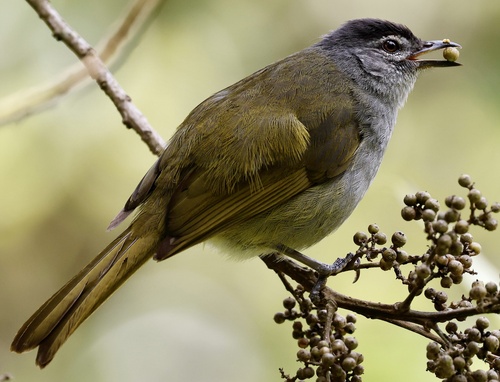 Eastern Mountain Greenbul
In short
The most reliable way to separate Simple Greenbul from Eastern Mountain Greenbul is by habitat: Simple Greenbul is found in lowland tropical forests and shrublands, while Eastern Mountain Greenbul is restricted to the eastern Afromontane regions. In the field, plumage differences are subtle and not well documented for age or wing pattern, so context and location are key. Both species are medium-sized bulbuls with similar overall structure, but only Eastern Mountain Greenbul has a confirmed average body mass (31g). Vocalizations and behavior are not described in the available notes, so focus on where you are birding and the typical habitats of each species.
Identification tips
- Habitat is critical: If you are in lowland tropical forest or shrubland, expect Simple Greenbul; if you are in eastern Afromontane highlands, expect Eastern Mountain Greenbul. This is the most reliable separator in the field.
- No diagnostic plumage differences are documented: Both species are greenbuls with similar overall coloration; do not rely on subtle plumage marks for separation unless you have additional references.
- No age-specific or wing pattern marks: There are no notes on juvenile or immature upperwing or flight patterns for either species, so these features cannot be used for separation.
- Structure is similar: Both are medium-sized, typical bulbul-shaped songbirds. Bill, tail, and wing structure are not described as distinctive in the notes.
- Size overlap: Only Eastern Mountain Greenbul has a documented mass (31g), but this is not likely to be useful in the field without direct comparison.
- Vocalizations not described: Do not rely on song or calls for separation based on current notes.
- Behavior not described: Foraging style, flight, and other behaviors are not noted as distinctive.
- Context matters: Consider your location and elevation before making an identification. If you are in a region where only one species is expected, this can be decisive.
- Diet not diagnostic: While Eastern Mountain Greenbul is noted as eating fruit and nectar, this is not a field mark and does not separate it from Simple Greenbul in practice.
- Consult local checklists: If in doubt, check eBird or local birding resources for which species is expected in your area and habitat.
In summary: Use habitat and location as your primary tools for separating these two species. Do not rely on plumage, structure, or voice unless you have more detailed field guides or local knowledge.
Size
Eastern Mountain Greenbul has a documented average body mass of 31g [wikidata], while no measurement is available for Simple Greenbul, but both are medium-sized bulbuls and likely overlap in size. In the field, size alone is unlikely to be a reliable separator between these two unless you have direct comparison or detailed measurements.
Plumage
There are no detailed descriptions of age-specific or wing pattern differences between Simple Greenbul and Eastern Mountain Greenbul in the provided notes. Both species are typical greenbuls with greenish or olive tones. Any subtle differences in head or body coloration are not specified here, so plumage is not a reliable field mark for separation based on current information.
Habitat
Habitat is the most diagnostic difference: Simple Greenbul is widespread in African tropical lowland forests, dry forests, moist lowland forests, and shrublands [wikipedia]. In contrast, Eastern Mountain Greenbul is native to the eastern Afromontane, a highland region [wikipedia]. If you are birding in lowland rainforest or shrubland, Simple Greenbul is expected; if you are in montane or high-elevation forest in eastern Africa, Eastern Mountain Greenbul is the likely species.
Simple Greenbul · Eastern Mountain Greenbul · My Tricky Birds