

Silver-rumped Spinetail vs Brown-backed Needletail
Rhaphidura leucopygialis versus Hirundapus giganteus
Play a quiz with Silver-rumped Spinetail and Brown-backed Needletail
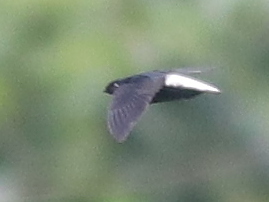 Silver-rumped Spinetail
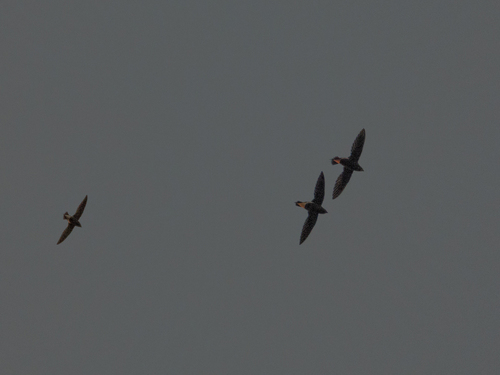 Brown-backed Needletail
In short
The most reliable way to separate Silver-rumped Spinetail from Brown-backed Needletail is by size and overall structure: Brown-backed Needletail is enormous for a swift, with a heavy, barrel-shaped body and a much more powerful, rapid flight. Both species show a white patch on the rump or undertail, but the pattern, extent, and body proportions differ markedly. Silver-rumped Spinetail is much smaller, lighter, and more delicate, with a less robust silhouette. If seen well, the tail shape and the prominence of tail spines also help: Brown-backed Needletail has a stouter tail with more obvious spines. Both species are aerial insectivores, but Brown-backed Needletail is strictly a hill-forest and cliff-nester, while Silver-rumped Spinetail prefers lowland forests.
Identification tips
- Size is the first check: If the bird is strikingly large and bulky for a swift, think Brown-backed Needletail. If it is small and light, Silver-rumped Spinetail is likely.
- Body shape: Brown-backed Needletail has a heavy, barrel-shaped body, almost reminiscent of a small falcon in build. Silver-rumped Spinetail is much slimmer and more delicate.
- Rump/undertail pattern: Silver-rumped Spinetail shows a crisp, silvery-white rump patch that stands out against the rest of the dark plumage. Brown-backed Needletail has a white undertail area that extends onto the flanks, not a sharply defined rump patch.
- Overall color: Brown-backed Needletail is uniformly dark brown above, lacking the silvery contrast of the spinetail. Silver-rumped Spinetail is darker overall but with a bright white rump.
- Tail shape and spines: Both have spined tails, but Brown-backed Needletail's tail is stouter with more prominent spines. The tail is not forked in either species, but the spines are more obvious in Brown-backed Needletail.
- Flight style: Brown-backed Needletail is exceptionally fast and powerful, often flying high and with great speed. Silver-rumped Spinetail is less forceful and more fluttery.
- Perching behavior: Both species only cling to vertical surfaces and never perch on wires or branches, so this is not a useful separator.
- Habitat: In lowland forests, especially away from cliffs, Silver-rumped Spinetail is the default. In hill forests and near cliffs, especially if you see nesting in rock crevices, Brown-backed Needletail is more likely.
- Geographic range: Both overlap in Southeast Asia, but Brown-backed Needletail also occurs in southern India and the Philippines, while Silver-rumped Spinetail is absent from those areas.
- Group size: Brown-backed Needletail may be seen singly or in small groups, often high above the canopy. Silver-rumped Spinetail is more likely to be seen lower, sometimes in loose flocks.
- Confusion with other swifts: Both can be confused with other large or small swifts, but the combination of size, rump/undertail pattern, and habitat should clarify the ID.
- No age-specific upperwing marks: Neither species is described as having distinctive juvenile or immature upperwing patterns, so do not rely on this feature.
- Voice: No diagnostic vocal differences are described in the available notes.
- Sexes similar: No sexual dimorphism is described for either species, so all field marks apply to both sexes.
- Seasonal variation: No seasonal plumage changes are noted for either species, so field marks are reliable year-round.
Size
Size is the most dramatic difference: Brown-backed Needletail is among the largest swifts in the world, weighing about 145 g and reaching up to 23 cm in length, with a heavy, barrel-like body. In contrast, Silver-rumped Spinetail is tiny by comparison, weighing only 14 g. In the field, Brown-backed Needletail will appear almost raptor-sized for a swift, while Silver-rumped Spinetail is much smaller and slimmer. If seen together or with other swifts, the difference is unmistakable. Even at a distance, the bulk and length of Brown-backed Needletail stand out.
Plumage
Both species show contrasting white on the rump or undertail, but the details differ. Silver-rumped Spinetail has a distinctive white rump patch that is sharply set off from the rest of the dark plumage, visible in flight and often catching the light. Brown-backed Needletail, on the other hand, is dark brown overall with a white undertail area that extends onto the flanks, rather than a crisp rump patch. The brown upperparts of Brown-backed Needletail are uniform, lacking the silvery contrast of the spinetail. No age-specific upperwing patterns are described for either species in the available notes, so focus on the rump/undertail contrast and overall coloration. Juvenile or immature differences are not detailed in the sources.
Behaviour
Both species are highly aerial and rarely perch except on vertical surfaces. Brown-backed Needletail is exceptionally fast and powerful in flight, even compared to other swifts, and never settles on the ground. Its flight is direct, rapid, and often high above the canopy or cliffs. Silver-rumped Spinetail is also an aerial insectivore but is less forceful in flight and more likely to be seen lower over lowland forests. Both use their short legs only for clinging to vertical surfaces, not for perching on wires or branches.
Habitat
Habitat can be a useful clue. Silver-rumped Spinetail is found in subtropical or tropical moist lowland forests across Southeast Asia, including Brunei, Indonesia, Malaysia, Myanmar, Singapore, and Thailand. Brown-backed Needletail prefers hill forests and breeds in rock crevices on cliffs, with a range extending from southern India through Southeast Asia to Indonesia and the Philippines. If you see a swift near cliffs or in hilly terrain, especially nesting in rock crevices, Brown-backed Needletail is more likely. In lowland forest, especially away from cliffs, Silver-rumped Spinetail is the expected species.
Silver-rumped Spinetail · Brown-backed Needletail · My Tricky Birds