

Siberian House Martin vs Asian House Martin
Delichon lagopodum versus Delichon dasypus
Play a quiz with Siberian House Martin and Asian House Martin
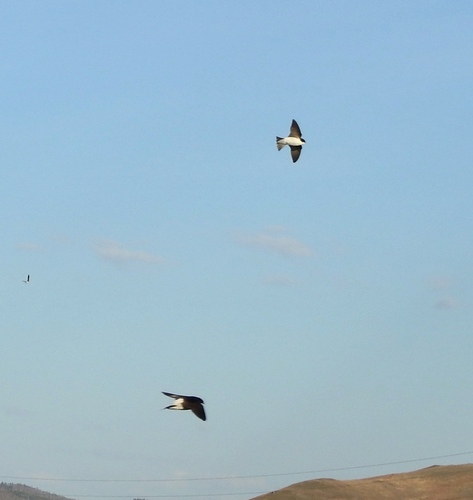 Siberian House Martin
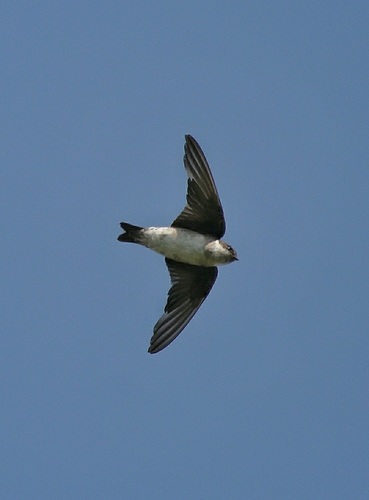 Asian House Martin
In short
Separating Siberian House Martin from Asian House Martin in the field is challenging, especially in flight and among immatures, but the most reliable mark is the underpart color: Asian House Martin shows grey-washed underparts, while Siberian House Martin is expected to be cleaner white below. Tail shape is also useful—Asian House Martin has a less deeply forked tail. Juvenile Asian House Martins are duller above and can show a brownish wash to the rump, which is less expected in Siberian. Both species have a white rump and blue-black upperparts, but subtle differences in gloss and underpart tone are key. Expect overlap in structure and size, so focus on plumage and tail details.
Identification tips
- Underpart color: Asian House Martin shows pale grey-washed underparts, while Siberian House Martin is expected to be clean white below. This is often the most reliable mark, especially in good light.
- Tail fork: Asian House Martin has a less deeply forked tail than Siberian House Martin. Look for this in flight or when perched with the tail spread.
- Juvenile upperparts: Juvenile Asian House Martins are less glossy above, with dark brown upperparts and sometimes a brownish wash to the rump. Siberian House Martin juveniles should be glossier and lack the brownish rump wash.
- Rump color: Both have a white rump, but Asian House Martin (especially subspecies cashmiriensis) can show a brighter, whiter rump. This is subtle and not always reliable.
- Gloss of upperparts: Asian House Martin adults are described as dark steel blue above, but juveniles are duller. Siberian House Martin should be similar, but focus on the gloss difference in immatures.
- Sex differences: Minimal; male Asian House Martins may be slightly paler below in fresh plumage, but this is not a strong field mark.
- Tail and upperwing color: Asian House Martin has brownish-black tail and upperwings, and grey-brown underwings. Siberian House Martin is expected to be similar, so not a strong separator.
- Legs and feet: Asian House Martin's legs and feet are brownish-pink and feathered white, but this is rarely visible in the field.
- Flight style and jizz: No reliable differences described; both species are typical aerial swallows.
- Habitat: Overlap is extensive in winter and migration; do not rely on habitat alone for separation.
- Voice: No diagnostic differences described; both have calls similar to common house martin.
- Subspecific variation: Asian House Martin subspecies can show brighter blue above and a whiter rump, but these are subtle and best used with caution.
- Pitfalls: Most confusion arises with immatures in flight; focus on underpart tone and tail fork, and beware of lighting effects that can mask subtle plumage differences.
- Season: Both species can be present in Southeast Asia in winter, so seasonal context does not reliably separate them where ranges overlap.
- Do not rely on size: Both are similar in size and structure; apparent differences are not reliable in the field.
Size
Both species are very similar in size and structure, and field separation by size is not reliable. Asian House Martin has a reported average body mass of 18g [wikidata], but no comparative weight is available for Siberian House Martin. In practice, do not rely on size to distinguish these two.
Plumage
- Juveniles/immatures: Juvenile Asian House Martins are less glossy above, with dark brown upperparts and sometimes a brownish wash to the rump, and grey-white underparts. This contrasts with Siberian House Martin, which is expected to be cleaner white below and not show the brownish wash to the rump.
- Adults: Both have blue-black upperparts and white rumps, but Asian House Martin is described as having a grey wash to the underparts, while Siberian House Martin is cleaner white. Asian House Martin's tail is only slightly forked, and the upperwings and tail are brownish-black. Subspecific variation in Asian House Martin (e.g., cashmiriensis) can show brighter blue above and a whiter rump, but these are subtle and not always field-usable. Sex differences are minimal, but adult male Asian House Martins may be paler below in fresh plumage.
Behaviour
Both species are aerial insectivores, feeding high in the air on small insects. There is no strong behavioral separation in flight style or foraging noted in the sources. Both breed in colonies and build mud nests under overhangs or on vertical surfaces.
Habitat
Both species breed in rocky or mountainous areas in Asia and winter in Southeast Asia. Siberian House Martin breeds in northeastern Russia, Mongolia, and northern China, while Asian House Martin breeds in the Himalayas and central/eastern Asia. Both can be found in similar habitats during migration and winter, so habitat alone is not a reliable separator where their ranges overlap.
Voice
No vocal differences are described between these two species in the available sources. Asian House Martin's call is a dry, metallic cheep or trill, similar to the common house martin, but there is no comparative information for Siberian House Martin.
Siberian House Martin · Asian House Martin · My Tricky Birds