

Short-tailed Swift vs Fork-tailed Palm Swift
Chaetura brachyura versus Tachornis squamata
Play a quiz with Short-tailed Swift and Fork-tailed Palm Swift
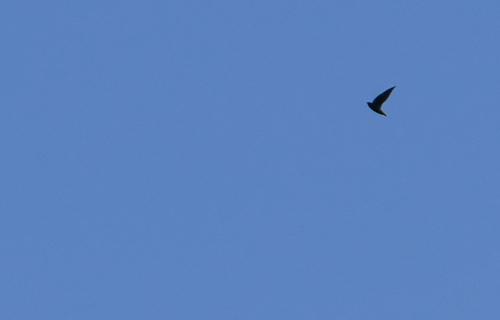 Short-tailed Swift
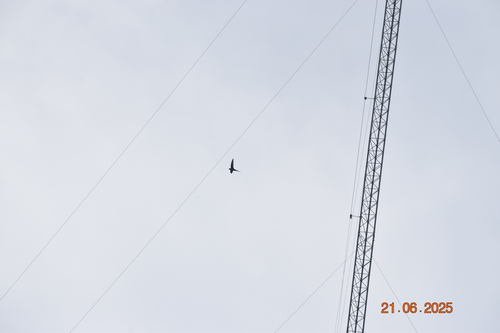 Fork-tailed Palm Swift
In short
The most reliable field mark to separate Short-tailed Swift from Fork-tailed Palm Swift is the tail shape: Short-tailed Swift has a very short, squared or only slightly notched tail, while Fork-tailed Palm Swift shows a long, deeply forked tail that is obvious even at a distance. Both species have long, narrow wings and similar dark upperparts, but Short-tailed Swift is chunkier with a pale rump that blends into the tail, whereas Fork-tailed Palm Swift is slimmer, with a more contrasting, paler rump and a distinctive forked tail. Juvenile Fork-tailed Palm Swifts may show buffy feather edges, but the tail shape remains the most consistent separator in all ages and seasons. In flight, the jizz and tail shape are your best clues; perched views are rare for both.
Identification tips
- Tail shape is the single most reliable mark: Short-tailed Swift has a short, squared or only slightly notched tail; Fork-tailed Palm Swift has a long, deeply forked tail visible in all ages and flight attitudes.
- Body structure: Short-tailed Swift is compact and robust, appearing heavier-bodied and shorter overall. Fork-tailed Palm Swift is slim, long, and delicate, with a noticeably longer tail-to-body ratio.
- Rump contrast: Short-tailed Swift's pale rump merges smoothly into the tail, with little contrast. Fork-tailed Palm Swift's rump is paler than the back and contrasts more, especially in good light.
- Underparts: Fork-tailed Palm Swift has pale, mottled underparts and a very pale, mottled throat, while Short-tailed Swift is darker below with less contrast.
- Juvenile marks: Juvenile Fork-tailed Palm Swifts show buffy feather edges and a buff tinge to the head, but these are subtle and the tail remains forked. No distinctive juvenile marks are noted for Short-tailed Swift.
- Flight style: Short-tailed Swift is fast and direct, with rapid wingbeats and a compact profile. Fork-tailed Palm Swift appears more buoyant and agile, often fanning or closing its long forked tail.
- Association with palms: Fork-tailed Palm Swift is almost always near palms and nests in hanging feather clumps on dead palm fronds. Short-tailed Swift is less strictly tied to palms.
- Perched views: Both species rarely perch in the open; if seen, tail shape is still diagnostic.
- Size in mixed flocks: In direct comparison, Fork-tailed Palm Swift is longer and slimmer, Short-tailed Swift is shorter and chunkier.
- Subspecies variation: Fork-tailed Palm Swift subspecies can be darker (T. s. semota), but tail shape and structure remain reliable.
- Sexes similar: No sexual dimorphism in either species; all marks apply to both sexes.
- Seasonal variation: No seasonal plumage changes described for either species; structural and rump/tail contrasts are reliable year-round.
- Common pitfalls: Do not rely on overall darkness or gloss alone, as lighting can be misleading. Focus on tail shape and rump contrast.
- Habitat context: In urban areas with planted palms, Fork-tailed Palm Swift is likely; in more varied open country, Short-tailed Swift may be present.
- Voice: Not described in the sources; do not rely on vocalizations for separation.
Size
Short-tailed Swift is smaller and heavier-bodied: about 10.5 cm long and 20 g. Fork-tailed Palm Swift is longer but much lighter: about 13 cm long but only 9–13.6 g. The Fork-tailed Palm Swift appears slimmer and more delicate, while Short-tailed Swift is more compact and robust. This difference in build is often apparent in direct comparison or when observing mixed flocks.
Plumage
No age-specific upperwing patterns are described for either species, so focus on tail and rump contrasts. Short-tailed Swift is mainly black with a pale rump that merges smoothly into the tail, lacking strong contrast. Fork-tailed Palm Swift has blackish-brown upperparts with a slight greenish gloss, a slightly paler rump, and a very pale, mottled throat and underparts. Juvenile Fork-tailed Palm Swifts have a buff tinge to the head and buffy feather edges, but the long, forked tail is present at all ages. Subspecies variation in Fork-tailed Palm Swift can make it darker overall (T. s. semota), but the tail remains diagnostic. In summary: Short-tailed Swift is darker overall with a less contrasting rump and a short, squared tail; Fork-tailed Palm Swift is paler below, with a paler rump and a long, deeply forked tail.
Behaviour
Both species are aerial insectivores, feeding on flying insects (notably ants and termites). Fork-tailed Palm Swift often forages in small flocks of up to 10, and is closely associated with palm trees, especially for nesting. Short-tailed Swift is robust and fast-flying, often seen in rapid, direct flight. Fork-tailed Palm Swift may appear more buoyant and agile, with its long tail often fanned or closed in a deep fork during flight. Both rarely perch in the open.
Habitat
Fork-tailed Palm Swift is almost always found near palms, especially Mauritia flexuosa, and is common in palm swamps, savannas, riparian forests, and even urban areas with planted palms. Short-tailed Swift is less strictly tied to palms and can be found in a wider range of open habitats, though both may overlap in lowland areas. If you see swifts circling palms, especially nesting in hanging feather clumps on dead fronds, Fork-tailed Palm Swift is more likely.
Short-tailed Swift · Fork-tailed Palm Swift · My Tricky Birds