
Short-tailed Hawk vs Swainson's Hawk
Buteo brachyurus versus Buteo swainsoni
Play a quiz with Short-tailed Hawk and Swainson's Hawk
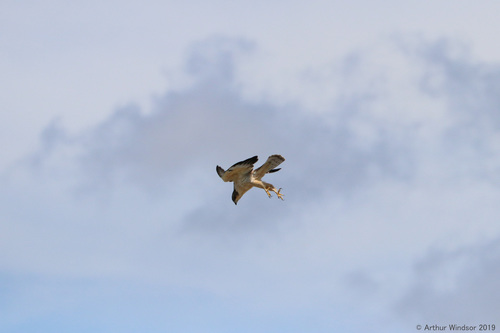 Short-tailed Hawk
 Swainson's Hawk
In short
The most reliable field mark between Short-tailed Hawk and Swainson's Hawk is the underwing pattern in flight, especially in light-morph birds: Swainson's Hawk shows a distinctive contrast between pale wing linings and dark flight feathers, while Short-tailed Hawk lacks this sharp division. Juvenile Swainson's Hawks show pale mottling in the dark areas and a less obvious subterminal tail band, which can trip up observers. Structurally, Swainson's Hawk is much larger and bulkier, with a longer tail, while Short-tailed Hawk is compact and often appears short-tailed and broad-winged. Perched, Short-tailed Hawk is usually well-hidden in dense canopy, while Swainson's Hawk often perches in the open. Both can be variable in plumage, but careful attention to wing and tail patterns, size, and behavior will separate them in most field situations.
Identification tips
- Underwing pattern in flight (all ages): Swainson's Hawk (light morph) shows a sharp contrast between pale wing linings (leading edge) and dark flight feathers (trailing edge); Short-tailed Hawk lacks this, with a more uniform underwing or only a dark trailing edge. This is the single most reliable mark in flight.
- Juvenile Swainson's Hawk: Look for pale mottling in dark areas and a less distinct subterminal tail band; Short-tailed Hawk juveniles do not show this pattern.
- Tail length and shape: Swainson's Hawk has a long, straight tail with multiple narrow bands and a broad subterminal band; Short-tailed Hawk has a noticeably shorter tail, often squared or slightly rounded, and appears more compact overall.
- Size and structure: Swainson's Hawk is much larger and bulkier, with long wings and a rangy silhouette; Short-tailed Hawk is small, stocky, and broad-winged, with a short tail. Use this when both species are seen in the same area or with known-size birds.
- Perched behavior: Swainson's Hawk often perches in the open (trees, poles, ground); Short-tailed Hawk is secretive and usually hidden in dense canopy, rarely seen perched in the open.
- Chest and throat pattern (perched, light morph): Swainson's Hawk shows a reddish 'bib' on the chest and a white throat/face patch; Short-tailed Hawk is more uniformly colored below, lacking the bib and face patch.
- Dark morph confusion: Both species have dark morphs, but Swainson's Hawk dark morph shows a pale patch under the tail and a longer tail; Short-tailed Hawk dark morph is overall dark below, but still appears short-tailed and compact.
- Flight style: Short-tailed Hawk often kites (hovers facing into the wind with stationary wings) and performs vertical or stair-step stoops; Swainson's Hawk soars with wings in a shallow dihedral and may course low over fields or hover briefly.
- Habitat context: Open country, grassland, or agricultural areas favor Swainson's Hawk; forest edge or canopy, especially in Florida or the tropics, favors Short-tailed Hawk.
- Flocking and migration: Swainson's Hawk may be seen in large flocks during migration or on wintering grounds, often following tractors or fires; Short-tailed Hawk is solitary or in pairs, rarely seen in groups.
- Prey and hunting: Swainson's Hawk often hunts large insects, especially grasshoppers and locusts, and may be seen on the ground; Short-tailed Hawk is primarily an aerial predator of small birds, rarely seen on the ground.
- Head and face: Swainson's Hawk (light morph) may show a pale head in first spring due to feather wear; Short-tailed Hawk does not show this feature.
- Vocalization: Not diagnostic based on available notes.
- Seasonal context: In Florida, Short-tailed Hawk is rare and local; Swainson's Hawk is a migrant or winter visitor, more likely in open habitats.
- When in doubt: Prioritize underwing pattern in flight, tail length, and overall size/structure, then check for bib and face patch (Swainson's) or very short tail and compact jizz (Short-tailed).
Size
Swainson's Hawk is substantially larger and heavier, with an average body mass near 960 g [wikidata], while Short-tailed Hawk is much smaller and more compact (no mass given, but consistently described as a small Buteo). In the field, Swainson's Hawk appears long-winged and long-tailed, with a rangy silhouette, while Short-tailed Hawk is noticeably short-tailed and stocky, with broad wings and a more compact frame. Size alone is often enough to separate them when seen together, but beware lone birds at a distance.
Plumage
Juvenile and immature Swainson's Hawks show pale mottling in the dark areas of the wings and body, and their pale chest is marked with darker streaks; the subterminal tail band is less distinct than in adults. In all ages, light-morph Swainson's Hawks have a striking underwing pattern: pale wing linings (leading edge) and dark flight feathers (trailing edge), creating a two-toned look unique among North American raptors. The tail is gray-brown with narrow dark bands and a broader subterminal band. Dark-morph Swainson's Hawks are mostly dark brown with a pale patch under the tail. Short-tailed Hawk, in contrast, lacks the sharp underwing contrast: light morphs have mostly white underparts and underwings, with dark trailing edges but not the strong division of Swainson's. Dark morphs are overall dark below, but still show a shorter tail and more compact shape. Perched, Swainson's Hawk often shows a reddish 'bib' on the chest and a white throat/face patch, while Short-tailed Hawk is more uniformly colored and often hidden in foliage.
Behaviour
Short-tailed Hawk is primarily an aerial hunter, often seen soaring or kiting over forest edges and swooping down nearly vertically on prey, rarely perching in the open. It is often difficult to spot when perched, as it hides in dense canopy. Swainson's Hawk is much more likely to perch in the open on trees, poles, or even on the ground, and often hunts by still-hunting from a perch or soaring with wings in a dihedral. Swainson's Hawk is also known for following tractors or fires to catch insects and small vertebrates, and may be seen in flocks during migration or on the wintering grounds.
Habitat
Short-tailed Hawk is local and uncommon, favoring wooded edges in tropical and subtropical Americas, and is very secretive when perched. In Florida, it is rare and often overlooked except when soaring. Swainson's Hawk prefers open country, grasslands, and agricultural areas, and is much more likely to be seen in open habitats, especially during migration or on the breeding grounds in North America. If you see a Buteo perched in the open in grassland or farmland, Swainson's Hawk is far more likely; a Buteo soaring over forest edge or vanishing into canopy is more likely Short-tailed.