

Motmot

Short-billed Dowitcher vs Spotted Sandpiper

Limnodromus griseus versus Actitis macularius

Play a quiz with Short-billed Dowitcher and Spotted Sandpiper
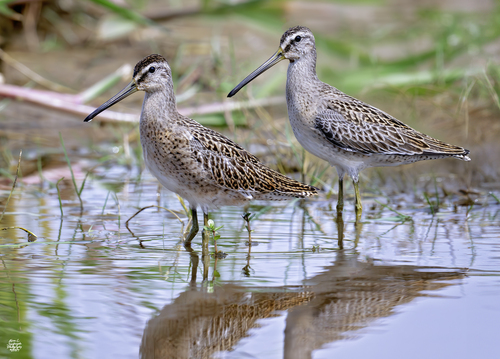
Short-billed Dowitcher (Limnodromus griseus) Short-billed Dowitcher
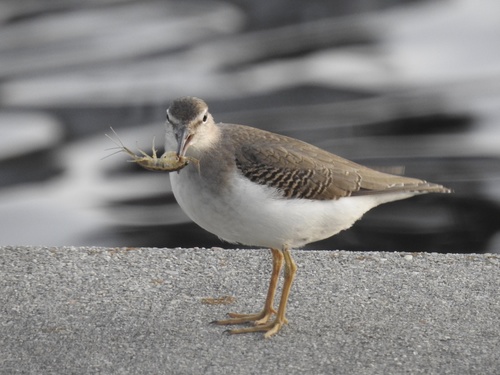
Spotted Sandpiper (Actitis macularius) Spotted Sandpiper

Media

Loading…

In short

The most reliable way to separate Short-billed Dowitcher from Spotted Sandpiper is by overall structure and bill length: dowitchers are much bulkier with very long, straight bills, while spotted sandpipers are smaller, slimmer, and have short, straight bills. In flight, Short-billed Dowitchers show a stocky shape and barred black-and-white tails, while Spotted Sandpipers have a more delicate, stiff-winged flight and lack bold tail barring. Breeding plumage is also distinctive: dowitchers are reddish below (with variable barring or spotting by subspecies), while spotted sandpipers have bold black spots on white underparts. Non-breeding and juvenile plumages are plainer, but structure and bill length remain reliable. Calls are quite different but may not always be heard.

Identification tips

  1. Bill length and shape: Short-billed Dowitcher has a very long, straight bill (almost body length), while Spotted Sandpiper's bill is short, straight, and orange with a dark tip. This is the most consistent field mark in all seasons and ages.
  2. Body size and shape: Dowitchers are much bulkier and stockier than the slim, delicate Spotted Sandpiper. Even at a distance, dowitchers look heavier and more robust.
  3. Tail pattern in flight: Dowitchers show a striking black-and-white barred tail in flight (all ages), while Spotted Sandpiper lacks this and shows plain white sides to the tail.
  4. Leg color: Both have yellowish legs, but this is not reliable on its own due to variation and mud staining.
  5. Breeding plumage underparts: Dowitchers are reddish below with variable barring or spotting (never crisp black spots on white). Spotted Sandpiper has bold black spots on white underparts (breeding only), which are never matched by dowitchers.
  6. Non-breeding/juvenile plumage: Both become plainer below, but dowitchers remain larger and longer-billed. Spotted Sandpiper retains a white supercilium and a more delicate look.
  7. Feeding behavior: Dowitchers feed in groups with rapid, sewing-machine probing. Spotted Sandpipers are solitary, walking with a constant tail-bob.
  8. Flight style: Dowitchers have a strong, direct flight with rapid wingbeats; Spotted Sandpipers fly low over water with stiff, shallow wingbeats.
  9. Habitat context: Dowitchers are more likely on coastal mudflats and tidal marshes, especially during migration. Spotted Sandpipers are more often at freshwater edges, but can overlap in muddy habitats.
  10. Vocalizations: If heard, dowitchers give a mellow, soft call; Spotted Sandpipers give a clear "peet-weet."
  11. Group size: Dowitchers often occur in flocks, while Spotted Sandpipers are usually alone or in pairs.
  12. Bill color: Dowitchers' bills are mostly dark with some orange at the base; Spotted Sandpiper's bill is more orange overall with a dark tip.
  13. Supercilium: Spotted Sandpiper has a clear white eyebrow; dowitchers do not show this feature as distinctly.
  14. Tail length: Dowitchers have a relatively short tail for their size, but it is not diagnostic compared to the sandpiper.
  15. Pitfalls: Non-breeding and juvenile plumages are the trickiest—rely on size, bill length, and tail pattern in flight, not underpart color or spots, which can be absent or faint in both.

Size

Short-billed Dowitcher is substantially larger and heavier (body mass ~113 g) compared to Spotted Sandpiper (34–50 g). Dowitchers measure 23–32 cm in length with a 46–56 cm wingspan, while Spotted Sandpipers are only 18–20 cm long with a 37–40 cm wingspan. The dowitcher's bulk and long bill are obvious even at a distance, especially when both species are seen together.

Plumage

Juvenile and non-breeding Short-billed Dowitchers are mostly gray above and below, lacking the bold spots of breeding Spotted Sandpipers, but can be confused with non-breeding sandpipers due to their plainness. In flight, dowitchers show a black-and-white barred tail, which is absent in Spotted Sandpiper. Breeding Short-billed Dowitchers have reddish underparts with variable barring or spotting (depending on subspecies), but never the crisp black spots on white of breeding Spotted Sandpiper. Spotted Sandpipers in breeding plumage have brown upperparts, white underparts with bold black spots, and a white supercilium. Outside the breeding season, Spotted Sandpipers lose their spots and become plainer below, but still retain a white supercilium and a more washed-out wing pattern in flight than their Eurasian counterpart. Bill color also differs: dowitchers have a long, straight, dark-tipped bill; spotted sandpipers have a short orange bill with a dark tip.

Behaviour

Short-billed Dowitchers feed by rapidly probing mud with a sewing-machine motion, often in groups. Spotted Sandpipers are more solitary, walk with a distinctive teetering motion (tail bobbing up and down), and have a stiff-winged, low flight over water. Dowitchers appear stocky and deliberate, while sandpipers are more active and dainty.

Habitat

Short-billed Dowitchers are most often found on mudflats, tidal marshes, and coastal areas during migration, and breed in northern bogs and marshes. Spotted Sandpipers are more likely to be seen along the edges of freshwater streams, ponds, and lakes, and are less tied to coastal habitats. However, both can overlap on migration at muddy shorelines.

Voice

Short-billed Dowitchers have a mellow call, which is less sharp and piercing than the Long-billed Dowitcher, but still distinct from the Spotted Sandpiper. Spotted Sandpipers give a clear, whistled "peet-weet" call, often heard as they flush from the water's edge. Calls are helpful if heard, but not always available.

Submit a better description

Use the same sections as the comparison. Your text is published immediately.

The most reliable way to separate Short-billed Dowitcher from Spotted Sandpiper is by overall structure and bill length: dowitchers are much bulkier with very long, straight bills, while spotted sandpipers are smaller, slimmer, and have short, straight bills. In flight, Short-billed Dowitchers show a stocky shape and barred black-and-white tails, while Spotted Sandpipers have a more delicate, stiff-winged flight and lack bold tail barring. Breeding plumage is also distinctive: dowitchers are reddish below (with variable barring or spotting by subspecies), while spotted sandpipers have bold black spots on white underparts. Non-breeding and juvenile plumages are plainer, but structure and bill length remain reliable. Calls are quite different but may not always be heard.

  1. Bill length and shape: Short-billed Dowitcher has a very long, straight bill (almost body length), while Spotted Sandpiper's bill is short, straight, and orange with a dark tip. This is the most consistent field mark in all seasons and ages.
  2. Body size and shape: Dowitchers are much bulkier and stockier than the slim, delicate Spotted Sandpiper. Even at a distance, dowitchers look heavier and more robust.
  3. Tail pattern in flight: Dowitchers show a striking black-and-white barred tail in flight (all ages), while Spotted Sandpiper lacks this and shows plain white sides to the tail.
  4. Leg color: Both have yellowish legs, but this is not reliable on its own due to variation and mud staining.
  5. Breeding plumage underparts: Dowitchers are reddish below with variable barring or spotting (never crisp black spots on white). Spotted Sandpiper has bold black spots on white underparts (breeding only), which are never matched by dowitchers.
  6. Non-breeding/juvenile plumage: Both become plainer below, but dowitchers remain larger and longer-billed. Spotted Sandpiper retains a white supercilium and a more delicate look.
  7. Feeding behavior: Dowitchers feed in groups with rapid, sewing-machine probing. Spotted Sandpipers are solitary, walking with a constant tail-bob.
  8. Flight style: Dowitchers have a strong, direct flight with rapid wingbeats; Spotted Sandpipers fly low over water with stiff, shallow wingbeats.
  9. Habitat context: Dowitchers are more likely on coastal mudflats and tidal marshes, especially during migration. Spotted Sandpipers are more often at freshwater edges, but can overlap in muddy habitats.
  10. Vocalizations: If heard, dowitchers give a mellow, soft call; Spotted Sandpipers give a clear "peet-weet."
  11. Group size: Dowitchers often occur in flocks, while Spotted Sandpipers are usually alone or in pairs.
  12. Bill color: Dowitchers' bills are mostly dark with some orange at the base; Spotted Sandpiper's bill is more orange overall with a dark tip.
  13. Supercilium: Spotted Sandpiper has a clear white eyebrow; dowitchers do not show this feature as distinctly.
  14. Tail length: Dowitchers have a relatively short tail for their size, but it is not diagnostic compared to the sandpiper.
  15. Pitfalls: Non-breeding and juvenile plumages are the trickiest—rely on size, bill length, and tail pattern in flight, not underpart color or spots, which can be absent or faint in both.

Short-billed Dowitcher is substantially larger and heavier (body mass ~113 g) compared to Spotted Sandpiper (34–50 g). Dowitchers measure 23–32 cm in length with a 46–56 cm wingspan, while Spotted Sandpipers are only 18–20 cm long with a 37–40 cm wingspan. The dowitcher's bulk and long bill are obvious even at a distance, especially when both species are seen together.

Juvenile and non-breeding Short-billed Dowitchers are mostly gray above and below, lacking the bold spots of breeding Spotted Sandpipers, but can be confused with non-breeding sandpipers due to their plainness. In flight, dowitchers show a black-and-white barred tail, which is absent in Spotted Sandpiper. Breeding Short-billed Dowitchers have reddish underparts with variable barring or spotting (depending on subspecies), but never the crisp black spots on white of breeding Spotted Sandpiper. Spotted Sandpipers in breeding plumage have brown upperparts, white underparts with bold black spots, and a white supercilium. Outside the breeding season, Spotted Sandpipers lose their spots and become plainer below, but still retain a white supercilium and a more washed-out wing pattern in flight than their Eurasian counterpart. Bill color also differs: dowitchers have a long, straight, dark-tipped bill; spotted sandpipers have a short orange bill with a dark tip.

Short-billed Dowitchers feed by rapidly probing mud with a sewing-machine motion, often in groups. Spotted Sandpipers are more solitary, walk with a distinctive teetering motion (tail bobbing up and down), and have a stiff-winged, low flight over water. Dowitchers appear stocky and deliberate, while sandpipers are more active and dainty.

Short-billed Dowitchers are most often found on mudflats, tidal marshes, and coastal areas during migration, and breed in northern bogs and marshes. Spotted Sandpipers are more likely to be seen along the edges of freshwater streams, ponds, and lakes, and are less tied to coastal habitats. However, both can overlap on migration at muddy shorelines.

Short-billed Dowitchers have a mellow call, which is less sharp and piercing than the Long-billed Dowitcher, but still distinct from the Spotted Sandpiper. Spotted Sandpipers give a clear, whistled "peet-weet" call, often heard as they flush from the water's edge. Calls are helpful if heard, but not always available.

Discard your changes?

You have unsaved edits. If you leave now, those changes will be lost.

Short-billed Dowitcher · Spotted Sandpiper · My Tricky Birds