

Motmot

Shore Plover vs Double-banded Plover

Thinornis novaeseelandiae versus Anarhynchus bicinctus

Play a quiz with Shore Plover and Double-banded Plover
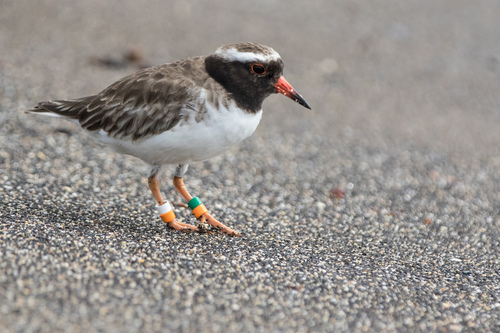
Shore Plover (Thinornis novaeseelandiae) Shore Plover
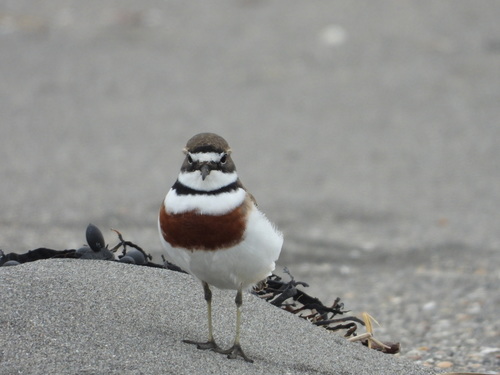
Double-banded Plover (Anarhynchus bicinctus) Double-banded Plover

Media

Loading…

In short

The most reliable field mark to separate Shore Plover from Double-banded Plover is the Shore Plover's distinctive white head band below a brown cap and its bright orange-red legs and bill with a sharply defined dark tip. In contrast, Double-banded Plover lacks the white head band and instead shows a clear double chest band (in adults), with a plain black bill and less vivid leg color. Juvenile Double-banded Plovers lack chest bands and can appear superficially similar to juvenile Shore Plovers, but the latter always show a scaly upperpart pattern and the white head band. Both species are small plovers, but Shore Plover is slightly heavier and much rarer, typically restricted to offshore islands, while Double-banded Plover is widespread in New Zealand.

Identification tips

  1. White head band (Shore Plover only): Look for a strong white band circling the head below a brown cap—diagnostic for all ages of Shore Plover and never shown by Double-banded Plover.
  2. Face mask (adult Shore Plover): Adult males have a bold black mask, females a brown one. Double-banded Plover never shows a face mask, only chest bands.
  3. Bill and leg color: Shore Plover has bright orange-red legs and bill with a sharply defined dark tip (bill color brightest in males). Double-banded Plover has a plain dark bill and legs that are not as vividly colored.
  4. Chest bands (Double-banded Plover): Adult Double-banded Plovers in breeding plumage show a thin black band across the upper chest and a broader brown band below. Shore Plover never shows chest bands.
  5. Juvenile confusion: Juvenile Double-banded Plovers lack chest bands and are speckled brown above, but never have the white head band or scaly upperparts of juvenile Shore Plover. Juvenile Shore Plovers have broader pale fringes on brown back feathers, giving a strongly scaly look.
  6. Upperwing in flight: Shore Plover shows a narrow white wingbar along the full length of the wing and white sides to the tail. Double-banded Plover's upperwing is less distinctly marked and lacks a full-length white wingbar.
  7. Structure: Double-banded Plover looks leggier and more upright, especially when running. Shore Plover is stockier with shorter legs relative to body size.
  8. Habitat context: Shore Plover is extremely rare and restricted to a few offshore islands; Double-banded Plover is widespread on New Zealand beaches and estuaries. If you are not on a predator-free offshore island, Double-banded is vastly more likely.
  9. Behavior: Double-banded Plover often runs quickly and pauses to feed, showing agility and long, pointed wings. Shore Plover is more secretive and may be seen sheltering under cover or in burrows.
  10. Bill shape: Both have short, sturdy bills, but Shore Plover's is slightly more robust and always has a dark tip.
  11. Tail pattern: Shore Plover has a brown tail with white sides; Double-banded Plover's tail pattern is less distinctive.
  12. Vocalization: If you hear a clear 'chirp-chirp' call, it's likely Double-banded Plover. Shore Plover's call is not described here.
  13. Sex differences: In both species, males are more brightly marked in breeding plumage, but the head pattern (white band and mask vs. chest bands) remains the best separator.
  14. Seasonal changes: Double-banded Plover loses its chest bands outside breeding season, becoming plainer, but still lacks the Shore Plover's head pattern and bill/leg color.
  15. Population context: Shore Plover is one of the world's rarest shorebirds; always consider rarity and location before claiming one.

Size

Both species are very similar in size, with Shore Plover averaging 61 g and Double-banded Plover 58 g [wikidata]. In the field, this difference is negligible and not a reliable separation point. Both are small, compact plovers, but Shore Plover may appear slightly chunkier due to its stockier build and shorter legs relative to body size, while Double-banded Plover often looks leggier and more upright, especially when foraging.

Plumage

Juvenile and immature birds are a common source of confusion. Juvenile Shore Plovers lack the full adult face mask but always show a strong white band circling the head below a brown cap, and their brown upperparts have broad pale fringes, giving a strongly scaly look. Juvenile Double-banded Plovers lack chest bands and are speckled brown above, but do not show the white head band or the scaly pattern of Shore Plover. In adults, Shore Plover males have a bold black face mask, females a brown one, both with the white head band and orange-red bill/legs. Double-banded Plovers in breeding plumage show a thin black upper chest band and a broader brown lower chest band (males more distinct), with a plain dark bill and legs that are not as vividly colored. Non-breeding and juvenile Double-banded Plovers lose the chest bands and become plainer, but still lack the Shore Plover's head pattern and bill/leg color. In flight, Shore Plover shows a narrow white wingbar and white tail sides, while Double-banded Plover's upperwing is less distinctly marked.

Behaviour

Double-banded Plovers are active foragers, often seen running quickly then pausing to feed, and are agile in flight with long, pointed wings. Shore Plovers are more secretive, often nesting and sheltering under cover or in burrows, and may appear less restless when feeding. The difference in leg length is sometimes visible in the field, with Double-banded Plovers appearing leggier and more upright.

Habitat

Shore Plover is now restricted to a few predator-free offshore islands and is extremely rare, so any sighting on the New Zealand mainland is highly unlikely. They favor rocky shores, boulder beaches, and nest under cover or in burrows. Double-banded Plover is widespread and breeds throughout New Zealand, including the Chatham Islands, and is commonly found on sandy beaches, estuaries, and riverbeds. If you are on a mainland beach or estuary, Double-banded Plover is far more likely.

Voice

Double-banded Plover has a distinctive 'chirp-chirp' call, which is often heard before the bird is seen. No specific vocalization is described for Shore Plover in the provided notes, so voice is not a reliable separator unless the Double-banded's call is heard.

Submit a better description

Use the same sections as the comparison. Your text is published immediately.

The most reliable field mark to separate Shore Plover from Double-banded Plover is the Shore Plover's distinctive white head band below a brown cap and its bright orange-red legs and bill with a sharply defined dark tip. In contrast, Double-banded Plover lacks the white head band and instead shows a clear double chest band (in adults), with a plain black bill and less vivid leg color. Juvenile Double-banded Plovers lack chest bands and can appear superficially similar to juvenile Shore Plovers, but the latter always show a scaly upperpart pattern and the white head band. Both species are small plovers, but Shore Plover is slightly heavier and much rarer, typically restricted to offshore islands, while Double-banded Plover is widespread in New Zealand.

  1. White head band (Shore Plover only): Look for a strong white band circling the head below a brown cap—diagnostic for all ages of Shore Plover and never shown by Double-banded Plover.
  2. Face mask (adult Shore Plover): Adult males have a bold black mask, females a brown one. Double-banded Plover never shows a face mask, only chest bands.
  3. Bill and leg color: Shore Plover has bright orange-red legs and bill with a sharply defined dark tip (bill color brightest in males). Double-banded Plover has a plain dark bill and legs that are not as vividly colored.
  4. Chest bands (Double-banded Plover): Adult Double-banded Plovers in breeding plumage show a thin black band across the upper chest and a broader brown band below. Shore Plover never shows chest bands.
  5. Juvenile confusion: Juvenile Double-banded Plovers lack chest bands and are speckled brown above, but never have the white head band or scaly upperparts of juvenile Shore Plover. Juvenile Shore Plovers have broader pale fringes on brown back feathers, giving a strongly scaly look.
  6. Upperwing in flight: Shore Plover shows a narrow white wingbar along the full length of the wing and white sides to the tail. Double-banded Plover's upperwing is less distinctly marked and lacks a full-length white wingbar.
  7. Structure: Double-banded Plover looks leggier and more upright, especially when running. Shore Plover is stockier with shorter legs relative to body size.
  8. Habitat context: Shore Plover is extremely rare and restricted to a few offshore islands; Double-banded Plover is widespread on New Zealand beaches and estuaries. If you are not on a predator-free offshore island, Double-banded is vastly more likely.
  9. Behavior: Double-banded Plover often runs quickly and pauses to feed, showing agility and long, pointed wings. Shore Plover is more secretive and may be seen sheltering under cover or in burrows.
  10. Bill shape: Both have short, sturdy bills, but Shore Plover's is slightly more robust and always has a dark tip.
  11. Tail pattern: Shore Plover has a brown tail with white sides; Double-banded Plover's tail pattern is less distinctive.
  12. Vocalization: If you hear a clear 'chirp-chirp' call, it's likely Double-banded Plover. Shore Plover's call is not described here.
  13. Sex differences: In both species, males are more brightly marked in breeding plumage, but the head pattern (white band and mask vs. chest bands) remains the best separator.
  14. Seasonal changes: Double-banded Plover loses its chest bands outside breeding season, becoming plainer, but still lacks the Shore Plover's head pattern and bill/leg color.
  15. Population context: Shore Plover is one of the world's rarest shorebirds; always consider rarity and location before claiming one.

Both species are very similar in size, with Shore Plover averaging 61 g and Double-banded Plover 58 g [wikidata]. In the field, this difference is negligible and not a reliable separation point. Both are small, compact plovers, but Shore Plover may appear slightly chunkier due to its stockier build and shorter legs relative to body size, while Double-banded Plover often looks leggier and more upright, especially when foraging.

Juvenile and immature birds are a common source of confusion. Juvenile Shore Plovers lack the full adult face mask but always show a strong white band circling the head below a brown cap, and their brown upperparts have broad pale fringes, giving a strongly scaly look. Juvenile Double-banded Plovers lack chest bands and are speckled brown above, but do not show the white head band or the scaly pattern of Shore Plover. In adults, Shore Plover males have a bold black face mask, females a brown one, both with the white head band and orange-red bill/legs. Double-banded Plovers in breeding plumage show a thin black upper chest band and a broader brown lower chest band (males more distinct), with a plain dark bill and legs that are not as vividly colored. Non-breeding and juvenile Double-banded Plovers lose the chest bands and become plainer, but still lack the Shore Plover's head pattern and bill/leg color. In flight, Shore Plover shows a narrow white wingbar and white tail sides, while Double-banded Plover's upperwing is less distinctly marked.

Double-banded Plovers are active foragers, often seen running quickly then pausing to feed, and are agile in flight with long, pointed wings. Shore Plovers are more secretive, often nesting and sheltering under cover or in burrows, and may appear less restless when feeding. The difference in leg length is sometimes visible in the field, with Double-banded Plovers appearing leggier and more upright.

Shore Plover is now restricted to a few predator-free offshore islands and is extremely rare, so any sighting on the New Zealand mainland is highly unlikely. They favor rocky shores, boulder beaches, and nest under cover or in burrows. Double-banded Plover is widespread and breeds throughout New Zealand, including the Chatham Islands, and is commonly found on sandy beaches, estuaries, and riverbeds. If you are on a mainland beach or estuary, Double-banded Plover is far more likely.

Double-banded Plover has a distinctive 'chirp-chirp' call, which is often heard before the bird is seen. No specific vocalization is described for Shore Plover in the provided notes, so voice is not a reliable separator unless the Double-banded's call is heard.

Discard your changes?

You have unsaved edits. If you leave now, those changes will be lost.

Shore Plover · Double-banded Plover · My Tricky Birds