

Shore Lark vs Woodlark
Eremophila alpestris versus Lullula arborea
Play a quiz with Shore Lark and Woodlark
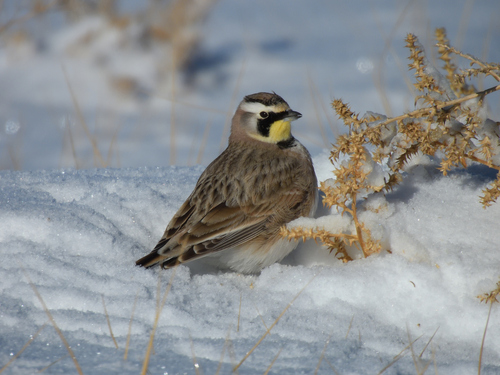 Shore Lark
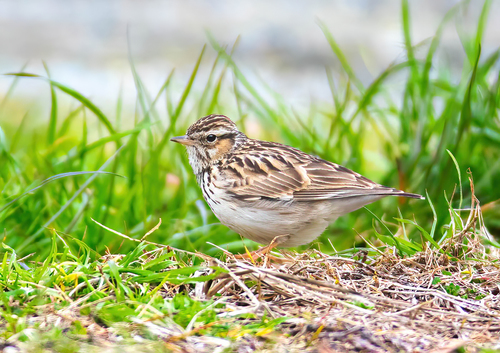 Woodlark
In short
The most reliable field mark to separate Shore Lark from Woodlark is the bold, contrasting black and yellow (or white) face pattern of the Shore Lark, especially the black 'horns' on adult males in summer, which Woodlark never shows. In flight, Shore Lark displays a mostly black tail with pale central feathers, while Woodlark has a short tail tipped with white but lacks strong tail contrast. Woodlark is smaller, with a more compact, short-tailed appearance and a subtle white supercilium meeting at the nape, unlike the Shore Lark’s striking facial pattern. Both species are brown above and pale below, but their face and tail patterns are key in all plumages. Voice and habitat can help, but plumage and structure are most decisive.
Identification tips
- Face pattern (all ages): Shore Lark always shows a bold face pattern with black and yellow (or white) elements, including a black mask and, in males, black 'horns'. Woodlark has a plain face with a white supercilium meeting at the nape, forming a pale 'collar', but never any black mask or horns.
- Tail pattern in flight: Shore Lark has a mostly black tail with pale central feathers, creating a strong contrast visible from above or below. Woodlark’s tail is short, tipped with white, but lacks strong black sides or central contrast.
- Size and shape: Shore Lark is larger and longer, with a more elongated appearance, especially in flight. Woodlark is smaller, more compact, and has a noticeably shorter tail and broader wings.
- Crest: Woodlark has a small, often inconspicuous crest, while Shore Lark’s 'horns' (in breeding males) are upright feather tufts, not a true crest. Females and immatures may lack obvious horns but still show facial contrast.
- Upperparts: Both are brown above, but Shore Lark may appear greyer (especially in southern races), while Woodlark is more uniformly brown.
- Underparts: Both are pale below, not diagnostic.
- Perched jizz: Shore Lark appears longer and more upright, with a striking face; Woodlark is dumpier, with a rounder head and less contrast.
- Flight style: Shore Lark’s flight is more direct and elongated; Woodlark’s is fluttery and spiraling, with frequent song flights.
- Song: Shore Lark’s song is weak, high-pitched, and tinkling, often with a warbling trill. Woodlark’s is a rich, fluting, repetitive 'lu-lu-lu', more musical and easily distinguished with experience.
- Habitat: Shore Lark favors open, bare ground and shorelines (in Europe, especially in winter); Woodlark prefers heathland, clearings, and open woodland.
- Seasonal context: Shore Lark is more likely on shorelines in winter, Woodlark is resident in woodlands and heaths year-round in western Europe.
- Bill: Not strongly diagnostic, but both have typical lark bills; structure is more useful.
- Sex/age pitfalls: Immature and female Shore Larks may lack full horns but still show facial contrast; Woodlark of all ages lacks strong face pattern.
- Tail length on perched birds: Woodlark’s tail is noticeably short and may look stubby; Shore Lark’s is longer and more pointed.
- Local abundance: In southern England, Woodlark is more likely in heath and pine clearings; Shore Lark is rare and usually only in winter on coasts.
Size
Shore Lark is distinctly larger: 16–20 cm in length, 28–48 g in weight, and a wingspan of 30–34 cm [avonet]. Woodlark is smaller, at 13.5–15 cm long, and is about 20% shorter than a Skylark [wikipedia]. In the field, Woodlark appears more compact and short-tailed, while Shore Lark is longer and more elongated, especially in flight.
Plumage
-
Juvenile/immature/flight views: Shore Lark of all ages shows a mostly black tail with pale central feathers, creating a strong contrast in flight. Woodlark’s tail is short and tipped with white, but lacks the broad black tail sides of Shore Lark. Woodlark does not show a strong tail contrast or any black 'horns' at any age.
-
Adult breeding male Shore Lark: Shows bold black 'horns' (tufts), a black mask, and a yellow (or white in some races) face. Woodlark never shows horns or such a bold face pattern; instead, it has a subtle white supercilium that meets at the nape, forming a pale 'collar'.
-
Adult female/immature Shore Lark: Still shows some facial contrast, though less intense than males. Woodlark remains plain-faced with only the supercilium as a mark.
-
Upperparts: Both species are brown above and pale below, but Shore Lark is often greyer (especially southern European races) and Woodlark is more uniformly brown.
-
Perched: Shore Lark’s face pattern is always more striking; Woodlark’s crest is small and usually inconspicuous.
Behaviour
Both species sing in flight, but their display differs: Shore Lark males perform circular flights above the female, then dive steeply, while Woodlark males flutter and spiral upwards, circling at a constant height. Woodlark often sings from a perch or the ground as well. Shore Lark is more likely to be seen on open ground or shorelines, while Woodlark prefers clearings and open woodland. Shore Lark’s flight is more direct and elongated, while Woodlark appears more fluttery and compact in the air.
Habitat
Shore Lark is found on open ground, often bare or sparsely vegetated, and in Europe is associated with shorelines in winter. Woodlark prefers heathland, clearings in pine forests, and open spaces with scattered trees, rarely venturing to true shorelines. If seen in a pine clearing or heath, Woodlark is more likely; on a windswept shore or bare field, Shore Lark is expected.
Voice
Shore Lark’s calls are high-pitched, lisping or tinkling, and weak. Its song is a few chips followed by a warbling, ascending trill, usually delivered in flight. Woodlark’s song is a melodious, repetitive warble, often described as 'lu-lu-lu' or 'toolooeet', and is more musical and fluting than Shore Lark’s. Woodlark sings both in flight and from perches or the ground, starting early in the season (from February in Britain).