
Shore Lark vs Crested Lark
Eremophila alpestris versus Galerida cristata
Play a quiz with Shore Lark and Crested Lark
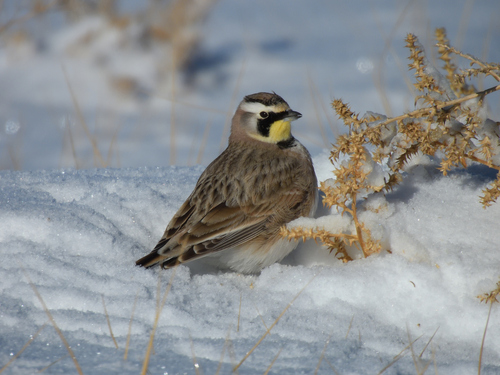 Shore Lark
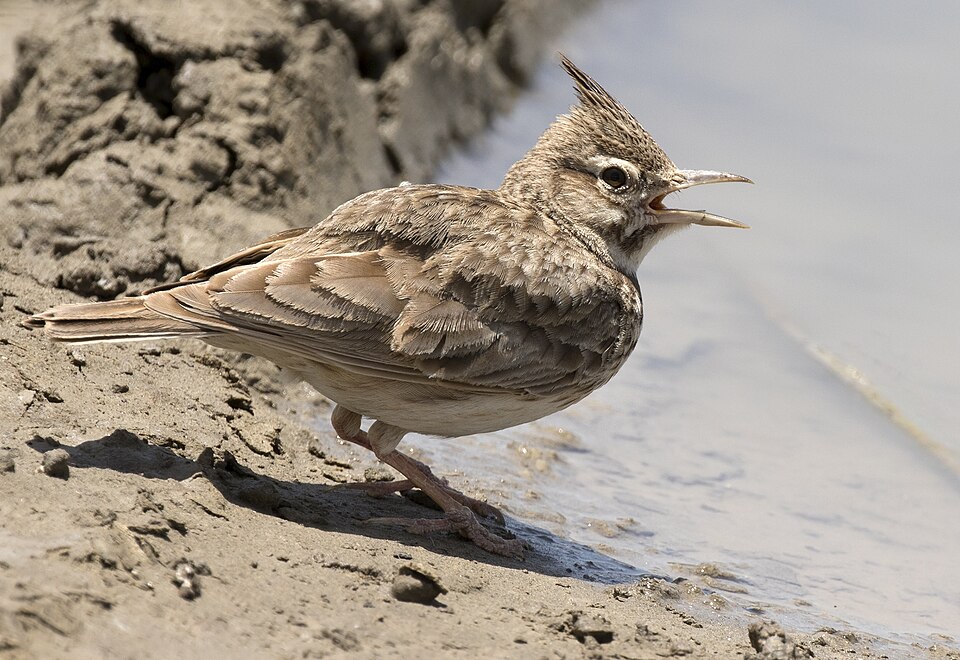 Crested Lark
In short
The most reliable field mark between Shore Lark and Crested Lark is the Shore Lark’s bold black-and-yellow (or black-and-white in some races) face pattern, often with small black feather "horns" on adult males, versus the Crested Lark’s plainer, streaked face and prominent pointed crest. In flight, Shore Lark shows a striking black tail with pale body contrast, while Crested Lark has a shorter tail with pale outer feathers and reddish underwings. Juvenile Crested Larks are more spotted above, but never show the Shore Lark’s facial pattern. Structure also differs: Crested Lark is bulkier with a heavier bill and a longer, always-visible crest. Both are ground-dwelling larks, but Shore Lark favors open, often barren or coastal ground, while Crested Lark prefers wasteland and urban edges.
Identification tips
- Face pattern (all ages): Shore Lark always shows a bold black-and-yellow (or black-and-white) face pattern, even in duller immatures; Crested Lark’s face is plain, with only subtle streaking and no bold markings.
- Crest vs. horns (adults): Crested Lark has a long, pointed crest that is always visible and especially obvious when raised; Shore Lark males have small, black feather "horns" (tufts) on the crown, but these are much shorter and only obvious at close range or in good light.
- Tail pattern in flight (all ages): Shore Lark has a mostly black tail (except central feathers), creating a strong contrast with the pale body, especially obvious in flight; Crested Lark’s tail is shorter, with pale outer feathers and no strong contrast.
- Underwing color (flight): Crested Lark shows reddish underwings in flight, a feature never shown by Shore Lark.
- Juvenile upperparts: Juvenile Crested Larks are more spotted on the back, but never show a face pattern; juvenile Shore Larks have a duller version of the adult face pattern.
- Bill shape: Crested Lark has a heavier, more robust bill, often slightly downcurved; Shore Lark’s bill is finer and more delicate.
- Body structure: Crested Lark is bulkier around the head and body, with a shorter tail relative to body size; Shore Lark is slimmer and longer-tailed in appearance.
- Plumage above/below: Shore Lark is brown-grey above and pale below, with a sharp contrast; Crested Lark is more uniformly brownish above and below, with less contrast.
- Breast band: Shore Lark has a black breast band (especially males in breeding plumage); Crested Lark lacks any breast band.
- Song: Shore Lark’s song is high-pitched, weak, and tinkling; Crested Lark’s is richer, more liquid, and melodious.
- Display flight: Shore Lark males perform circling, fluttering song flights with a sudden dive; Crested Lark’s display is more undulatory and often from the ground.
- Habitat: Shore Lark prefers open, often barren or coastal ground; Crested Lark is more likely in wasteland, urban edges, and disturbed ground.
- Seasonal context: In Europe, Shore Lark is mainly a winter visitor to shorelines; Crested Lark is resident year-round.
- Sex differences: Crested Lark sexes are similar; Shore Lark males have more pronounced horns and face pattern, but females and immatures still show the key face pattern.
- Pitfalls: At distance, Crested Lark’s crest can look like "horns" if raised, but the lack of a bold face pattern and the reddish underwings in flight are diagnostic. Shore Lark’s horns are much shorter and only obvious in good views.
Size
Shore Lark is slightly smaller and lighter: 16–20 cm length, 28–48 g weight, 30–34 cm wingspan [wikipedia][avonet][wikidata]. Crested Lark is 17 cm long, 37–55 g, and has a wingspan of 29–38 cm [wikipedia][avonet][wikidata]. In the field, Crested Lark appears bulkier around the head and body, with a heavier build and a more robust bill, while Shore Lark is slimmer and more delicate overall.
Plumage
-
Juveniles/immatures: Juvenile Crested Larks are more spotted on the back than adults, but lack any bold facial pattern; their upperparts are streaked and plain brown, with a short tail and pale outer tail feathers. Juvenile Shore Larks already show a pale below/dark above contrast and begin to develop the face pattern, though it is duller than in adults.
-
Adults (breeding): Shore Lark males have a dramatic black-and-yellow (or black-and-white in some races) face pattern, with black "horns" (tufts) on the crown, a black breast band, and a mostly black tail (except central feathers) that contrasts with the pale body, especially in flight. Crested Lark adults are plain brown above, pale below, with a streaked back and a prominent pointed crest; their face is plain and lacks any bold pattern, and the underwings are reddish in flight.
-
Flight: Shore Lark shows a striking black tail with pale body contrast; Crested Lark has a shorter tail with pale outer feathers and reddish underwings, lacking any strong tail/body contrast.
Behaviour
Both species are ground-dwelling larks, often seen walking or running on open ground. Shore Lark males perform aerial song displays with a circling, fluttering flight and a sudden dive, often singing in flight. Crested Lark also sings in flight, but its display is more undulatory and it often sings from the ground or low perches. Crested Lark’s crest is raised during display or excitement, making it more obvious. Both nest in ground depressions, but Shore Lark’s nest is more carefully constructed and often has a 'doorstep' of pebbles or debris.
Habitat
Shore Lark prefers open, often barren or coastal ground, such as shorelines in winter or tundra-like habitats; in Europe, it is associated with shorelines in winter. Crested Lark is more likely in wastelands, urban edges, roadsides, and disturbed ground, often near towns or villages. While both can be seen in open country, Crested Lark is more tolerant of human-modified habitats and is non-migratory, whereas Shore Lark is migratory or nomadic in many regions.
Voice
Shore Lark’s calls are high-pitched, lisping or tinkling, and weak; its song is a few chips followed by a warbling, ascending trill, often delivered in flight [wikipedia]. Crested Lark’s song is a liquid, warbling sequence ("whee-whee-wheeoo" or "twee-tee-too"), also given in flight or from the ground, and is richer and more melodious than Shore Lark’s. Both sing in flight, but Crested Lark’s song is more complex and less high-pitched.