

Motmot

Shikra vs Eurasian Sparrowhawk

Tachyspiza badia versus Accipiter nisus

Play a quiz with Shikra and Eurasian Sparrowhawk
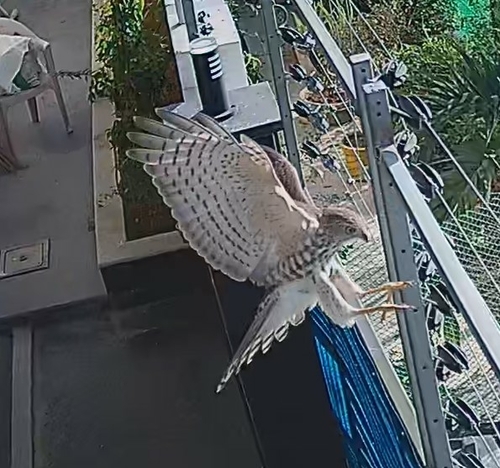
Shikra (Tachyspiza badia) Shikra
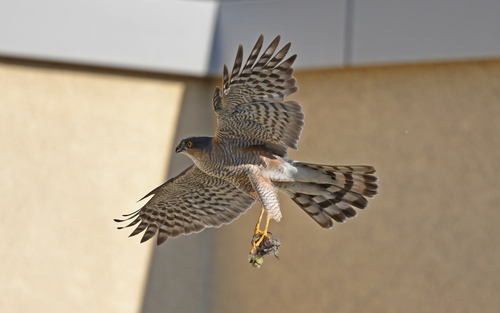
Eurasian Sparrowhawk (Accipiter nisus) Eurasian Sparrowhawk

Media

Loading…

In short

The most reliable field mark between Shikra and Eurasian Sparrowhawk is the tail and underpart pattern, especially in flight and on juveniles. Juvenile Shikra have a narrow, dark-banded tail with the central feathers mostly unbanded except for a terminal band, while juvenile Eurasian Sparrowhawks show a more evenly and strongly barred tail. Adults differ in iris color and underpart barring: male Shikra have a red iris and fine rufous barring, while male Eurasian Sparrowhawks have orange to red irides and broader orange barring. Females and juveniles of both can be confusing, but the Shikra is smaller and has a less robust structure. Use flight views and iris color for the most confident separation.

Identification tips

  1. Juvenile tail pattern: Juvenile Shikra have central tail feathers that are mostly unbanded except for a terminal band, while juvenile Eurasian Sparrowhawks have a more evenly and strongly barred tail. This is best seen in flight or when the tail is spread.
  2. Juvenile underparts: Juvenile Shikra show dark streaks and spots on the upper breast with narrow barring on the wing; juvenile Sparrowhawks are coarsely barred or spotted brown below and lack the Shikra's pattern.
  3. Adult male iris color: Male Shikra have a striking red iris, while male Sparrowhawks have orange to red irides. This is visible at close range or in good light.
  4. Adult female iris color: Female Shikra have a yellowish-orange iris; female Sparrowhawks have yellow to orange irides. This is subtle and may overlap, but can help with experience.
  5. Adult underpart barring: Shikra males have fine rufous bars on a whitish background; Sparrowhawk males have broader orange barring that can look plain orange from a distance.
  6. Upperpart color: Male Shikra are grey above; male Sparrowhawks are bluish-grey (sometimes tending to blue). Female Shikra are brownish; female Sparrowhawks are dark brown or greyish-brown.
  7. Thighs and lower belly: Shikra has whitish thighs and less barring on the lower belly; Sparrowhawk shows more extensive barring, including on the thighs.
  8. Underwing in flight: Male Shikra show a light underwing lining and blackish wingtips; Sparrowhawks have a more uniformly barred underwing.
  9. Tail shape and pattern: Shikra's tail bands are faint on the outer feathers and the central feathers are mostly plain; Sparrowhawk's tail is more evenly and strongly barred across all feathers.
  10. Size and structure: Shikra is smaller and more lightly built, with a narrower, longer tail; Sparrowhawk is bulkier, especially the female, and has a square-ended tail and broader wings.
  11. Flight style: Both use flap-flap-glide, but Shikra often appears more buoyant and less powerful than Sparrowhawk, which is more direct and rapid.
  12. Habitat context: In open or urban areas, Shikra is more likely; in dense woodland, Sparrowhawk is more probable, though both can overlap in gardens.
  13. Perched posture: Shikra often perches more openly and upright; Sparrowhawk is more secretive and often perches in cover.
  14. Voice: If heard, Shikra's pee-wee or sharp kik-ki calls are distinctive, but voice is rarely diagnostic unless compared directly.
  15. Pitfalls: Females and juveniles of both species are the most frequently confused; always check tail pattern and iris color if possible, and use multiple marks for a confident ID.

Size

Eurasian Sparrowhawk is noticeably larger and bulkier, especially in females. Adult female Sparrowhawks can be up to 41 cm long and weigh up to 342 g, while Shikra are smaller at 26–30 cm (no mass given, but always smaller than Sparrowhawk). Males of both are closer in size, but Sparrowhawk still has the edge. In the field, the Shikra appears more petite and lightly built, with a narrower, longer tail relative to body size.

Plumage

Juvenile Shikra show dark streaks and spots on the upper breast, with a narrowly barred wing and a tail with narrow, dark bands—crucially, the central tail feathers are mostly unbanded except for a dark terminal band. Juvenile Eurasian Sparrowhawks are brown above with rusty fringes, coarsely barred or spotted brown below, and have a more evenly and strongly barred tail. Adult male Shikra are grey above, whitish below with fine rufous bars, and have a red iris; adult male Sparrowhawks are bluish-grey above, orange-barred below, and have orange to red irides. Female Shikra are brownish above with heavier barring below and a yellowish-orange iris, while female Sparrowhawks are dark brown or greyish-brown above, brown-barred below, and have yellow to orange irides. The Shikra's lower belly is less barred and the thighs are whitish, while Sparrowhawks show more extensive barring. In flight, Shikra males show a light underwing lining and blackish wingtips; Sparrowhawks have a more uniformly barred underwing.

Behaviour

Both species use a flap-flap-glide flight style, but Shikra is more likely to be seen in a wider range of open habitats, including urban areas, and often perches more openly. Sparrowhawk is a woodland specialist, flying with rapid wingbeats and glides, and is more secretive, often seen darting through trees. Both can soar during the breeding season, but Sparrowhawk is more likely to hunt by surprise in dense cover.

Habitat

Shikra is highly adaptable, found in forests, farmland, and urban areas across Asia and Africa. Eurasian Sparrowhawk prefers woodland and forest edge, but can also be found in gardens and parks, especially when hunting. In overlap zones, Shikra is more likely in open or urban settings, while Sparrowhawk sticks closer to dense cover.

Voice

Shikra gives a pee-wee call, with the first note higher and the second longer; in flight, it gives sharp kik-ki...kik-ki notes. Eurasian Sparrowhawk's call is not described in the notes, but is known to differ. In practice, vocalizations are not usually diagnostic unless the call is heard well and compared directly.

Submit a better description

Use the same sections as the comparison. Your text is published immediately.

The most reliable field mark between Shikra and Eurasian Sparrowhawk is the tail and underpart pattern, especially in flight and on juveniles. Juvenile Shikra have a narrow, dark-banded tail with the central feathers mostly unbanded except for a terminal band, while juvenile Eurasian Sparrowhawks show a more evenly and strongly barred tail. Adults differ in iris color and underpart barring: male Shikra have a red iris and fine rufous barring, while male Eurasian Sparrowhawks have orange to red irides and broader orange barring. Females and juveniles of both can be confusing, but the Shikra is smaller and has a less robust structure. Use flight views and iris color for the most confident separation.

  1. Juvenile tail pattern: Juvenile Shikra have central tail feathers that are mostly unbanded except for a terminal band, while juvenile Eurasian Sparrowhawks have a more evenly and strongly barred tail. This is best seen in flight or when the tail is spread.
  2. Juvenile underparts: Juvenile Shikra show dark streaks and spots on the upper breast with narrow barring on the wing; juvenile Sparrowhawks are coarsely barred or spotted brown below and lack the Shikra's pattern.
  3. Adult male iris color: Male Shikra have a striking red iris, while male Sparrowhawks have orange to red irides. This is visible at close range or in good light.
  4. Adult female iris color: Female Shikra have a yellowish-orange iris; female Sparrowhawks have yellow to orange irides. This is subtle and may overlap, but can help with experience.
  5. Adult underpart barring: Shikra males have fine rufous bars on a whitish background; Sparrowhawk males have broader orange barring that can look plain orange from a distance.
  6. Upperpart color: Male Shikra are grey above; male Sparrowhawks are bluish-grey (sometimes tending to blue). Female Shikra are brownish; female Sparrowhawks are dark brown or greyish-brown.
  7. Thighs and lower belly: Shikra has whitish thighs and less barring on the lower belly; Sparrowhawk shows more extensive barring, including on the thighs.
  8. Underwing in flight: Male Shikra show a light underwing lining and blackish wingtips; Sparrowhawks have a more uniformly barred underwing.
  9. Tail shape and pattern: Shikra's tail bands are faint on the outer feathers and the central feathers are mostly plain; Sparrowhawk's tail is more evenly and strongly barred across all feathers.
  10. Size and structure: Shikra is smaller and more lightly built, with a narrower, longer tail; Sparrowhawk is bulkier, especially the female, and has a square-ended tail and broader wings.
  11. Flight style: Both use flap-flap-glide, but Shikra often appears more buoyant and less powerful than Sparrowhawk, which is more direct and rapid.
  12. Habitat context: In open or urban areas, Shikra is more likely; in dense woodland, Sparrowhawk is more probable, though both can overlap in gardens.
  13. Perched posture: Shikra often perches more openly and upright; Sparrowhawk is more secretive and often perches in cover.
  14. Voice: If heard, Shikra's pee-wee or sharp kik-ki calls are distinctive, but voice is rarely diagnostic unless compared directly.
  15. Pitfalls: Females and juveniles of both species are the most frequently confused; always check tail pattern and iris color if possible, and use multiple marks for a confident ID.

Eurasian Sparrowhawk is noticeably larger and bulkier, especially in females. Adult female Sparrowhawks can be up to 41 cm long and weigh up to 342 g, while Shikra are smaller at 26–30 cm (no mass given, but always smaller than Sparrowhawk). Males of both are closer in size, but Sparrowhawk still has the edge. In the field, the Shikra appears more petite and lightly built, with a narrower, longer tail relative to body size.

Juvenile Shikra show dark streaks and spots on the upper breast, with a narrowly barred wing and a tail with narrow, dark bands—crucially, the central tail feathers are mostly unbanded except for a dark terminal band. Juvenile Eurasian Sparrowhawks are brown above with rusty fringes, coarsely barred or spotted brown below, and have a more evenly and strongly barred tail. Adult male Shikra are grey above, whitish below with fine rufous bars, and have a red iris; adult male Sparrowhawks are bluish-grey above, orange-barred below, and have orange to red irides. Female Shikra are brownish above with heavier barring below and a yellowish-orange iris, while female Sparrowhawks are dark brown or greyish-brown above, brown-barred below, and have yellow to orange irides. The Shikra's lower belly is less barred and the thighs are whitish, while Sparrowhawks show more extensive barring. In flight, Shikra males show a light underwing lining and blackish wingtips; Sparrowhawks have a more uniformly barred underwing.

Both species use a flap-flap-glide flight style, but Shikra is more likely to be seen in a wider range of open habitats, including urban areas, and often perches more openly. Sparrowhawk is a woodland specialist, flying with rapid wingbeats and glides, and is more secretive, often seen darting through trees. Both can soar during the breeding season, but Sparrowhawk is more likely to hunt by surprise in dense cover.

Shikra is highly adaptable, found in forests, farmland, and urban areas across Asia and Africa. Eurasian Sparrowhawk prefers woodland and forest edge, but can also be found in gardens and parks, especially when hunting. In overlap zones, Shikra is more likely in open or urban settings, while Sparrowhawk sticks closer to dense cover.

Shikra gives a pee-wee call, with the first note higher and the second longer; in flight, it gives sharp kik-ki...kik-ki notes. Eurasian Sparrowhawk's call is not described in the notes, but is known to differ. In practice, vocalizations are not usually diagnostic unless the call is heard well and compared directly.

Discard your changes?

You have unsaved edits. If you leave now, those changes will be lost.

Shikra · Eurasian Sparrowhawk · My Tricky Birds