
Sharp-tailed Sandpiper vs Temminck's Stint
Calidris acuminata versus Calidris temminckii
Play a quiz with Sharp-tailed Sandpiper and Temminck's Stint
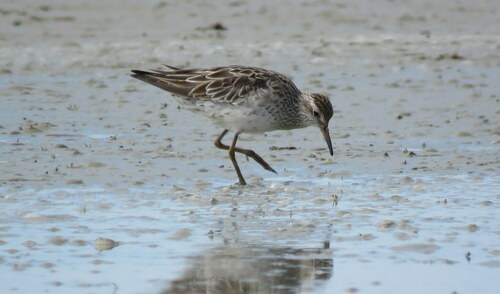 Sharp-tailed Sandpiper
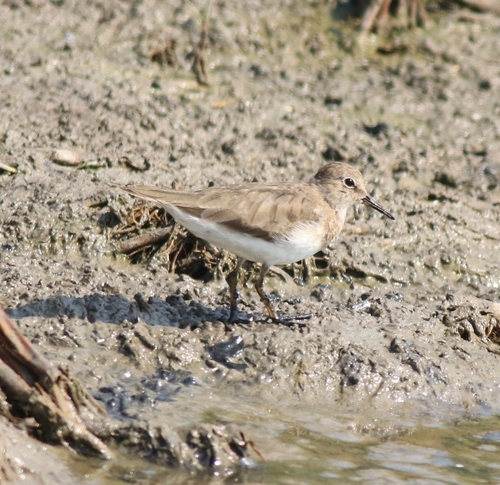 Temminck's Stint
In short
The most reliable field mark between Sharp-tailed Sandpiper and Temminck's Stint is size: Sharp-tailed is much larger and bulkier, with a pot-bellied look, while Temminck's is tiny and slim. Juvenile Sharp-taileds show a bright chestnut crown and bold supercilium, while Temminck's is always drabber, with plain brown upperparts and a less contrasting face. In flight or at rest, Sharp-tailed's structure is more robust, with a longer rear end and a flat back, compared to the compact, short-legged Temminck's. Leg color can overlap, but Temminck's has dull yellowish or brown legs, while Sharp-tailed's are olive to yellow. If you see a small, plain, white-tailed wader, it's Temminck's; a larger, chestnut-capped, sharply marked bird is Sharp-tailed.
Identification tips
- Size is the most immediate clue: Sharp-tailed Sandpiper is much larger and bulkier than Temminck's Stint. If the bird looks tiny and delicate, it's likely Temminck's.
- Juvenile/first-autumn plumage: Sharp-tailed juveniles have a bright chestnut crown, strong white supercilium, and boldly marked scapulars; Temminck's juveniles are always drab brown above, with little contrast and no chestnut.
- Face pattern: Sharp-tailed shows a strong, pale supercilium and a dark brown eye-stripe; Temminck's has a plain brown face with only a faint supercilium.
- Breast and flank marks: Sharp-tailed has buffy, arrow-shaped marks on the flanks and a softly mottled breast, never forming a sharp band; Temminck's has a plain, slightly darker breast with no strong flank marks.
- Leg color: Both can show yellowish or olive legs, but this is not reliable alone. Temminck's legs are dull yellowish or brown; Sharp-tailed's are olive to yellow.
- Bill shape and color: Both have straight, dark bills, but Sharp-tailed's is proportionally heavier and longer relative to head size.
- Tail pattern in flight: Temminck's Stint has white outer tail feathers, visible in flight or when preening; Sharp-tailed lacks this feature.
- Overall structure: Sharp-tailed is pot-bellied with a flat back and drawn-out rear end; Temminck's is compact, short-legged, and lacks the elongated rear.
- Upperpart color: Sharp-tailed is mottled chestnut-brown above, especially in juveniles and breeding adults; Temminck's is plain brown or grey-brown, with little contrast.
- Crown color: Sharp-tailed shows a chestnut crown (especially juveniles); Temminck's crown is plain brown.
- Group size: Sharp-tailed is often in flocks; Temminck's is usually solitary or in small groups.
- Feeding behavior: Temminck's feeds with quick, precise movements, often along vegetated margins; Sharp-tailed is steadier and more likely to wade.
- Habitat: Sharp-tailed prefers open, muddy or grassy wetlands; Temminck's is more often at the edge of water or in damp grass.
- Seasonal context: Sharp-tailed is a long-distance migrant, most likely in Australia in the non-breeding season; Temminck's is widespread in the Old World, especially on passage.
- If in doubt: Focus on size, face pattern, and the presence or absence of a chestnut crown and white outer tail feathers. These are the most reliable field marks for all ages.
Size
Sharp-tailed Sandpiper is much heavier (about 67g) than Temminck's Stint (about 26g) [wikidata]. In the field, Sharp-tailed appears medium-sized among small waders, with a noticeably pot-bellied, elongated rear, and a flat back. Temminck's Stint is among the smallest Calidris, with a compact, short-legged appearance and shorter overall length (13.5–15 cm). If seen side by side, the difference is striking: Temminck's looks dainty and delicate, while Sharp-tailed is robust and portly.
Plumage
Juvenile and first-autumn Sharp-tailed Sandpipers are distinctly brighter than Temminck's Stint, with a rich chestnut crown, bold white supercilium, and sharply defined scapulars with dark centers and pale edges. Their underparts are white with buffy, arrow-shaped marks on the flanks and a softly mottled breast, lacking the strong breast band of some other Calidris. Temminck's Stint, in all ages, is much plainer: upperparts are dull brown (occasionally with some rufous or blackish mantle feathers in breeding adults), the head is unmarked brown, and the face pattern is subtle. The underparts are white with a slightly darker breast, but never with the sharp flank marks or chestnut tones of Sharp-tailed. In flight, Temminck's shows white outer tail feathers, which can be a useful mark if seen well; Sharp-tailed does not have this feature. Leg color overlaps but is not diagnostic alone.
Behaviour
Sharp-tailed Sandpiper often feeds in loose flocks, moving steadily with a horizontal posture, sometimes wading deeper. It may appear more deliberate and less nervous than Temminck's. Temminck's Stint is typically solitary or in small groups, feeding with quick, precise movements, often at the water's edge or on mud. Its behavior is reminiscent of a tiny Common Sandpiper, and it may pump its rear end slightly when feeding.
Habitat
Sharp-tailed Sandpiper is most often found in open, muddy or grassy wetlands, often with other medium-sized waders. Temminck's Stint prefers the edges of shallow pools, muddy margins, or damp grassland, often in more vegetated or secluded spots. While both can overlap on migration, Temminck's is more likely to be seen singly or in small numbers, and in less open areas.