
Motmot

Sharp-billed Treehunter vs Buff-browed Foliage-gleaner

Heliobletus contaminatus versus Syndactyla rufosuperciliata

Play a quiz with Sharp-billed Treehunter and Buff-browed Foliage-gleaner
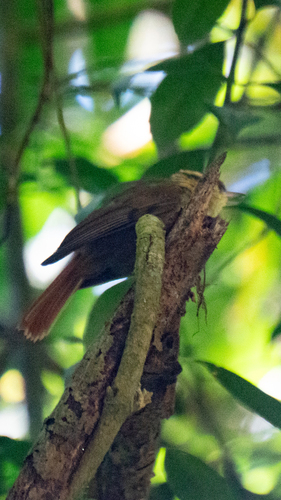
Sharp-billed Treehunter (Heliobletus contaminatus) Sharp-billed Treehunter
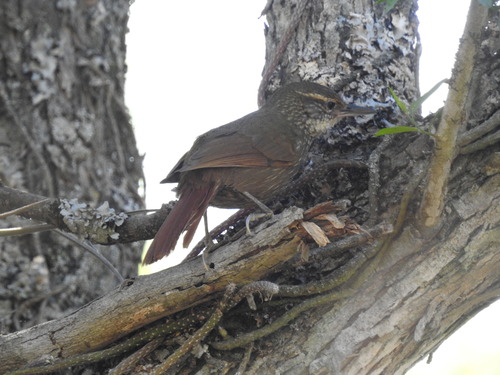
Buff-browed Foliage-gleaner (Syndactyla rufosuperciliata) Buff-browed Foliage-gleaner

Media

Loading…

In short

The most reliable way to separate Sharp-billed Treehunter from Buff-browed Foliage-gleaner is by size and structure: the Treehunter is notably smaller and slimmer, with a short, sharply pointed, slightly downcurved bill, while the Foliage-gleaner is much bulkier with a thick, slightly upcurved bill. Both have a buffy supercilium, but the Treehunter’s is broader and more golden, and its crown is boldly streaked, unlike the Foliage-gleaner’s duller, faintly streaked crown. Juveniles of both are similar to adults, but the Foliage-gleaner juvenile has spotted (not streaked) underparts. In the field, focus on overall size, bill shape, and head pattern, as both species can overlap in habitat and general coloration.

Identification tips

  1. Size and bulk: Buff-browed Foliage-gleaner is much larger and heavier than Sharp-billed Treehunter. If the bird appears medium-sized and robust, suspect Foliage-gleaner; if small and slim, Treehunter is more likely. This is reliable for all ages and seasons.
  2. Bill shape: Treehunter has a short, sharply pointed, slightly downcurved bill; Foliage-gleaner’s bill is thick, longer, and slightly upcurved. Bill shape is visible in both perched and foraging birds.
  3. Supercilium: Treehunter’s supercilium is wide, golden-buff, and contrasts strongly with a blackish-brown post-ocular band. Foliage-gleaner’s is lighter, tawny-buff, narrower, and extends to the nape, with a less contrasting face.
  4. Crown pattern: Treehunter shows bold golden-olive streaks on a blackish-brown crown, while Foliage-gleaner’s crown is dull olive-brown with only vague whitish streaks at the rear. Look for sharp streaks on the Treehunter’s crown, especially in good light.
  5. Partial collar: Treehunter often shows a partial buff collar, which is absent in Foliage-gleaner.
  6. Back and rump: Treehunter’s back is dull olive-brown with rufous tips on the coverts; Foliage-gleaner’s back is plain olive-brown, lacking rufous tips.
  7. Tail color and structure: Both have rufous tails, but Treehunter’s is darker and the feather tips lack barbs (may appear more worn or pointed). Foliage-gleaner’s tail is dull rufous and broader.
  8. Breast and belly pattern: Treehunter has a pale yellowish buff breast with olive-brown streaks and a plain dull olive-brown belly. Foliage-gleaner has a buffy whitish breast with olive-brown feather edges, giving a scalloped look, and a belly with wide, blurry buffy-whitish streaks fading towards the rear.
  9. Juvenile underparts: Juvenile Foliage-gleaner has spotted underparts, while juvenile Treehunter is streaked (though less distinctly than adults). This is a key mark for immatures.
  10. Face pattern: Treehunter’s face is more contrasting, with dark lores and a blackish-brown band behind the eye. Foliage-gleaner’s face is brownish with small buff markings and a tawny-buff eye ring.
  11. Leg and foot color: Treehunter’s legs are greenish gray to dull yellow-green; Foliage-gleaner’s are olive to brownish gray. This is subtle and rarely diagnostic in the field.
  12. Iris color: Both have dark brown irises; not useful for separation.
  13. Habitat and elevation: Treehunter is more likely at higher elevations within its range, but both species overlap widely in habitat type.
  14. Behavior: Foraging style is similar and not reliably separable in the field.
  15. Subspecies variation: Be aware that both species have subspecies with minor variation in supercilium and underpart streaking, but the main contrasts above hold throughout their ranges.

Size

Sharp-billed Treehunter is significantly smaller and lighter, averaging 14 g and measuring 12–13 cm in length. Buff-browed Foliage-gleaner is much larger and heavier, with an average mass of 25.6 g and a length of 17–18 cm. This size difference is usually obvious in the field, especially when seen side-by-side or compared to familiar species. The Foliage-gleaner appears more robust and broad-bodied, while the Treehunter is compact and slim.

Plumage

Juvenile Buff-browed Foliage-gleaner has spotted underparts, while juvenile Sharp-billed Treehunter is similar to the adult but with a more ochraceous supercilium and less distinct streaks. Adult Treehunter shows a wide golden-buff supercilium, blackish-brown crown with bold golden-olive streaks, and a partial buff collar. Its back is dull olive-brown with rufous tips on the coverts, and the tail is dark rufous with unbarbed tips. The underparts are pale yellowish buff with olive-brown streaks on the breast and plain dull olive-brown belly. In contrast, adult Buff-browed Foliage-gleaner has a lighter, tawny-buff supercilium extending to the nape, a dull olive-brown crown with vague whitish streaks only at the rear, and a plain olive-brown back. Its tail is dull rufous, and the wings are rich olivaceous brown. The throat is whitish with brownish tips, the breast is buffy whitish with olive-brown feather edges creating a scalloped look, and the belly is olive-brownish with wide, blurry buffy-whitish streaks that fade towards the rear. Subspecies variation in both species can affect the intensity of streaking and supercilium color, but the Treehunter always appears more sharply marked on the head.

Behaviour

Both species forage for arthropods, often singly or in pairs, and may join mixed-species flocks. The Treehunter is described as foraging singly or in pairs, usually as part of a flock, while the Foliage-gleaner’s foraging behavior is not detailed here but is generally similar among foliage-gleaners. No major behavioral differences are noted in the sources that would be reliable for field separation.

Habitat

Both species overlap in much of their range (Argentina, Brazil, Paraguay, Uruguay) and inhabit humid lowland and montane evergreen forests. The Treehunter is more often found at higher elevations up to 1,830 m, while the Foliage-gleaner’s elevation range is not specified here but is broader geographically (also found in Bolivia, Ecuador, Peru). Habitat alone is not a reliable separator where ranges overlap.

Submit a better description

Use the same sections as the comparison. Your text is published immediately.

The most reliable way to separate Sharp-billed Treehunter from Buff-browed Foliage-gleaner is by size and structure: the Treehunter is notably smaller and slimmer, with a short, sharply pointed, slightly downcurved bill, while the Foliage-gleaner is much bulkier with a thick, slightly upcurved bill. Both have a buffy supercilium, but the Treehunter’s is broader and more golden, and its crown is boldly streaked, unlike the Foliage-gleaner’s duller, faintly streaked crown. Juveniles of both are similar to adults, but the Foliage-gleaner juvenile has spotted (not streaked) underparts. In the field, focus on overall size, bill shape, and head pattern, as both species can overlap in habitat and general coloration.

  1. Size and bulk: Buff-browed Foliage-gleaner is much larger and heavier than Sharp-billed Treehunter. If the bird appears medium-sized and robust, suspect Foliage-gleaner; if small and slim, Treehunter is more likely. This is reliable for all ages and seasons.
  2. Bill shape: Treehunter has a short, sharply pointed, slightly downcurved bill; Foliage-gleaner’s bill is thick, longer, and slightly upcurved. Bill shape is visible in both perched and foraging birds.
  3. Supercilium: Treehunter’s supercilium is wide, golden-buff, and contrasts strongly with a blackish-brown post-ocular band. Foliage-gleaner’s is lighter, tawny-buff, narrower, and extends to the nape, with a less contrasting face.
  4. Crown pattern: Treehunter shows bold golden-olive streaks on a blackish-brown crown, while Foliage-gleaner’s crown is dull olive-brown with only vague whitish streaks at the rear. Look for sharp streaks on the Treehunter’s crown, especially in good light.
  5. Partial collar: Treehunter often shows a partial buff collar, which is absent in Foliage-gleaner.
  6. Back and rump: Treehunter’s back is dull olive-brown with rufous tips on the coverts; Foliage-gleaner’s back is plain olive-brown, lacking rufous tips.
  7. Tail color and structure: Both have rufous tails, but Treehunter’s is darker and the feather tips lack barbs (may appear more worn or pointed). Foliage-gleaner’s tail is dull rufous and broader.
  8. Breast and belly pattern: Treehunter has a pale yellowish buff breast with olive-brown streaks and a plain dull olive-brown belly. Foliage-gleaner has a buffy whitish breast with olive-brown feather edges, giving a scalloped look, and a belly with wide, blurry buffy-whitish streaks fading towards the rear.
  9. Juvenile underparts: Juvenile Foliage-gleaner has spotted underparts, while juvenile Treehunter is streaked (though less distinctly than adults). This is a key mark for immatures.
  10. Face pattern: Treehunter’s face is more contrasting, with dark lores and a blackish-brown band behind the eye. Foliage-gleaner’s face is brownish with small buff markings and a tawny-buff eye ring.
  11. Leg and foot color: Treehunter’s legs are greenish gray to dull yellow-green; Foliage-gleaner’s are olive to brownish gray. This is subtle and rarely diagnostic in the field.
  12. Iris color: Both have dark brown irises; not useful for separation.
  13. Habitat and elevation: Treehunter is more likely at higher elevations within its range, but both species overlap widely in habitat type.
  14. Behavior: Foraging style is similar and not reliably separable in the field.
  15. Subspecies variation: Be aware that both species have subspecies with minor variation in supercilium and underpart streaking, but the main contrasts above hold throughout their ranges.

Sharp-billed Treehunter is significantly smaller and lighter, averaging 14 g and measuring 12–13 cm in length. Buff-browed Foliage-gleaner is much larger and heavier, with an average mass of 25.6 g and a length of 17–18 cm. This size difference is usually obvious in the field, especially when seen side-by-side or compared to familiar species. The Foliage-gleaner appears more robust and broad-bodied, while the Treehunter is compact and slim.

Juvenile Buff-browed Foliage-gleaner has spotted underparts, while juvenile Sharp-billed Treehunter is similar to the adult but with a more ochraceous supercilium and less distinct streaks. Adult Treehunter shows a wide golden-buff supercilium, blackish-brown crown with bold golden-olive streaks, and a partial buff collar. Its back is dull olive-brown with rufous tips on the coverts, and the tail is dark rufous with unbarbed tips. The underparts are pale yellowish buff with olive-brown streaks on the breast and plain dull olive-brown belly. In contrast, adult Buff-browed Foliage-gleaner has a lighter, tawny-buff supercilium extending to the nape, a dull olive-brown crown with vague whitish streaks only at the rear, and a plain olive-brown back. Its tail is dull rufous, and the wings are rich olivaceous brown. The throat is whitish with brownish tips, the breast is buffy whitish with olive-brown feather edges creating a scalloped look, and the belly is olive-brownish with wide, blurry buffy-whitish streaks that fade towards the rear. Subspecies variation in both species can affect the intensity of streaking and supercilium color, but the Treehunter always appears more sharply marked on the head.

Both species forage for arthropods, often singly or in pairs, and may join mixed-species flocks. The Treehunter is described as foraging singly or in pairs, usually as part of a flock, while the Foliage-gleaner’s foraging behavior is not detailed here but is generally similar among foliage-gleaners. No major behavioral differences are noted in the sources that would be reliable for field separation.

Both species overlap in much of their range (Argentina, Brazil, Paraguay, Uruguay) and inhabit humid lowland and montane evergreen forests. The Treehunter is more often found at higher elevations up to 1,830 m, while the Foliage-gleaner’s elevation range is not specified here but is broader geographically (also found in Bolivia, Ecuador, Peru). Habitat alone is not a reliable separator where ranges overlap.

Discard your changes?

You have unsaved edits. If you leave now, those changes will be lost.

Sharp-billed Treehunter · Buff-browed Foliage-gleaner · My Tricky Birds