

Motmot

Scripps's Murrelet vs Craveri's Murrelet

Synthliboramphus scrippsi versus Synthliboramphus craveri

Play a quiz with Scripps's Murrelet and Craveri's Murrelet
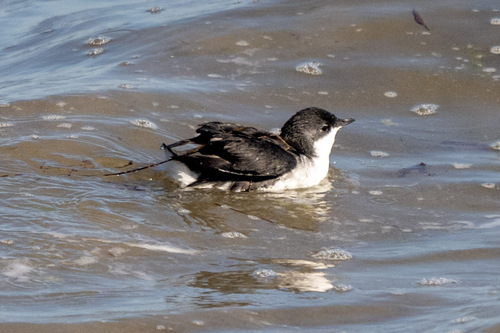
Scripps's Murrelet (Synthliboramphus scrippsi) Scripps's Murrelet
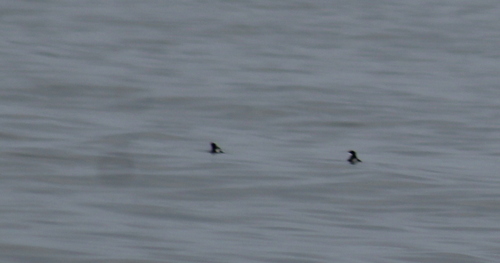
Craveri's Murrelet (Synthliboramphus craveri) Craveri's Murrelet

Media

Loading…

In short

The most reliable field mark to separate Scripps's Murrelet from Craveri's Murrelet is the underwing color in flight: Scripps's shows strikingly white underwings, while Craveri's has noticeably dusky (grayish) underwings. At rest, Craveri's often shows a partial dark collar and a more extensive black face mask, while Scripps's lacks the collar and has a less extensive mask. Craveri's also tends to hold its tail up on the water, a behavior not seen in Scripps's. Both are small, sharp-billed auks, but careful attention to these plumage and behavioral cues is key, especially when viewing birds at sea.

Identification tips

  1. Underwing color in flight: Scripps's Murrelet has white underwings; Craveri's has dusky or grayish underwings. This is the single most reliable field mark and works for all ages and seasons.
  2. Partial neck collar: Craveri's shows a partial dark collar across the lower neck, visible when perched or swimming; Scripps's never shows this collar.
  3. Face mask extent: Craveri's black face mask dips further down the face, giving a more hooded look. Scripps's mask is more restricted and does not extend as far down.
  4. Tail posture on water: Craveri's often holds its tail cocked upward when sitting on the water, while Scripps's keeps its tail flat. This is subtle but useful when birds are resting.
  5. Bill shape: Both have thin, sharp bills with no reliable difference in the field.
  6. Size and structure: Both species are very similar in size and shape; do not rely on this for identification.
  7. Habitat and range: Scripps's is more likely near the California coast and Channel Islands, while Craveri's is more pelagic and rarely seen from shore, especially north of Baja. However, range overlap does occur offshore.
  8. Behavior at sea: Both are usually seen in pairs, but Craveri's tail-cocking is a subtle behavioral clue.
  9. Vocalizations: While the species differ vocally, no field-usable differences are described; not a practical cue for most birders.
  10. Juvenile/immature marks: No age-specific upperwing or flight pattern differences are described, so rely on underwing and collar/mask for all ages.
  11. Plumage pitfalls: Lighting and distance can make the underwing color hard to judge. Try to see birds banking or flapping for a clear view. The collar on Craveri's can be faint or obscured in poor light, so use in combination with other marks.
  12. At-sea context: If seen close to the California coast, Scripps's is more likely, but do not use range alone for positive ID.
  13. Confusion with other murrelets: Both resemble each other closely and are best separated from other small auks by their sharp bills and black-and-white pattern, but this does not help between these two.
  14. Sex and season: No differences between sexes; all field marks apply year-round.
  15. Summary: Prioritize underwing color in flight, neck collar, and tail posture for the most confident separation. Use multiple marks whenever possible, especially in challenging conditions.

Size

Both species are very similar in size and structure, with no reliable difference in the field. The only available measurement is a body mass of 151g for Craveri's Murrelet [wikidata], but this is not a practical field mark. Both are small, compact auks with thin, pointed bills.

Plumage

The most diagnostic plumage difference, visible in all ages and seasons, is the underwing: Scripps's Murrelet has white underwings, while Craveri's Murrelet shows dusky (grayish) underwings. In addition, Craveri's has a partial dark collar across the lower neck, absent in Scripps's. The black face mask is more extensive and dips further down the face in Craveri's, while Scripps's mask is more restricted. These features are visible in both perched and flying birds, but the underwing is most obvious in flight. There are no notes on age-specific upperwing patterns (e.g., juvenile panels or trailing edges) in either species, so these marks apply to all ages.

Behaviour

Both species are wing-propelled divers and are usually seen in pairs at sea. Craveri's Murrelet is noted for holding its tail upward when sitting on the water, a trait not shown by Scripps's. Both can take off from the water without a running start. Feeding and nesting behaviors are similar, but these are not useful for field separation.

Habitat

Scripps's Murrelet breeds on islands off southern California and northern Baja California, and is more likely to be seen closer to shore in the California Current system. Craveri's Murrelet breeds on islands off the Baja peninsula, both in the Pacific and the Gulf of California, and is rarely seen from shore, usually occurring farther out to sea. After breeding, Craveri's disperses north as far as central California, but is still rarely seen near land. Habitat overlap is possible during post-breeding dispersal, but Scripps's is more likely closer to the mainland.

Voice

Both species can be separated by voice, but no specific vocal differences are described in the available notes. Vocalizations are not a practical field mark for most observers at sea.

Submit a better description

Use the same sections as the comparison. Your text is published immediately.

The most reliable field mark to separate Scripps's Murrelet from Craveri's Murrelet is the underwing color in flight: Scripps's shows strikingly white underwings, while Craveri's has noticeably dusky (grayish) underwings. At rest, Craveri's often shows a partial dark collar and a more extensive black face mask, while Scripps's lacks the collar and has a less extensive mask. Craveri's also tends to hold its tail up on the water, a behavior not seen in Scripps's. Both are small, sharp-billed auks, but careful attention to these plumage and behavioral cues is key, especially when viewing birds at sea.

  1. Underwing color in flight: Scripps's Murrelet has white underwings; Craveri's has dusky or grayish underwings. This is the single most reliable field mark and works for all ages and seasons.
  2. Partial neck collar: Craveri's shows a partial dark collar across the lower neck, visible when perched or swimming; Scripps's never shows this collar.
  3. Face mask extent: Craveri's black face mask dips further down the face, giving a more hooded look. Scripps's mask is more restricted and does not extend as far down.
  4. Tail posture on water: Craveri's often holds its tail cocked upward when sitting on the water, while Scripps's keeps its tail flat. This is subtle but useful when birds are resting.
  5. Bill shape: Both have thin, sharp bills with no reliable difference in the field.
  6. Size and structure: Both species are very similar in size and shape; do not rely on this for identification.
  7. Habitat and range: Scripps's is more likely near the California coast and Channel Islands, while Craveri's is more pelagic and rarely seen from shore, especially north of Baja. However, range overlap does occur offshore.
  8. Behavior at sea: Both are usually seen in pairs, but Craveri's tail-cocking is a subtle behavioral clue.
  9. Vocalizations: While the species differ vocally, no field-usable differences are described; not a practical cue for most birders.
  10. Juvenile/immature marks: No age-specific upperwing or flight pattern differences are described, so rely on underwing and collar/mask for all ages.
  11. Plumage pitfalls: Lighting and distance can make the underwing color hard to judge. Try to see birds banking or flapping for a clear view. The collar on Craveri's can be faint or obscured in poor light, so use in combination with other marks.
  12. At-sea context: If seen close to the California coast, Scripps's is more likely, but do not use range alone for positive ID.
  13. Confusion with other murrelets: Both resemble each other closely and are best separated from other small auks by their sharp bills and black-and-white pattern, but this does not help between these two.
  14. Sex and season: No differences between sexes; all field marks apply year-round.
  15. Summary: Prioritize underwing color in flight, neck collar, and tail posture for the most confident separation. Use multiple marks whenever possible, especially in challenging conditions.

Both species are very similar in size and structure, with no reliable difference in the field. The only available measurement is a body mass of 151g for Craveri's Murrelet [wikidata], but this is not a practical field mark. Both are small, compact auks with thin, pointed bills.

The most diagnostic plumage difference, visible in all ages and seasons, is the underwing: Scripps's Murrelet has white underwings, while Craveri's Murrelet shows dusky (grayish) underwings. In addition, Craveri's has a partial dark collar across the lower neck, absent in Scripps's. The black face mask is more extensive and dips further down the face in Craveri's, while Scripps's mask is more restricted. These features are visible in both perched and flying birds, but the underwing is most obvious in flight. There are no notes on age-specific upperwing patterns (e.g., juvenile panels or trailing edges) in either species, so these marks apply to all ages.

Both species are wing-propelled divers and are usually seen in pairs at sea. Craveri's Murrelet is noted for holding its tail upward when sitting on the water, a trait not shown by Scripps's. Both can take off from the water without a running start. Feeding and nesting behaviors are similar, but these are not useful for field separation.

Scripps's Murrelet breeds on islands off southern California and northern Baja California, and is more likely to be seen closer to shore in the California Current system. Craveri's Murrelet breeds on islands off the Baja peninsula, both in the Pacific and the Gulf of California, and is rarely seen from shore, usually occurring farther out to sea. After breeding, Craveri's disperses north as far as central California, but is still rarely seen near land. Habitat overlap is possible during post-breeding dispersal, but Scripps's is more likely closer to the mainland.

Both species can be separated by voice, but no specific vocal differences are described in the available notes. Vocalizations are not a practical field mark for most observers at sea.

Discard your changes?

You have unsaved edits. If you leave now, those changes will be lost.

Scripps's Murrelet · Craveri's Murrelet · My Tricky Birds