

Scaled Quail vs California Quail
Callipepla squamata versus Callipepla californica
Play a quiz with Scaled Quail and California Quail
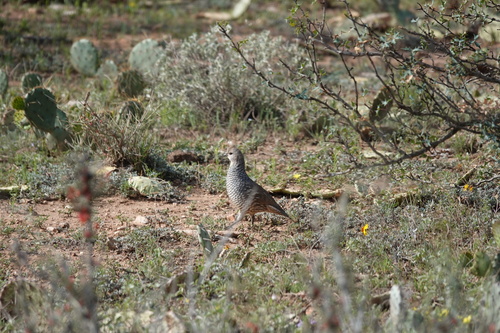 Scaled Quail
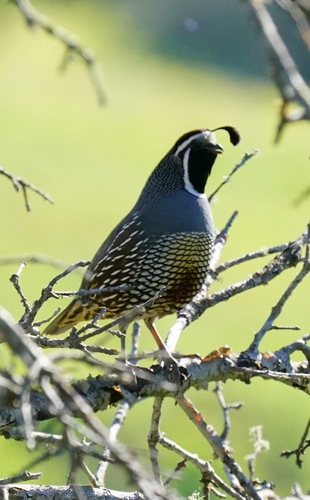 California Quail
In short
The most reliable field mark to separate Scaled Quail from California Quail is the unique scaly pattern on the breast and back of Scaled Quail, combined with its pale, cottony white crest. California Quail, in contrast, show a forward-drooping black topknot (plume) and, in males, a bold black-and-white facial pattern; females are plainer but still lack the scaly look. Both species are similar in size and shape, but their head patterns and body coloration are distinct when seen well. Immature and adult birds can be separated by these features in all seasons.
Identification tips
- Scaly Pattern: Scaled Quail of all ages show a distinctive scaly appearance on the breast, neck, and back—this is the single best field mark. California Quail never show this pattern.
- Crest Shape: Scaled Quail has a short, bushy, white crest ('cottontop'), while California Quail has a long, black, comma-shaped topknot that droops forward (longer in males, shorter in females).
- Head Pattern (Males): Male California Quail have a striking black face bordered by white, with a chestnut belly patch. Scaled Quail males lack these facial markings and have a plain, pale face.
- Head Pattern (Females): Female California Quail are brownish and lack the bold facial stripes, but still show a short, dark topknot. Female Scaled Quail are also plain-faced but have the white cottontop and scaly body.
- Body Color: Scaled Quail appear bluish-gray overall; California Quail are more brownish or gray-brown, with males showing richer chestnut and gray tones.
- Underparts: Scaled Quail show scaly markings down the entire underparts; California Quail have smooth, unmarked underparts (males with a chestnut patch, females plain).
- Flight Appearance: No distinctive wing or flight pattern differences are noted between these two species for any age group.
- Bill and Structure: Both have short, stout bills typical of quail; structure is not a reliable separator.
- Tail: Both species have short tails; tail shape is not diagnostic.
- Group Behavior: Both species form coveys, but California Quail are especially noted for communal dust bathing, leaving circular marks.
- Habitat: In arid, open grasslands or desert with yucca and sparse shrubs, expect Scaled Quail. In brushy, chaparral, or suburban edges, California Quail is more likely.
- Geographic Range: Scaled Quail are restricted to the arid Southwest and Central Mexico. California Quail are widespread in western North America and introduced elsewhere.
- Sex Differences: Only California Quail show strong sexual dimorphism in head pattern and topknot length; Scaled Quail sexes are similar.
- Juvenile/Immature Birds: Young Scaled Quail already show some scaly pattern, though less crisp; young California Quail lack scaly markings entirely.
- Pitfalls: In poor light or at a distance, both can appear grayish and similar in size. Always look for the scaly pattern and the shape/color of the crest/topknot for a confident ID.
Size
Scaled Quail and California Quail are very close in size. Scaled Quail averages about 184 g in mass, with a length of 25.4–30.5 cm and a wingspan around 38 cm. California Quail is slightly smaller on average (24–27 cm in length, 32–37 cm wingspan), but with overlapping weight ranges (140–230 g). In the field, size alone is not a reliable separator; focus on plumage and head shape.
Plumage
No age-specific wing or flight pattern differences are noted for either species, so focus on body and head plumage. Scaled Quail of all ages and sexes show a distinctive scaly pattern across the breast, neck, and back, created by pale feather edges on bluish-gray plumage. Their crest is a short, bushy white tuft ('cottontop'), not a plume. California Quail males have a bold black face bordered by white stripes, a chestnut belly patch, and a prominent comma-shaped black topknot that droops forward; females are brownish overall, lack the strong facial pattern, but still show the topknot (shorter and duller). California Quail never show the scaly pattern of Scaled Quail, and their underparts are smooth, not scaled.
Behaviour
Both species are ground-dwelling and often seen in small coveys. California Quail are especially sociable, frequently dust-bathing in groups and leaving obvious circular dust bath marks. Both species flush with rapid, whirring flight when startled, but prefer to escape on foot if possible. Foraging habits are similar, with both scratching for seeds and insects, but these behaviors are not diagnostic in the field.
Habitat
Scaled Quail are found in arid, open country of the Southwestern US to Central Mexico, often in areas with sparse grass, yucca, and scattered shrubs. California Quail inhabit a wider range of habitats in western North America, including chaparral, foothills, suburban edges, and brushy areas. While ranges overlap in some southwestern areas, Scaled Quail are much more tied to dry, open, desert-like environments, whereas California Quail are common in brushy, semi-open, and even suburban habitats.