

Motmot

Scaled Pigeon vs White-tipped Dove

Patagioenas speciosa versus Leptotila verreauxi

Play a quiz with Scaled Pigeon and White-tipped Dove
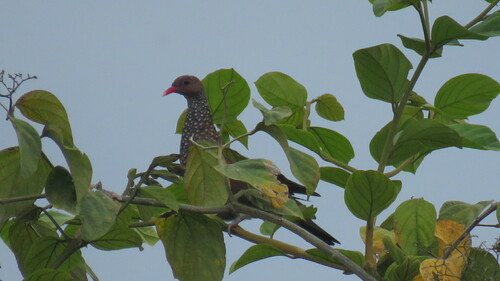
Scaled Pigeon (Patagioenas speciosa) Scaled Pigeon
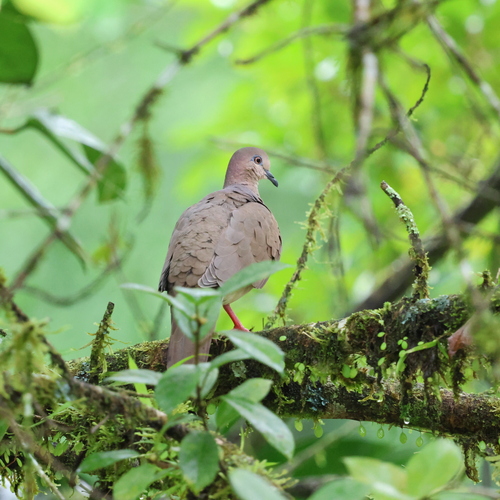
White-tipped Dove (Leptotila verreauxi) White-tipped Dove

Media

Loading…

In short

The most reliable field mark to separate Scaled Pigeon from White-tipped Dove is overall size and structure: Scaled Pigeon is much larger and bulkier, with a purplish, scaly neck and underparts, while White-tipped Dove is smaller, slimmer, and lacks the scaly effect. In flight, White-tipped Dove shows a broad white tip to the tail, best seen from below, which Scaled Pigeon lacks. Both species have red legs and eyering (though White-tipped Dove can show a blue eyering in parts of its range), but their body color and pattern are distinct. Vocalizations and habitat preference can help when plumage is ambiguous.

Identification tips

  1. Size is the quickest separator: Scaled Pigeon is much larger and bulkier than White-tipped Dove. If the bird looks pigeon-sized or larger, suspect Scaled Pigeon; if it is more dove-sized, consider White-tipped Dove. This works for all ages and sexes.
  2. Scaly neck and underparts: Only Scaled Pigeon (both sexes, but especially males) shows a pale, scaly pattern on the neck and underparts. White-tipped Dove has smooth, unpatterned underparts.
  3. Tail pattern in flight: White-tipped Dove shows a broad white tip to the tail, especially visible from below or when the tail is fanned. Scaled Pigeon lacks this; its tail is uniformly colored.
  4. Underwing color: White-tipped Dove has rufous underwing coverts, visible in flight. Scaled Pigeon does not show this rufous patch.
  5. Bill color: Scaled Pigeon has a red bill with a white tip; White-tipped Dove has a black bill. This is best seen at close range.
  6. Eyering color: Both species can have a red eyering, but White-tipped Dove may show a blue eyering in parts of its range (Amazon and northern South America). This is not always reliable, but a blue eyering rules out Scaled Pigeon.
  7. Leg color: Both have red legs, so this is not a useful separator.
  8. Head and forehead: White-tipped Dove has a pale grey or whitish forehead and crown, contrasting with the rest of the head. Scaled Pigeon is more uniformly colored on the head, with a purplish or brown tone.
  9. Body color: Scaled Pigeon is purple-brown overall (male) or dark brown (female), while White-tipped Dove is grey-brown above and paler below, often with a pinkish or buff tinge on the chest.
  10. Flight style: Both species have fast, direct flight, but Scaled Pigeon often flies higher and with more powerful wingbeats. White-tipped Dove may show more wing clattering on takeoff.
  11. Perching behavior: Scaled Pigeon is more likely to be seen perched high in trees; White-tipped Dove is usually on the ground or low perches.
  12. Vocalizations: Listen for the call: Scaled Pigeon gives a series of deep coos, while White-tipped Dove gives a two-note, hollow ooo-wooooo. Voice can be diagnostic if heard well.
  13. Habitat context: In dense canopy or semi-open forest, especially if the bird is high up, suspect Scaled Pigeon. In open woodland, forest edge, or on the ground, White-tipped Dove is more likely.
  14. Sex differences: Female Scaled Pigeons are duller brown but still show the scaly pattern; White-tipped Dove sexes are similar.
  15. Juvenile/immature marks: No distinctive juvenile or immature wing patterns are described for either species, so rely on size, structure, and overall color for young birds.

Size

Scaled Pigeon is substantially larger, at about 36 cm (14 in) and 290 g (10 oz), compared to White-tipped Dove at 28 cm (11 in) and 155 g (5.5 oz) [wikipedia][avonet]. The size difference is obvious in direct comparison or with experience: Scaled Pigeon appears much heavier-bodied and longer-necked, while White-tipped Dove is compact and more delicate. Bill size and head proportions also reflect this: Scaled Pigeon has a stouter bill and a more robust head.

Plumage

No distinctive juvenile or immature upperwing marks are described for either species, so focus is on adult plumage. Adult Scaled Pigeon males are purple-brown overall, with a distinctive pale scaly pattern on the neck and underparts; lower underparts are whitish edged with purple. Females are duller, dark brown, but still show the scaly effect. The bill is red with a white tip, and the eyering and legs are red. In contrast, White-tipped Dove adults are grey-brown above, with a pale grey or whitish forehead, whitish throat, and underparts that shade to pinkish, dull grey, or buff on the chest. The underwing coverts are rufous (seen in flight), and the tail is broadly tipped with white, especially visible from below or when the bird fans its tail. The bill is black, the legs are red, and the eyering is usually red but can be blue in some regions. White-tipped Dove never shows the scaly effect of Scaled Pigeon, and its overall coloration is paler and less purple-toned.

Behaviour

Both species are typically solitary and wary, rarely forming flocks. Scaled Pigeon tends to perch high and is often seen flying high and fast over the canopy, while White-tipped Dove is more often encountered on or near the ground, foraging quietly. Both flush with strong, direct flight, but White-tipped Dove may show more wing clattering on takeoff. Feeding behavior also differs: Scaled Pigeon feeds mainly on fruits and seeds in trees, while White-tipped Dove forages for seeds and some insects on the ground.

Habitat

Scaled Pigeon is found in semi-open forests, often in the canopy or subcanopy, and is more likely in mature or secondary woodland with fruiting trees. White-tipped Dove prefers a variety of woodland habitats but is most often seen in more open or edge habitats, including forest edges, clearings, and even gardens. It is more terrestrial, often walking on the ground, while Scaled Pigeon is more arboreal.

Voice

Scaled Pigeon gives a series of deep, cooing cro ku-ks, which is markedly different from the White-tipped Dove's call. White-tipped Dove's song is a deep, hollow ooo-wooooo, typically two notes at the same pitch: an introductory hoot followed by a longer, more audible, hollow note. If you hear a deep, drawn-out two-note call, it's likely White-tipped Dove; a series of deep coos suggests Scaled Pigeon.

Submit a better description

Use the same sections as the comparison. Your text is published immediately.

The most reliable field mark to separate Scaled Pigeon from White-tipped Dove is overall size and structure: Scaled Pigeon is much larger and bulkier, with a purplish, scaly neck and underparts, while White-tipped Dove is smaller, slimmer, and lacks the scaly effect. In flight, White-tipped Dove shows a broad white tip to the tail, best seen from below, which Scaled Pigeon lacks. Both species have red legs and eyering (though White-tipped Dove can show a blue eyering in parts of its range), but their body color and pattern are distinct. Vocalizations and habitat preference can help when plumage is ambiguous.

  1. Size is the quickest separator: Scaled Pigeon is much larger and bulkier than White-tipped Dove. If the bird looks pigeon-sized or larger, suspect Scaled Pigeon; if it is more dove-sized, consider White-tipped Dove. This works for all ages and sexes.
  2. Scaly neck and underparts: Only Scaled Pigeon (both sexes, but especially males) shows a pale, scaly pattern on the neck and underparts. White-tipped Dove has smooth, unpatterned underparts.
  3. Tail pattern in flight: White-tipped Dove shows a broad white tip to the tail, especially visible from below or when the tail is fanned. Scaled Pigeon lacks this; its tail is uniformly colored.
  4. Underwing color: White-tipped Dove has rufous underwing coverts, visible in flight. Scaled Pigeon does not show this rufous patch.
  5. Bill color: Scaled Pigeon has a red bill with a white tip; White-tipped Dove has a black bill. This is best seen at close range.
  6. Eyering color: Both species can have a red eyering, but White-tipped Dove may show a blue eyering in parts of its range (Amazon and northern South America). This is not always reliable, but a blue eyering rules out Scaled Pigeon.
  7. Leg color: Both have red legs, so this is not a useful separator.
  8. Head and forehead: White-tipped Dove has a pale grey or whitish forehead and crown, contrasting with the rest of the head. Scaled Pigeon is more uniformly colored on the head, with a purplish or brown tone.
  9. Body color: Scaled Pigeon is purple-brown overall (male) or dark brown (female), while White-tipped Dove is grey-brown above and paler below, often with a pinkish or buff tinge on the chest.
  10. Flight style: Both species have fast, direct flight, but Scaled Pigeon often flies higher and with more powerful wingbeats. White-tipped Dove may show more wing clattering on takeoff.
  11. Perching behavior: Scaled Pigeon is more likely to be seen perched high in trees; White-tipped Dove is usually on the ground or low perches.
  12. Vocalizations: Listen for the call: Scaled Pigeon gives a series of deep coos, while White-tipped Dove gives a two-note, hollow ooo-wooooo. Voice can be diagnostic if heard well.
  13. Habitat context: In dense canopy or semi-open forest, especially if the bird is high up, suspect Scaled Pigeon. In open woodland, forest edge, or on the ground, White-tipped Dove is more likely.
  14. Sex differences: Female Scaled Pigeons are duller brown but still show the scaly pattern; White-tipped Dove sexes are similar.
  15. Juvenile/immature marks: No distinctive juvenile or immature wing patterns are described for either species, so rely on size, structure, and overall color for young birds.

Scaled Pigeon is substantially larger, at about 36 cm (14 in) and 290 g (10 oz), compared to White-tipped Dove at 28 cm (11 in) and 155 g (5.5 oz) [wikipedia][avonet]. The size difference is obvious in direct comparison or with experience: Scaled Pigeon appears much heavier-bodied and longer-necked, while White-tipped Dove is compact and more delicate. Bill size and head proportions also reflect this: Scaled Pigeon has a stouter bill and a more robust head.

No distinctive juvenile or immature upperwing marks are described for either species, so focus is on adult plumage. Adult Scaled Pigeon males are purple-brown overall, with a distinctive pale scaly pattern on the neck and underparts; lower underparts are whitish edged with purple. Females are duller, dark brown, but still show the scaly effect. The bill is red with a white tip, and the eyering and legs are red. In contrast, White-tipped Dove adults are grey-brown above, with a pale grey or whitish forehead, whitish throat, and underparts that shade to pinkish, dull grey, or buff on the chest. The underwing coverts are rufous (seen in flight), and the tail is broadly tipped with white, especially visible from below or when the bird fans its tail. The bill is black, the legs are red, and the eyering is usually red but can be blue in some regions. White-tipped Dove never shows the scaly effect of Scaled Pigeon, and its overall coloration is paler and less purple-toned.

Both species are typically solitary and wary, rarely forming flocks. Scaled Pigeon tends to perch high and is often seen flying high and fast over the canopy, while White-tipped Dove is more often encountered on or near the ground, foraging quietly. Both flush with strong, direct flight, but White-tipped Dove may show more wing clattering on takeoff. Feeding behavior also differs: Scaled Pigeon feeds mainly on fruits and seeds in trees, while White-tipped Dove forages for seeds and some insects on the ground.

Scaled Pigeon is found in semi-open forests, often in the canopy or subcanopy, and is more likely in mature or secondary woodland with fruiting trees. White-tipped Dove prefers a variety of woodland habitats but is most often seen in more open or edge habitats, including forest edges, clearings, and even gardens. It is more terrestrial, often walking on the ground, while Scaled Pigeon is more arboreal.

Scaled Pigeon gives a series of deep, cooing cro ku-ks, which is markedly different from the White-tipped Dove's call. White-tipped Dove's song is a deep, hollow ooo-wooooo, typically two notes at the same pitch: an introductory hoot followed by a longer, more audible, hollow note. If you hear a deep, drawn-out two-note call, it's likely White-tipped Dove; a series of deep coos suggests Scaled Pigeon.

Discard your changes?

You have unsaved edits. If you leave now, those changes will be lost.

Scaled Pigeon · White-tipped Dove · My Tricky Birds