
Savi's Warbler vs Common Grasshopper Warbler
Locustella luscinioides versus Locustella naevia
Play a quiz with Savi's Warbler and Common Grasshopper Warbler
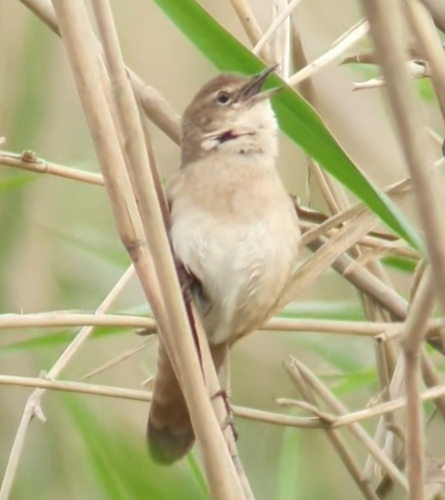 Savi's Warbler
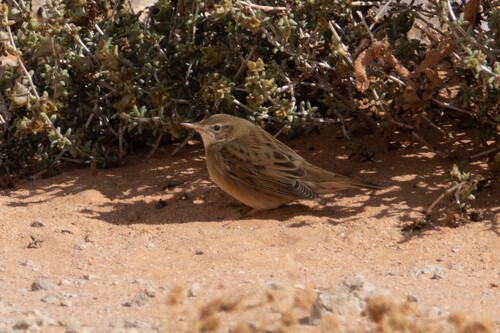 Common Grasshopper Warbler
In short
The most reliable field mark between Savi's Warbler and Common Grasshopper Warbler is the presence or absence of strong streaking on the upperparts: Grasshopper Warbler shows obvious dark streaks on a pale olive-brown back, while Savi's Warbler is a uniform dark reddish-brown above with no streaking. In flight or perched, look for the streaked breast and flanks of Grasshopper Warbler versus the plain underparts of Savi's. Savi's is slightly larger and longer-tailed, but this is subtle. Both species are secretive reedbed skulkers, but their preferred habitats and songs differ, and these can help clinch identification when plumage is ambiguous.
Identification tips
- Check for upperpart streaking: Grasshopper Warbler always shows strong dark streaks on a pale olive-brown back; Savi's Warbler is plain and uniform dark reddish-brown above. This is the best field mark at all ages and seasons.
- Look for underpart streaking: Grasshopper Warbler has streaks or spots on the breast, flanks, and undertail coverts; Savi's Warbler is plain below with no streaking.
- Facial pattern: Grasshopper Warbler usually shows a more distinct pale eye-stripe behind the eye and greyish cheeks; Savi's has a faint, indistinct buff eye-stripe and pale brown ear-coverts.
- Tail pattern: Grasshopper Warbler's tail is reddish-brown with faint bars and streaked undertail coverts; Savi's is plain brown with unstreaked undertail coverts. When the tail is fanned or flared, this can be a useful mark.
- Bill and leg color: Savi's has a brown bill and legs; Grasshopper Warbler has a darker upper mandible, yellowish lower mandible, and paler legs. Subtle, but can help in good light.
- Overall color tone: Savi's Warbler is darker, richer brown; Grasshopper Warbler is paler, more olive-brown or yellowish.
- Size and structure: Savi's is slightly larger and longer-tailed, but this is rarely obvious unless both species are seen together. Both are slim and long-tailed.
- Perched behavior: Savi's is more likely to climb and sing from high exposed reed stems; Grasshopper Warbler usually stays low in grass or bushes, rarely perching in the open.
- Flight behavior: Both are reluctant to fly, but Grasshopper Warbler often drops quickly back into cover and may run along the ground; Savi's may move more through reeds.
- Habitat context: In dense, extensive reedbeds, Savi's is much more likely; in bushy, grassy, or scrubby areas, especially away from water, Grasshopper Warbler is favored.
- Song: If heard, Grasshopper Warbler's reel is higher, faster, more prolonged, and harder to locate; Savi's is lower, shorter, and often starts with ticks. Use as confirmation, not sole ID.
- Season: Both are present in Europe in spring/summer; Savi's returns slightly later in the north (late May), but timing overlap is broad.
- Sex and age: No strong sexual dimorphism in either species; all ages of Grasshopper Warbler are streaked above, all Savi's are plain.
- Pitfalls: Worn or wet Grasshopper Warblers may look less streaked, but some streaking is always visible. Juvenile Savi's are still plain above. Avoid relying on size or bill color alone.
- When in doubt: Focus on the presence or absence of streaks on the back and underparts, and the habitat context. If the bird is singing, use the song as a supporting clue.
Size
Savi's Warbler is a bit larger at about 14 cm in length, compared to the Grasshopper Warbler's 12.5 cm. This size difference is modest and often hard to judge in the field, especially without direct comparison. Both are slender, but Savi's can appear slightly longer and bulkier, with a proportionally longer tail. Weight is not field-assessable, but Grasshopper Warbler is typically lighter (11.5–16 g).
Plumage
- Juvenile/immature/adult non-breeding: The most diagnostic difference is the upperpart pattern: Grasshopper Warbler of all ages shows pale olive-brown upperparts with strong, dark central streaks on each feather, giving a distinctly streaked appearance. Savi's Warbler is always plain above, with a uniform dark reddish-brown or slightly greenish tinge, lacking any streaks or spots.
- Underparts: Grasshopper Warbler has cream or yellowish-buff underparts with dark brown spots and streaks on the breast and flanks, and streaked undertail coverts. Savi's Warbler is much plainer below, with whitish-buff throat and belly, sandy brown flanks, and no streaking.
- Wings and tail: Grasshopper Warbler's wings are brown with paler edges, and the tail is reddish-brown with faint bars and streaked undertail coverts. Savi's Warbler's wings and tail are plain brown, with no barring or streaking, and the undertail coverts are unstreaked.
- Facial pattern: Both have faint eye-stripes, but Savi's is more indistinct; Grasshopper Warbler's is usually more noticeable behind the eye. Savi's has dark lores and pale brown ear-coverts, while Grasshopper Warbler's cheeks are greyish.
- Bill and legs: Savi's has a brown slender bill and brown legs; Grasshopper Warbler has a dark brown upper mandible, yellowish lower mandible, and pale yellowish-brown legs.
Behaviour
Both species are secretive and skulk in dense vegetation, but Grasshopper Warbler is especially elusive, spending much time scurrying through grass and low shrubs, rarely flying except when flushed. It often moves with a high-stepping gait and flares its tail to show streaked undertail coverts. Savi's Warbler is also difficult to see except when singing, but is more likely to climb reed stems and sing from exposed perches. After territory establishment, Savi's is more likely to be seen in the open atop reeds, whereas Grasshopper Warbler remains low and hidden, even when singing.
Habitat
Savi's Warbler is strongly tied to dense reedbeds, marshes, and lagoons with extensive stands of reeds and sedges, sometimes with scattered bushes. Grasshopper Warbler prefers rough grassland, bushy clearings, neglected hedgerows, heaths, young plantations, and the edges of fens—often in drier, more varied, or bushier habitats than Savi's. While both may overlap in wetland edges, Savi's is almost always in dense reedbeds, while Grasshopper Warbler is more flexible, often found away from water in overgrown or scrubby areas.
Voice
Both species have a distinctive reeling trill, but Grasshopper Warbler's song is higher-pitched, faster, and more prolonged, with a ventriloquial quality that makes it hard to locate. Savi's Warbler's trill is similar but lower-pitched, less prolonged, and often starts with a series of low ticks. Grasshopper Warbler's song can last several minutes and is described as resembling an angler's reel or distant mowing machine, audible up to 1 km. Savi's song is shorter and less powerful. Alarm calls are similar ticking noises, but voice is best used as a supporting mark, not a primary separator.
Savi's Warbler · Common Grasshopper Warbler · My Tricky Birds