

Sardinian Warbler vs Moltoni's Warbler
Curruca melanocephala versus Curruca subalpina
Play a quiz with Sardinian Warbler and Moltoni's Warbler
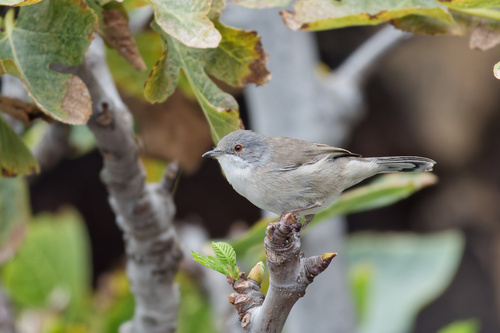 Sardinian Warbler
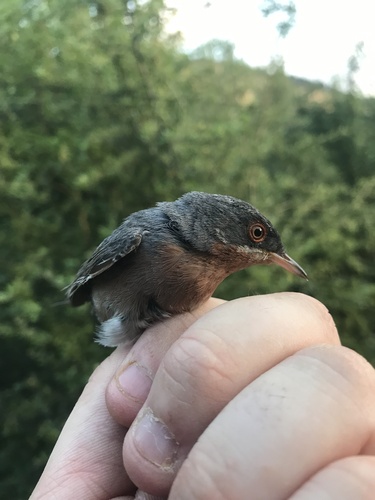 Moltoni's Warbler
In short
The most reliable field mark between Sardinian Warbler and Moltoni's Warbler is the adult male's head and underparts: Sardinian males show a striking black cap, white throat, and grey back with clean whitish underparts, while Moltoni's males have a less contrasting face and a unique salmon-pink wash below. Females and juveniles of both species are much more similar, but Sardinian Warbler females tend to be darker and greyer above, while Moltoni's are paler and browner. In flight or at a distance, structure and tail shape offer subtle clues, but beware: both are small, active warblers with overlapping jizz. Voice is a strong separator if heard, as Moltoni's has a faster, higher-pitched song. Always prioritize adult male plumage for a quick ID, but use a checklist of subtle marks for females and immatures.
Identification tips
- Adult male head pattern: Sardinian Warbler males have a deep black cap and white throat, sharply set off from the grey back and whitish underparts. Moltoni's males lack the intense black cap and have a duller face.
- Adult male underparts: Look for the salmon-pink wash on the underparts of Moltoni's males, which is never shown by Sardinian (always clean whitish or pale grey).
- Female and juvenile upperparts: Sardinian Warbler females are generally darker and greyer above, while Moltoni's are paler and browner. This is subtle and best judged in direct comparison or with experience.
- Eye color: Both species have a red eye-ring, but it is more striking in Sardinian Warbler, especially in males.
- Tail shape: Sardinian Warbler may show a more pointed or square tail tip depending on subspecies, but this is not always easy to judge in the field.
- Bill and structure: No strong differences; both are small, slim warblers, but Sardinian may appear slightly larger and longer-winged (especially nominate forms).
- Juvenile plumage: Juvenile Sardinian Warblers can be sandy below, especially in southern populations, but this is not a strong separator from Moltoni's.
- Vocalizations: Moltoni's Warbler sings a fast, high-pitched, insect-like song with a dry 'trill zerr' call. If you hear this, it's a strong clue for Moltoni's. Sardinian's song is less rapid and not as high-pitched.
- Range and habitat: If you are not in Italy or the Tyrrhenian islands, Sardinian Warbler is overwhelmingly more likely. Both species use similar Mediterranean scrub habitats.
- Seasonal context: Both species are resident or short-distance migrants in their respective ranges. Sardinian Warbler can be found year-round in much of the Mediterranean; Moltoni's is more localized.
- Subspecies variation: Be aware that Sardinian Warbler shows some regional variation in plumage (e.g., paler in the south, darker in the west), but these do not overlap with Moltoni's salmon-pink underparts in males.
- Confusion with Western Subalpine Warbler: Moltoni's is most easily confused with Western Subalpine Warbler, not Sardinian, but the salmon-pink underparts are unique to Moltoni's among the subalpine complex.
- Behavior: Both species are active and often skulking; behavior is not a reliable separator.
- Pitfalls: Females and immatures are very similar and can be impossible to separate without song or close, prolonged views. Always use a combination of marks and consider location and voice when possible.
- In flight: No distinctive wing or tail pattern separates these two, so rely on overall structure, tail shape, and any glimpses of head/underpart color.
Size
Both species are small warblers and very similar in overall size and proportions. Sardinian Warbler may appear slightly larger and longer-winged, especially in the nominate form, but this is subtle and not always reliable in the field. Bill size and tail length are not distinctly different enough to use as primary field marks between these two.
Plumage
Adult males are the easiest to separate: Sardinian Warbler males have a jet-black cap, white throat, grey back, and clean whitish underparts, with no reddish or salmon tones. Their red eye-ring is prominent. Moltoni's Warbler males have a duller head pattern, lacking the deep black cap, and their underparts are distinctly salmon-pink (not orange as in Western Subalpine Warbler). Females and juveniles of both species are much more similar, both showing brownish or olive-grey upperparts and pale underparts, but Sardinian Warbler females are generally darker and greyer above, while Moltoni's are paler and browner. Juvenile Sardinian Warblers are sandy, especially in the southernmost populations, but this is subtle. No distinctive age-specific upperwing pattern (like panels or W-marks) is described for either species, so wing pattern is not a primary separator. Subtle differences in tail tip shape (Sardinian: more pointed or square, depending on subspecies) may help with experience.
Behaviour
Both species are active, often skulking in dense Mediterranean scrub and low bushes, making quick, darting movements and frequently flicking their tails. Sardinian Warbler may appear slightly more robust and confident, sometimes perching more openly, but this is not a reliable field mark. Both species are insectivorous and forage in similar ways.
Habitat
Sardinian Warbler is widespread and common throughout the Mediterranean basin, found in a wide range of scrubby habitats, including coastal maquis, olive groves, and gardens. Moltoni's Warbler is much more restricted, native to Italy and the Tyrrhenian islands, and is typically found in similar Mediterranean scrub, but its range is far more limited. If you are outside the core range of Moltoni's (Italy, Corsica, Sardinia, Balearics), Sardinian is vastly more likely.
Voice
Vocalizations are a strong separator: Moltoni's Warbler has a faster-paced, higher-pitched song than the similar Western Subalpine Warbler, described as a rapid series of insect-like notes with a dry 'trill zerr' call. Sardinian Warbler's song is not described in detail here, but it is not noted for such a high-pitched, rapid delivery. If you hear a fast, high, insect-like song, Moltoni's is likely; otherwise, Sardinian is the default, especially outside Moltoni's limited range.