

Sanderling vs Rock Martin
Calidris alba versus Ptyonoprogne fuligula
Play a quiz with Sanderling and Rock Martin
 Sanderling
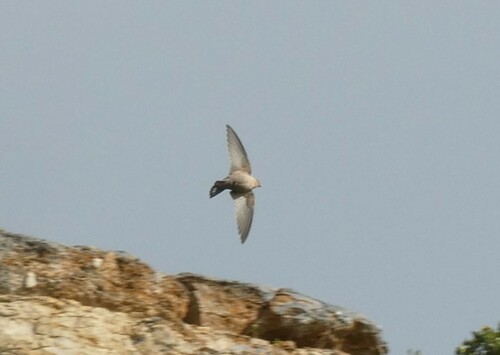 Rock Martin
In short
The most reliable field mark to separate Sanderling from Rock Martin is the leg and bill color: Sanderling shows black legs and a short, straight black bill, while Rock Martin has brownish-pink legs and a small, mainly black bill. In flight, Sanderling (of all ages) shows a strong white wingbar and white sides to the tail, whereas Rock Martin has brown wings with no white wingbar but does show small white 'windows' near the tips of the tail feathers. Sanderling is a compact, pale sandpiper often seen running along beaches, while Rock Martin is a brownish swallow with a square tail, seen gliding near cliffs or buildings. Juvenile Sanderlings lack any pale fringes to the upperparts, while juvenile Rock Martins show pale fringes to the upperparts and flight feathers. These differences are clear in both perched and flying birds.
Identification tips
- Leg and bill color: Sanderling has black legs and a short, straight black bill. Rock Martin has brownish-pink legs and a small, mainly black bill. This is visible at close range or in good light.
- Wing pattern in flight (all ages): Sanderling shows a strong white wingbar and white sides to the tail. Rock Martin lacks a white wingbar but shows small white windows near the tips of the tail feathers when the tail is spread.
- Tail shape and markings: Sanderling’s tail is short and plain. Rock Martin’s tail is square with small white patches near the tips of most tail feathers, visible in flight.
- Upperpart texture in juveniles: Juvenile Rock Martins have pale edges to the upperparts and flight feathers, giving a slightly scaly look. Sanderling juveniles are clean gray above without pale fringes.
- Overall coloration: Sanderling is much paler, with bright white underparts and pale gray upperparts in non-breeding plumage. Rock Martin is earth-brown above and below, with only the chin, throat, and underwing coverts paler cinnamon.
- Body shape and jizz: Sanderling is compact, stout, and runs with a rapid, mechanical gait. Rock Martin is slim, swallow-like, and glides or perches upright.
- Feeding behavior: Sanderling runs along the sand, probing for invertebrates. Rock Martin catches insects in flight, often near cliffs or buildings.
- Habitat: Sanderling is found on sandy beaches or tidal flats; avoid rocky areas. Rock Martin is found on cliffs, rocky outcrops, or buildings—almost never on open sand.
- Group size: Sanderling is often in large, tight flocks. Rock Martin is solitary or in small groups.
- Perching: Sanderling rarely perches except on the ground. Rock Martin often perches on rocks or wires.
- Hind toe: Sanderling lacks a hind toe (not visible in the field, but contributes to its running style). Rock Martin has a normal swallow foot structure.
- Flight style: Sanderling’s flight is direct and fast, often low over the beach. Rock Martin has a slower, more buoyant flight with glides.
- Voice: Not a strong separator, but Rock Martin’s soft twitter and calls may be heard near nests or perches.
- Seasonal confusion: Both species are present in southern Africa in the non-breeding season, but Sanderling is strictly coastal, while Rock Martin is resident and inland as well.
- Sex and age: Both species show little sexual dimorphism; age differences are subtle and mainly in juvenile upperpart texture for Rock Martin.
Size
Sanderling and Rock Martin are similar in length, both around 12–15 cm. However, Sanderling is stouter and more robust, with a thicker body and bill, while Rock Martin is slimmer and more streamlined, typical of swallows. Sanderling's build is more reminiscent of other small sandpipers, whereas Rock Martin is more elongated and less compact.
Plumage
For all ages, Sanderling in flight shows a strong white wingbar and white sides to the tail, which are absent in Rock Martin. Juvenile Rock Martins have pale edges to the upperparts and flight feathers, giving a slightly scaled look, while Sanderlings (including juveniles) do not show this feature and are generally clean pale gray above in non-breeding plumage. Sanderling is much paler overall, especially on the underparts, which are bright white year-round, while Rock Martin is earth-brown above and below, with only the chin, throat, upper breast, and underwing coverts being paler cinnamon. Rock Martin’s tail has small white patches ('windows') near the tips of all but the central and outermost feathers, visible when spread in flight, while Sanderling’s tail is plain. Sanderling lacks a hind toe, which is not visible in the field but affects its running gait. Sexes are similar in both species.
Behaviour
Sanderling is highly gregarious in winter, often seen in tight flocks running rapidly along sandy beaches with a distinctive 'bicycling' leg action, frequently stopping to pick at food. Rock Martin is solitary or in small groups, rarely gregarious, and is usually seen flying slowly with rapid wingbeats and glides near cliffs, buildings, or rocky outcrops. Sanderling feeds by probing in sand, while Rock Martin catches insects on the wing. Sanderling rarely perches; Rock Martin often perches on rocks or human structures.
Habitat
Sanderling is almost always found on open sandy beaches, tidal flats, or occasionally mudflats, especially along marine coasts during migration and winter. It avoids rocky areas. Rock Martin, on the other hand, is found in rocky habitats, cliffs, quarries, or around buildings, and is often far from water. It does not occur on open beaches. Thus, habitat is a strong clue: Sanderling on sand, Rock Martin on rock or man-made structures.
Voice
Rock Martin gives a soft, muffled twitter and various short calls ('trrt', nasal 'vick', high-pitched 'twee'), but is generally quiet. Sanderling is also not very vocal, especially in winter flocks, and the notes do not describe any distinctive calls for field separation. Voice is not a primary separator between these two.