

Sand Martin vs Western House Martin
Riparia riparia versus Delichon urbicum
Play a quiz with Sand Martin and Western House Martin
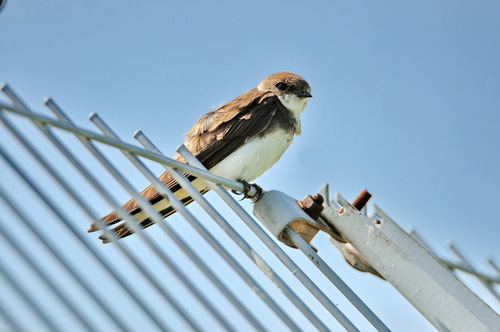 Sand Martin
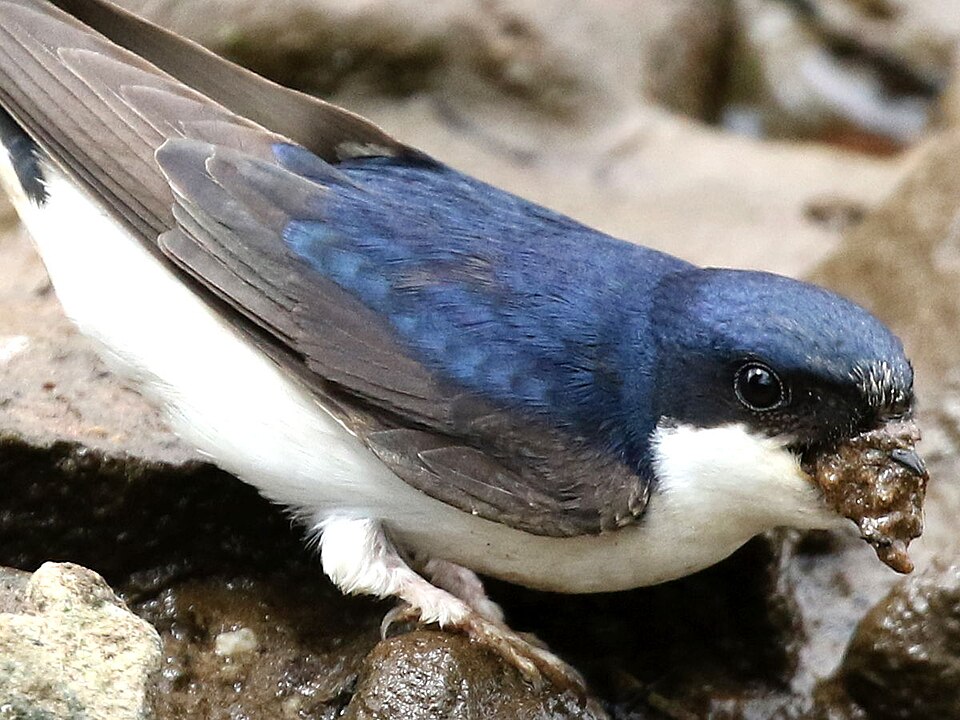 Western House Martin
In short
The most reliable way to separate Sand Martin from Western House Martin is by their underpart and rump pattern: Sand Martin always shows a narrow brown breast band and brown upperparts, while Western House Martin is clean white below with a bright white rump and glossy blue-black upperparts. In flight, the white rump of the House Martin is conspicuous and never present on Sand Martin. Juvenile Sand Martins have rufous-edged wing coverts, while juvenile House Martins are sooty black with some white-tipped coverts. Both are small swallows, but Sand Martin is slightly smaller and slimmer, with a more fluttery, jerky flight. Watch especially for the breast band and rump color, as these are visible at most angles and ages.
Identification tips
- Breast Band: Sand Martin always shows a narrow brown breast band across otherwise white underparts—this is the single most reliable mark at all ages and seasons. House Martin never has a breast band; its underparts are pure white.
- Rump Color: House Martin has a bright white rump, very obvious in flight and from above or behind. Sand Martin's rump is brown, matching the back.
- Upperparts Color: Sand Martin is uniformly brown above; House Martin is glossy blue-black above (adults) or sooty black (juveniles), with a sharp contrast to the white rump.
- Juvenile Wing Coverts: Juvenile Sand Martins have rufous tips to the wing coverts and rufous margins to the secondaries. Juvenile House Martins have white tips and edgings to some coverts and quills, but not rufous.
- Underwing Color: House Martin has white underwings and even white feathering on the legs; Sand Martin's underwing is plain and matches the brown upperparts.
- Tail Shape: House Martin's tail is slightly more deeply forked, but this is subtle and not always reliable at a distance.
- Flight Style: Sand Martin has a quick, jerky, fluttering flight, often low over water. House Martin's flight is more buoyant and gliding, with rapid, even wingbeats.
- Size and Structure: Sand Martin is slightly smaller and slimmer, with a more delicate build. House Martin is chunkier, especially around the head and body.
- Leg Color and Feathering: House Martin has pink toes and exposed leg parts, with white downy feathering on the legs. Sand Martin's legs are brown and unfeathered.
- Bill: Both have small black bills, not a useful field mark for separation.
- Habitat Context: In the breeding season, Sand Martin is almost always near sandy banks or cliffs by water; House Martin is usually found near buildings or on cliffs, often in urban or suburban settings.
- Perched Birds: When perched, look for the breast band (Sand Martin) and the white rump (House Martin, especially if the tail is spread or the bird is preening).
- Flock Composition: Mixed flocks can occur, especially on migration, but Sand Martins are more likely to be in tight, low-flying groups over water, while House Martins often form loose, high-flying groups near buildings.
- Voice: Sand Martin's gravelly twitter is distinctive if heard well, but not always easy to separate from House Martin's softer twitter in mixed flocks.
- Pitfalls: Juvenile House Martins can look dull above but never show a breast band or brown rump. Juvenile Sand Martins may appear paler below but always have the breast band and brown upperparts.
Size
Sand Martin is slightly smaller and lighter than Western House Martin. Sand Martin measures 12–13 cm in length, with a wingspan of 26.5–29 cm and weight of 11–16 g (occasionally up to 19.5 g pre-migration). Western House Martin is about 13 cm long, with a wingspan of 26–29 cm and a heavier average weight of 18.3 g. In the field, this size difference is subtle and not always reliable, but Sand Martin often appears slimmer and more delicate, while House Martin can look chunkier, especially around the head and body.
Plumage
Juvenile and immature birds are a common source of confusion. Juvenile Sand Martins have rufous tips to their wing coverts and rufous margins to the secondaries, but always retain the diagnostic brown breast band and brown upperparts. Juvenile House Martins are sooty black above, with some white tips and edgings to the wing coverts and quills, but never show a breast band; their underparts and rump are white. In all plumages, Sand Martin is brown above with a white throat and belly, and a narrow brown breast band. Western House Martin is glossy blue-black above (adults), with a bright white rump, pure white underparts and underwings, and even white feathering on the legs. The white rump is especially visible in flight and is never present on Sand Martin. The House Martin's tail is slightly more deeply forked, and the white underwing is a useful mark in good light. The brown breast band of Sand Martin is unique among these two, present at all ages and seasons.
Behaviour
Sand Martin tends to have a quick, jerky, fluttering flight, often low over water or open ground, and is generally more agile and less direct than House Martin. Western House Martin has a more buoyant, gliding flight, with rapid wingbeats (averaging 5.3 beats per second), and often forages higher or around buildings. Both species are social and may be seen in mixed flocks, but House Martins are more likely to be found near human habitation, especially during breeding season, where they build mud nests under eaves. Sand Martins nest in colonies in sandy banks, often near water.
Habitat
Sand Martin breeds in colonies in sandy or earthen banks, usually near water, and is less likely to be found close to buildings. Western House Martin is more urban or suburban, breeding on buildings and other structures, as well as cliffs, and is often seen in towns and villages. Both species are migratory and may occur together on migration, but their breeding habitats are usually distinct.
Voice
Sand Martin gives a continuous, gravelly twittering in flight, which becomes a softer conversational undertone when perched. Its alarm call is harsh and used in response to predators. Western House Martin's voice is not described in detail in the provided notes, but it generally gives a softer, more musical twittering typical of hirundines. Vocalizations are not the most reliable way to separate these two in the field.