

Sand Martin vs Rock Martin
Riparia riparia versus Ptyonoprogne fuligula
Play a quiz with Sand Martin and Rock Martin
 Sand Martin
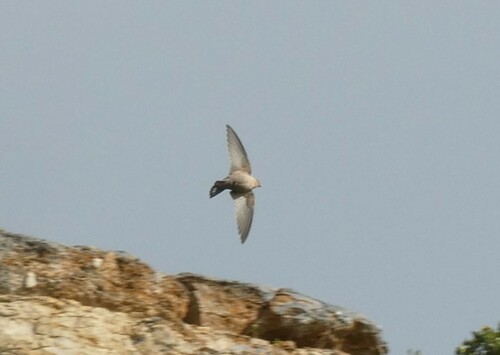 Rock Martin
In short
The most reliable field mark to separate Sand Martin from Rock Martin is the presence of a sharp, dark breast band on the Sand Martin, which is absent in Rock Martin of all ages. Juvenile Sand Martins also show rufous-edged wing coverts, while juvenile Rock Martins have pale fringes to the upperparts and flight feathers. In flight, Rock Martin shows small white 'windows' near the tips of the tail feathers, lacking in Sand Martin. Sand Martin is smaller, slimmer, and typically seen in fast, jerky flight over water, while Rock Martin is more robust, with slower, gliding flight, and is often found far from water, especially in rocky or urban settings.
Identification tips
- Breast band (all ages): Sand Martin always shows a distinct, narrow brown breast band on a white background; Rock Martin never has a breast band, instead showing a uniform brown or cinnamon-washed throat and breast.
- Juvenile wing coverts: Juvenile Sand Martins have rufous-edged coverts and secondaries, giving a warm, scaly look to the upperwing; Rock Martin juveniles have pale (not rufous) fringes, which look colder and less contrasting.
- Tail pattern in flight: Rock Martin shows small white 'windows' near the tips of the tail feathers (except central and outermost pairs), visible when tail is spread; Sand Martin lacks any white in the tail.
- Underparts color: Sand Martin is clean white below (apart from breast band); Rock Martin is brownish or cinnamon below, never pure white.
- Throat color: Sand Martin has a white throat; Rock Martin has a cinnamon or brownish throat and chin, blending into the breast.
- Size and structure: Sand Martin is smaller, slimmer, and more delicate; Rock Martin is slightly larger, more robust, with a heavier body and head.
- Tail shape: Sand Martin's tail is slightly forked; Rock Martin's tail is short and square, especially obvious when perched.
- Flight style: Sand Martin has a quick, jerky, fluttery flight, often low over water; Rock Martin flies more slowly, with bursts of rapid wingbeats and glides, often along cliffs or buildings.
- Habitat: Sand Martin is almost always near water; Rock Martin is often far from water, favoring rocky or urban sites.
- Sociality: Sand Martin is gregarious, often in large flocks; Rock Martin is more solitary or in small groups.
- Voice: Sand Martin has a gravelly, continuous twitter; Rock Martin's calls are softer, with a muffled twitter and high-pitched notes.
- Bill and legs: Both have small, blackish bills and brownish legs; not a useful separation point.
- Sex differences: Both species are similar between sexes; use age and plumage, not sex, for ID.
- Seasonal context: In southern Africa, Sand Martin is a passage migrant or rare visitor, almost always near water; Rock Martin is resident and widespread in rocky or urban habitats.
- Pitfalls: Beware of juvenile plumages—focus on the color of covert fringes (rufous in Sand, pale in Rock) and the presence/absence of the breast band. In poor light, Rock Martin's underparts can look paler, but never as white as Sand Martin.
Size
Sand Martin is the smaller species, measuring 12–13 cm in length and weighing 11–16 g (occasionally up to 19.5 g before migration) [wikipedia]. Rock Martin is slightly larger and more robust, at 12–15 cm in length, but the overlap means size alone is not always diagnostic. In direct comparison, Rock Martin appears bulkier and more solid, especially in the body and head.
Plumage
- Juvenile/immature birds: Sand Martin juveniles have rufous tips to the wing coverts and rufous margins to the secondaries, creating a warmer, subtly 'scaly' look on the upperwing. Rock Martin juveniles instead show pale (not rufous) fringes to the upperparts and flight feathers, giving a colder, more washed-out impression.
- Adults: Sand Martin is brown above, white below, with a crisp, narrow brown breast band and white throat. Rock Martin is earth-brown above and below, with a cinnamon throat, chin, and upper breast, and underwing coverts also tinged cinnamon. The rest of the underparts are brown, not white, and there is no breast band. In flight, Rock Martin shows small white patches ('windows') near the tips of all but the central and outermost tail feathers, a feature absent in Sand Martin. Sand Martin never shows white in the tail.
- Tail: Sand Martin has a short, slightly forked tail with no white spots. Rock Martin's tail is short and square, with white spots visible in flight.
- Sexes: Both species are similar between sexes; plumage marks apply to all adults.
Behaviour
Sand Martin is highly gregarious, often seen in flocks, especially near water, with a fast, jerky, fluttering flight. Rock Martin is more solitary or in small groups, often breeding alone or in loose aggregations. Its flight is slower, with rapid wingbeats interspersed with glides, and it is more likely to be seen hunting along cliff faces or buildings, sometimes far from water. Rock Martin is less likely to be seen in large flocks.
Habitat
Sand Martin is strongly associated with water, breeding and feeding near rivers, lakes, and sandbanks. It is rarely found far from water. Rock Martin, in contrast, is a bird of rocky areas, cliffs, and urban structures, and is often encountered far from water. In southern Africa, Rock Martin is the default small brown swallow in dry, rocky, or urban habitats, while Sand Martin is a passage migrant or rare visitor, usually near water.
Voice
Sand Martin gives a continuous gravelly twitter in flight, with a harsh alarm call when threatened. Rock Martin's song is a muffled twitter, with calls including a 'trrt' (like House Martin), a nasal 'vick', and a high-pitched 'twee'. Both are generally quiet, but Sand Martin's calls are harsher and more persistent in flight, while Rock Martin's are softer and less frequent.