

Saker Falcon vs Gyr Falcon
Falco cherrug versus Falco rusticolus
Play a quiz with Saker Falcon and Gyr Falcon
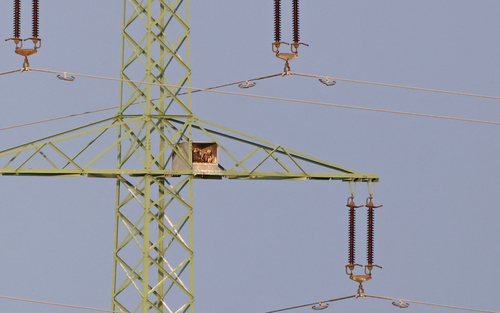 Saker Falcon
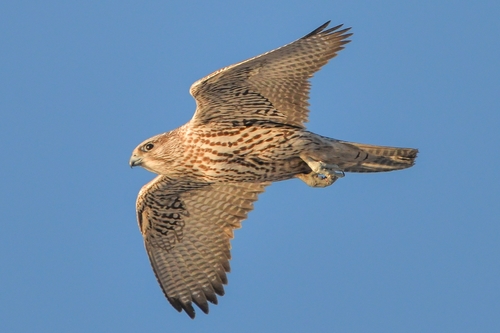 Gyr Falcon
In short
The most reliable field mark between Saker Falcon and Gyr Falcon is overall size and structure: Gyr Falcon is distinctly larger and bulkier, especially in females, with a heavier build and broader wings. Juvenile and adult plumages of both species are variable, but Saker Falcons are generally browner and more uniformly streaked, while Gyr Falcons show a wide range of color morphs from white to black, with pale birds being diagnostic for Gyr. In flight, Gyr Falcons appear broader-winged and longer-tailed, while Sakers are slightly slimmer. Both species can be confusing at a distance, especially brown-morph Gyrs and Sakers, but careful attention to size, wing shape, and plumage tone will usually separate them.
Identification tips
- Size is the best single clue: Gyr Falcons are much larger and bulkier than Sakers, especially in females. If the bird dwarfs a large crow or buzzard, consider Gyr.
- Structure in flight: Gyr Falcons have broader wings and a longer tail compared to the slimmer, more streamlined Saker. In direct comparison, Gyr looks more robust and powerful.
- Plumage color range: Only Gyr Falcon shows pure white or very pale grey ('silver') morphs; any predominantly white falcon is a Gyr. Saker is always brownish, never white.
- Brown morph confusion: Brown Gyr Falcons can look similar to Sakers, but usually have a colder, greyer tone and cream streaking on the nape/crown. Saker is warmer brown and more uniformly streaked.
- Juvenile confusion: Both juveniles are streaky and brown, but Saker juveniles are generally darker and more heavily streaked, while Gyr juveniles may show hints of their adult morph and are often colder in tone.
- Underparts: Gyr Falcons (especially black morphs) can show strong black spotting below, while Sakers are more heavily streaked but not spotted.
- Head pattern: Gyr Falcons lack a well-defined malar stripe and cap, which are more typical of Peregrine but can sometimes help separate from Saker, which also lacks strong facial markings.
- Habitat context: In Arctic or tundra settings, expect Gyr; in steppe, grassland, or semi-desert, expect Saker. Vagrants are possible but rare.
- Perched jizz: Gyr Falcons look massive and heavy-chested when perched, with a large head and thick legs. Sakers are large but slimmer and more upright.
- Wing formula and tail: No distinctive differences described, but Gyr's wings are broader and tail longer in proportion.
- Voice: Saker gives a sharp 'kiy-ee' or 'kyak-kyak-kyak', but both are usually silent and voice is rarely helpful.
- Sex differences: Both species are sexually monomorphic in plumage, but females are much larger; the largest Saker female can overlap with small male Gyrs, but most Gyrs are bigger.
- Plumage variability: Saker is variable but never as pale as the palest Gyr; beware of pale Sakers, but they will not approach the silver or white Gyr morphs.
- Migration timing: Saker is a partial migrant and may be seen in southern areas in winter, while Gyr is mostly resident in the far north but can wander widely in winter.
- Direct comparison: If seen together, Gyr's size, bulk, and paler morphs are unmistakable; Saker is always slimmer and browner.
Size
Gyr Falcon is the largest falcon in the world, with males averaging 1,130–1,170 g and females 1,585–1,752 g, and some females reaching over 2,000 g. Saker Falcon is smaller, with an average body mass of about 1,000 g. In length, Saker is 45–57 cm (wingspan 97–126 cm), while Gyr is 48–65 cm (wingspan 110–134 cm). Gyr Falcons are noticeably bulkier and heavier in the field, especially when seen perched or next to other raptors. Saker Falcons are large but slimmer and more streamlined.
Plumage
- Juvenile/immature plumage: Both species are darker and more heavily streaked when young, but Saker juveniles tend to be browner overall, while Gyr juveniles can be brown but often show a colder, greyer tone and may already show hints of their adult morph (especially in pale birds).
- Adult plumage: Saker Falcons are variable but generally brown above with heavy streaking below, lacking the extreme pale or white morphs of Gyr. Gyr Falcons are highly polymorphic: white morphs are unique to Gyr, silver morphs are pale grey, and brown morphs can resemble Saker but are usually colder in tone and often show cream streaking on the nape/crown. Black morph Gyrs are very dark with strong black spotting below, unlike any Saker. Saker lacks the Gyr's range of pale and white morphs.
- Flight/upperwing pattern: No distinctive age-specific upperwing pattern is described for either species in the sources, but Gyr's broader wings and longer tail are structural clues in flight.
Behaviour
Both species are powerful falcons, but Gyr Falcons are more likely to be seen in high-latitude, open tundra environments and often hunt over vast, open spaces. Saker Falcons are partial migrants, with some populations moving long distances, but are more associated with steppe and open country in temperate regions. Gyr Falcons may be seen harassing large birds or defending cliff nests aggressively. Both are fast and agile, but Gyr's bulk and power are more apparent in direct comparison.
Habitat
Gyr Falcons breed on Arctic coasts, tundra, and northern islands, often nesting on cliffs and rarely venturing far south except as vagrants. Saker Falcons breed from Central Europe to Manchuria, favoring open steppe, grasslands, and semi-desert. In winter, Sakers may migrate to the Sahel or Tibetan Plateau, but are not truly Arctic. If seen in tundra or far north, Gyr is far more likely; in steppe or temperate open country, Saker is expected.
Voice
Saker Falcon gives a sharp 'kiy-ee' or repeated 'kyak-kyak-kyak'. No distinctive vocalization is provided for Gyr Falcon in the sources, but both are generally silent outside the breeding season and voice is rarely diagnostic in the field.