
Rusty-tailed Flycatcher vs Blue-fronted Redstart
Ficedula ruficauda versus Phoenicurus frontalis
Play a quiz with Rusty-tailed Flycatcher and Blue-fronted Redstart
 Rusty-tailed Flycatcher
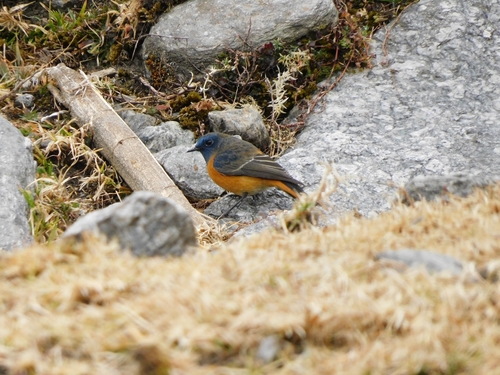 Blue-fronted Redstart
In short
The most reliable field mark between Rusty-tailed Flycatcher and Blue-fronted Redstart is the presence of strong blue coloration on the head and breast in adult male Blue-fronted Redstart, which is entirely absent in Rusty-tailed Flycatcher. Rusty-tailed Flycatcher is a small, plain flycatcher with a rufous tail, while Blue-fronted Redstart is a larger, more colorful bird with a striking blue front (in males) and orange underparts. Females and immatures of Blue-fronted Redstart are duller but still show richer coloration and a different structure compared to the uniformly brownish Rusty-tailed Flycatcher. Both species may overlap in the Himalayas in winter, but their structure, tail color, and especially the presence or absence of blue are key for separation.
Identification tips
- Blue coloration: Adult male Blue-fronted Redstart shows deep blue on the head, throat, and breast—never present in Rusty-tailed Flycatcher. This is the single most decisive mark in adult males.
- Orange underparts: Blue-fronted Redstart (both sexes, but especially males) has rich orange underparts; Rusty-tailed Flycatcher is pale and lacks any orange or rufous on the underparts.
- Tail color and pattern: Both species have rufous tails, but Blue-fronted Redstart’s tail is brighter and often shows a dark central area, while Rusty-tailed Flycatcher’s tail is more uniformly rusty or rufous with less contrast.
- Overall coloration: Rusty-tailed Flycatcher is plain brownish-olive above and pale below, with little contrast. Female and immature Blue-fronted Redstarts are browner but still warmer and more colorful than Rusty-tailed Flycatcher, especially on the tail and flanks.
- Size and structure: Blue-fronted Redstart is noticeably larger and bulkier, with a longer tail and a more upright, robust stance. Rusty-tailed Flycatcher is smaller, more delicate, and compact.
- Bill shape: Both have typical flycatcher bills, but Blue-fronted Redstart’s is slightly heavier and broader at the base, though this is subtle and best used in direct comparison.
- Perching behavior: Blue-fronted Redstart often perches on rocks or open ground and is more likely to fan or quiver its tail. Rusty-tailed Flycatcher prefers perches in trees or shrubs and is less conspicuous in its movements.
- Habitat context: In the Himalayas, Blue-fronted Redstart is more likely in open, rocky, or scrubby areas, while Rusty-tailed Flycatcher prefers woodland edges and denser vegetation.
- Sex and age confusion: Female and immature Blue-fronted Redstarts lack the blue but are still warmer and richer in tone than any Rusty-tailed Flycatcher. If you see any blue, it is not a Rusty-tailed Flycatcher.
- Seasonal overlap: Both may occur together in winter in the Himalayan foothills—do not rely on range alone for separation in this region and season.
- No wing panels: Neither species has distinctive wing bars or panels in any age, so do not use this feature for separation.
- Tail flicking: Both species may flick their tails, but Blue-fronted Redstart is more likely to fan and quiver it, especially when agitated or displaying.
- Plumage consistency: Rusty-tailed Flycatcher shows little variation between sexes or ages; Blue-fronted Redstart is sexually dimorphic, with males being much brighter.
- Direct comparison: If seen together, the size, color, and behavior differences are striking—Blue-fronted Redstart is larger, more colorful, and bolder; Rusty-tailed Flycatcher is smaller, plainer, and more retiring.
- Voice: Not diagnostic with available information—do not rely on calls or song for separation based on current sources.
Size
Rusty-tailed Flycatcher is smaller and lighter (body mass ~13.3 g) than Blue-fronted Redstart, which is generally a noticeably larger and bulkier bird (exact mass not provided, but redstarts are typically heavier and longer than small Ficedula flycatchers). In the field, Blue-fronted Redstart will appear more robust, with a longer tail and a more upright stance, while Rusty-tailed Flycatcher is compact and delicate.
Plumage
Adult male Blue-fronted Redstart is unmistakable with its deep blue head, throat, and breast, contrasting with bright orange underparts and a rufous tail. Females and immatures are duller, with brownish upperparts and paler underparts, but still show warmer tones and a more contrasting tail than Rusty-tailed Flycatcher. Rusty-tailed Flycatcher of all ages is plain brownish-olive above, pale below, and has a distinctive rusty or rufous tail that contrasts with the back but lacks any blue or orange. Both sexes and all ages of Rusty-tailed Flycatcher are similar, so sexing by plumage is not possible. In flight, Blue-fronted Redstart shows a bright rufous tail with dark central feathers, while Rusty-tailed Flycatcher’s tail is more uniformly rusty. No distinctive wing panels or upperwing patterns are described for either species in the sources, so separation relies on overall color and tail pattern.
Behaviour
Rusty-tailed Flycatcher typically perches upright on exposed twigs, making short sallies to catch insects, and often flicks its tail. Blue-fronted Redstart also perches upright but is more likely to be seen on rocks or low branches in open areas, often fanning and quivering its tail. Redstarts are generally bolder and more conspicuous in their movements, while Rusty-tailed Flycatcher is more retiring and less showy.
Habitat
Rusty-tailed Flycatcher is found in the northern Indian subcontinent and Central Asia, favoring open forests, forest edges, and wooded ravines, especially during migration and winter. Blue-fronted Redstart breeds at higher elevations in the Himalayas and central China, in temperate forests, and winters in the southern Himalayan foothills and northern Indochina. In winter, both may occur in similar habitats in the Himalayan foothills, but Blue-fronted Redstart prefers more open, rocky, or scrubby areas, while Rusty-tailed Flycatcher sticks to woodland edges and denser cover.
Rusty-tailed Flycatcher · Blue-fronted Redstart · My Tricky Birds