

Rusty Blackbird vs Boat-tailed Grackle
Euphagus carolinus versus Quiscalus major
Play a quiz with Rusty Blackbird and Boat-tailed Grackle
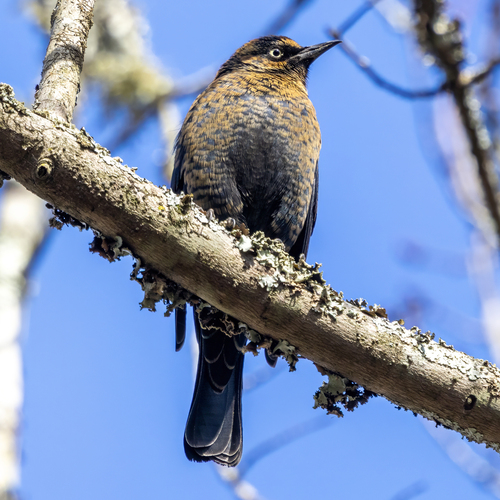 Rusty Blackbird
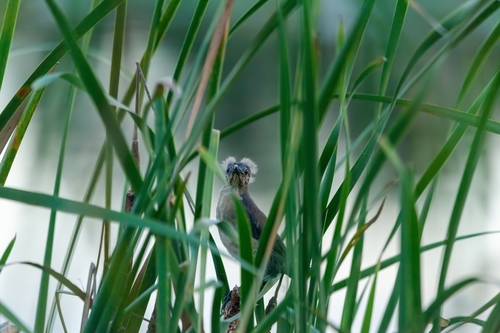 Boat-tailed Grackle
In short
The most reliable field mark separating Rusty Blackbird from Boat-tailed Grackle is size and structure: Boat-tailed Grackle is much larger, with a dramatically longer, keel-shaped tail and a heavier, longer bill, especially obvious in males. Rusty Blackbird is a medium-sized blackbird with a pointed bill and pale yellow eye, often showing a brownish ('rusty') wash in winter, while Boat-tailed Grackle males are entirely glossy black and females are brown with a shorter tail. In flight, the grackle’s long, paddle-shaped tail and bulk stand out, while Rusty Blackbird is more compact and lacks the exaggerated tail. Habitat is also a strong clue: Rusty Blackbird prefers wet forests and wooded swamps, while Boat-tailed Grackle is tied to coastal marshes and urban areas near water in the Southeast and Mid-Atlantic. Immature and female Boat-tailed Grackles can cause confusion, but careful attention to size, tail, and eye color will resolve most mix-ups.
Identification tips
- Size is a primary clue: Boat-tailed Grackle is nearly three times heavier than Rusty Blackbird. If the bird looks large and bulky among blackbirds, suspect grackle.
- Tail shape and length: Male Boat-tailed Grackles have a very long, keel-shaped tail, often held in a V or fanned. Rusty Blackbird’s tail is shorter and lacks the exaggerated shape. Even female grackles have longer tails than Rusty Blackbirds.
- Bill structure: Boat-tailed Grackle’s bill is longer and heavier, especially in males. Rusty Blackbird has a more slender, pointed bill.
- Eye color: Rusty Blackbird of both sexes shows a pale yellow eye, a standout mark. Boat-tailed Grackle’s iris varies: pale on the Atlantic coast, dark on the Gulf/inland, but never as strikingly pale as Rusty Blackbird’s.
- Plumage gloss: Adult male Boat-tailed Grackles are glossy black all over. Rusty Blackbird males are black with a faint green/purple gloss, but in winter, they show a brownish ('rusty') wash, especially on the back and flanks.
- Female/immature confusion: Female Boat-tailed Grackles are much larger, brownish-tan with darker wings and tail, and lack the grey tones of Rusty Blackbird females. Immature female grackles are blotchy on the breast; Rusty Blackbird females are more evenly grey.
- Habitat context: In coastal marshes, especially saltwater, or urban areas near the coast, Boat-tailed Grackle is expected. Rusty Blackbird prefers wooded swamps, wet forests, and is rarely found in open coastal or urban habitats.
- Behavior: Boat-tailed Grackles are bold, noisy, and often seen in large, conspicuous flocks, sometimes scavenging in human settings. Rusty Blackbirds are quieter, more secretive, and stick to natural, wooded wetlands.
- Flight jizz: In flight, Boat-tailed Grackle’s long, paddle-shaped tail is obvious, often trailing behind or fanned. Rusty Blackbird looks more compact, with a shorter tail and less exaggerated flight profile.
- Vocalizations: Boat-tailed Grackles are loud and varied in their calls; Rusty Blackbirds are quieter, with gurgling, squeaky songs mostly in spring.
- Seasonal plumage: Rusty Blackbird’s rusty-brown winter plumage is unique; Boat-tailed Grackle never shows this coloration.
- Mixed flocks: Rusty Blackbirds may join mixed blackbird flocks in migration/winter, but Boat-tailed Grackles are more likely to be in single-species or grackle-dominated groups, especially in coastal areas.
- Geographic range: If you are far from the Southeast or Mid-Atlantic coast, Boat-tailed Grackle is unlikely; Rusty Blackbird has a broader migration range but is declining and rare in many areas.
- Perched posture: Boat-tailed Grackles often perch high and display with fanned tails; Rusty Blackbirds perch more modestly, often lower in vegetation.
- Pitfall: Immature male Boat-tailed Grackles (black but dull) can be confused with Rusty Blackbird, but size, tail, and eye color will separate them.
Size
Boat-tailed Grackle is much heavier and larger than Rusty Blackbird. Adult Boat-tailed Grackles average about 159 g (males often much heavier), while Rusty Blackbirds are around 60 g. The grackle’s body is longer, and the tail is especially prominent—very long and keel-shaped in males, still longer than Rusty Blackbird in females. Even female Boat-tailed Grackles, though smaller than males, are noticeably larger and bulkier than Rusty Blackbirds. In direct comparison, Rusty Blackbird appears compact and slender, lacking the grackle’s imposing presence.
Plumage
- Juveniles/immatures: Young Boat-tailed Grackle males are black but lack strong iridescence; immature females are dull brown with blotched breasts. Rusty Blackbird immatures are not described in detail, but no strong upperwing pattern is noted for either species, so confusion is more likely with drab or brownish birds.
- Adult males: Rusty Blackbird males are black with faint green and purple gloss, and a distinctive pale yellow eye; in winter, they show a brownish ('rusty') wash. Boat-tailed Grackle males are larger, entirely glossy black, and have a long, keel-shaped tail and a pale yellowish or brown iris (varies by region).
- Adult females: Rusty Blackbird females are greyer overall, with a pale eye. Female Boat-tailed Grackles are tawny-brown with darker wings and tail, a shorter tail than males, and a dark or pale eye depending on location. The grackle female is much larger and browner, while Rusty Blackbird female is smaller and greyer.
- Key contrast: Rusty Blackbird’s pale yellow eye (in both sexes) is a strong mark, especially against the grackle’s variable iris color. The rusty or brownish wash in winter Rusty Blackbirds is unique and not matched by grackle plumage.
Behaviour
Rusty Blackbirds forage quietly on wet ground or in shallow water, often in small flocks, and are more secretive. Boat-tailed Grackles are bolder, often seen in conspicuous, noisy flocks, foraging in open marshes, urban areas, and even scavenging in parking lots and patios. Grackles display more aggressive, dominant behavior, especially males with their tail-fanning and strutting. Rusty Blackbirds are less likely to be seen in urban or highly disturbed areas.
Habitat
Rusty Blackbird is found in wet, forested habitats—boreal forests, wooded swamps, and muskeg—especially during migration and winter. It avoids open coastal marshes and urban settings. Boat-tailed Grackle is tightly associated with coastal saltwater marshes, the Florida peninsula, and urbanized coastal areas of the Southeast and Mid-Atlantic. If you see a blackbird in a coastal marsh or city parking lot near the coast, it is far more likely to be a Boat-tailed Grackle. Rusty Blackbird is rarely found in these habitats.
Voice
Rusty Blackbird’s song is a mix of gurgling and high-pitched squeaks, and it is generally quiet outside the breeding season. Boat-tailed Grackle is much more vocal, with a wide range of harsh, ringing calls and songs, often given in conspicuous displays. If you hear loud, varied, and frequent vocalizations, especially in a group, Boat-tailed Grackle is more likely.