

Rusty-backed Antwren vs Orange-eyed Thornbird
Formicivora rufa versus Phacellodomus erythrophthalmus
Play a quiz with Rusty-backed Antwren and Orange-eyed Thornbird
 Rusty-backed Antwren
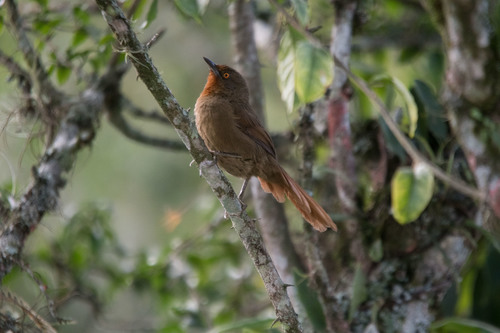 Orange-eyed Thornbird
In short
The most reliable field mark to separate Rusty-backed Antwren from Orange-eyed Thornbird is overall size and structure: the antwren is a tiny, active bird with a short tail and bold facial pattern, while the thornbird is much larger, bulkier, and has a long rufous tail and a less contrasting face. In perched or flight views, look for the antwren's white supercilium, black throat, and white wing spots versus the thornbird's plainer, rufous-toned face and uniform brownish underparts. The antwren is much lighter (about half the mass), and its behavior is more restless and bush-hopping, while the thornbird is slower and often seen near its large stick nest. Both can show rufous tones above, but the antwren is more sharply patterned and compact.
Identification tips
- Size and Structure: Rusty-backed Antwren is much smaller and lighter (11 g vs 24 g), with a compact build and short tail. Orange-eyed Thornbird is bulkier, longer (16–18 cm), and has a long, rufous tail. Size is often the easiest first check.
- Facial Pattern: Antwren males have a bold white supercilium and black face/throat; females are streaked black-and-white. Thornbird has a plainer, rufescent-brownish face with only a faint supercilium and no strong facial contrast.
- Wing Pattern: Antwren shows clear lines of white dots on the folded wings (all ages/sexes); thornbird's wings are plain warm brown with no white spots or lines.
- Tail: Antwren's tail is black with chestnut fringes and white tips; thornbird's tail is uniformly rufous and longer in proportion to the body.
- Underparts: Antwren males have a sharply defined black breast with a white edge and cinnamon flanks; females have cinnamon underparts with black-and-white streaking above. Thornbird has a dark rufous throat and otherwise olivaceous brown underparts, paler on the belly, lacking sharp contrasts.
- Crown and Upperparts: Both species show rufous tones on the crown, but the antwren's is a brighter tawny rufous, while the thornbird's is a more blended bright rufous only on the forehead/forecrown, with the rest of the crown and back dark brownish-olive.
- Bill: Not specifically described, but antwrens typically have a finer, more delicate bill, while thornbirds have a heavier, more robust bill suited to nest building and foraging in sticks.
- Behavior: Antwren is restless, often hopping and making short flights in low vegetation. Thornbird is slower, often seen near its large, boot-shaped stick nest hanging from a branch.
- Habitat: Antwren is found in open, shrubby areas across a wide range; thornbird is restricted to lowland southeast Brazil and prefers wooded or edge habitats.
- Voice: Antwren's song is a long, harsh rattle; thornbird's voice is not detailed here but is not similar to the antwren's rapid rattle.
- Sex Differences: Only the antwren shows strong sexual dimorphism in plumage (males with black face/throat, females with streaked face/chest); thornbird sexes are alike.
- Nest Association: Thornbird may be seen near its large, conspicuous stick nest; antwren's nest is a small grass cup, rarely obvious in the field.
- Iris Color: Thornbird has a distinctive orange iris, but this may be hard to see in the field; antwren's iris color is not described as distinctive.
- Geographic Range: If in Bolivia, Paraguay, Peru, or Suriname, only antwren is possible; in southeast Brazil, both are possible, but habitat and structure help separate them.
- Pitfalls: Female antwrens can appear paler and less contrasting, but still show white wing spots and a compact shape. Thornbirds never show white in the wings or strong facial contrast.
Size
Rusty-backed Antwren is a small bird, weighing about 11 g and measuring 12–13 cm in length. In contrast, Orange-eyed Thornbird is much larger and heavier, at 24 g and 16–18 cm long—nearly double the mass and substantially longer. In the field, the thornbird appears bulkier, with a longer tail and a heavier, more robust build, while the antwren is noticeably petite and dainty. This size difference is often obvious even without direct comparison.
Plumage
No age-specific juvenile or immature wing patterns are described for either species, so focus is on adult plumage. Rusty-backed Antwren males show a striking combination of a tawny rufous crown and upperparts, a bold white supercilium, black face and throat, and a sharply defined black breast with a white edge and cinnamon flanks. The folded wings have distinct lines of white dots, and the tail is black with chestnut fringes and white tips. Females are paler above, with black-and-white streaked face, throat, and chest, and cinnamon underparts. Orange-eyed Thornbird adults of both sexes are more uniformly colored: a rufous forehead and forecrown, dark brownish-olive back, chestnut-tinged uppertail coverts, and a rufous tail. The face is rufescent-brownish with only an indistinct rufous-brown supercilium, and the underparts are olivaceous brown with a dark rufous throat. The thornbird lacks the antwren's bold facial contrast and white wing spots, instead showing a more blended, earthy look throughout.
Behaviour
Rusty-backed Antwren is highly active, foraging by hopping through bushes and small trees, often making short sally flights to glean insects and spiders from foliage. It rarely sits still and does not follow ant swarms. Orange-eyed Thornbird is slower and more deliberate, often seen near its large, conspicuous stick nest, which hangs from tree branches. The thornbird's movements are less frenetic, and it is less likely to be seen making quick, darting flights. The antwren's jizz is distinctly more restless and energetic.
Habitat
Rusty-backed Antwren occupies a wide range across Bolivia, Brazil, Paraguay, Peru, and Suriname, favoring semi-open to open habitats such as cerrado, campos with scattered trees, white sand forest, and scrublands, from sea level up to 1,450 m. Orange-eyed Thornbird is endemic to a narrow band of lowland southeastern Brazil and is considered uncommon. It is typically found in forested or edge habitats where it can build its large stick nests. The antwren is more likely in open, shrubby areas, while the thornbird is tied to denser, wooded environments.
Voice
Rusty-backed Antwren gives a long rattle of evenly pitched harsh or sharp notes, often increasing in intensity, with common calls like 'chip cheep' or 'tit-tweep.' Orange-eyed Thornbird's vocalizations are not described in detail here, but are known to differ from similar species and are not likely to be confused with the antwren's rapid rattle. In the field, the antwren's song is more likely to be a fast, mechanical series of notes.
Rusty-backed Antwren · Orange-eyed Thornbird · My Tricky Birds