

Motmot

Russet-backed Oropendola vs Dusky-green Oropendola

Psarocolius angustifrons versus Psarocolius atrovirens

Play a quiz with Russet-backed Oropendola and Dusky-green Oropendola
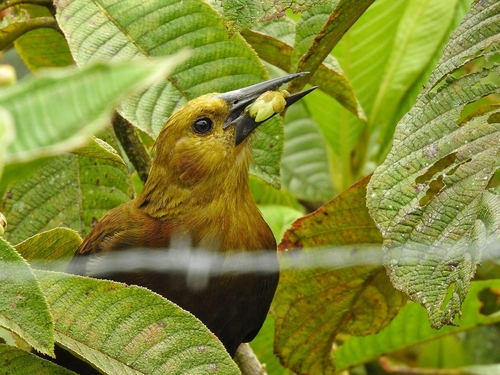
Russet-backed Oropendola (Psarocolius angustifrons) Russet-backed Oropendola
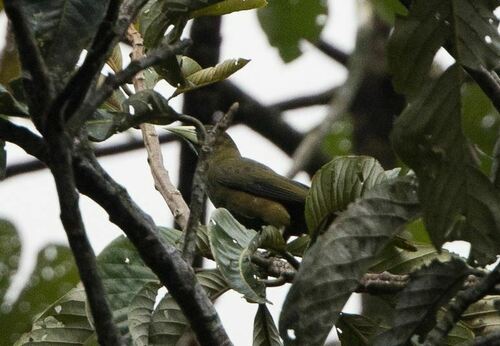
Dusky-green Oropendola (Psarocolius atrovirens) Dusky-green Oropendola

Media

Loading…

In short

The most reliable field mark between Russet-backed and Dusky-green Oropendolas is overall coloration: Russet-backed shows a distinctly rufous or russet-toned back and rump, often with a yellow forehead and olive-green head, while Dusky-green is much darker, with a uniform dark brownish- or blackish-green body and only a rufous-brown rump and crissum. Bill color is also key: Russet-backed typically has a blackish or dark bill (except in some subspecies), while Dusky-green has a pale greenish-white bill. In the field, Russet-backed often looks brighter and more contrasting, especially around the head and tail, whereas Dusky-green appears more somber and uniform. Both species overlap in range in the Andes of Peru and Bolivia, so careful attention to these marks is essential.

Identification tips

  1. Back and rump color: Russet-backed Oropendola shows a clear rufous or russet back and rump, which stands out against the darker wings and body. Dusky-green Oropendola's back is the same dark brownish- or blackish-green as its body, with only the rump and crissum being rufous-brown.
  2. Head and forehead: Many Russet-backed subspecies have a yellow forehead and an olive-green or olivaceous-brown head that contrasts with the back and wings. Dusky-green Oropendola lacks this contrast, with the head blending into the dark body; only a few yellow feathers may be present on the head, never a full yellow forehead.
  3. Bill color: Most Russet-backed Oropendolas have a blackish bill (except some subspecies with ivory or orange-yellow bills), while Dusky-green Oropendola consistently has a pale greenish-white bill. This is often visible even at a distance.
  4. Tail color: Russet-backed Oropendola has a mostly yellow tail with dusky brown or olive central feathers and brownish tips on the outermost feathers. Dusky-green's tail is less contrasting, lacking the bright yellow of Russet-backed.
  5. Overall brightness: Russet-backed appears brighter and more colorful, especially around the head and tail, while Dusky-green is uniformly dark and somber.
  6. Juvenile plumage: Juvenile Russet-backed Oropendolas have a yellower head and duller yellow tail, but still show the russet back and contrasting head. Dusky-green juveniles are not described in detail, but are expected to be dark and uniform like adults.
  7. Eye color: Both species can show brown or blue eyes, with blue possibly in older birds, so this is not a reliable separator.
  8. Size and structure: Both are large, long-tailed icterids with similar proportions. Only the largest male Russet-backed may appear bulkier, but this is subtle and unreliable in the field.
  9. Vocalizations: If you hear a song that starts low and rises to a crescendo, or distinctive liquid trills and clacking notes, it is likely Russet-backed. Dusky-green's song is not well described, so absence of these calls is not diagnostic.
  10. Habitat: In Peru and Bolivia, Dusky-green is more likely in higher elevation montane forests, while Russet-backed is more widespread and can be found in lowlands and foothills. However, both can overlap, so do not rely on habitat alone.
  11. Sexual dimorphism: Russet-backed males have long nape feathers forming a crest, but this is subtle and not always visible. Females of both species are similar to males in plumage, with size being the main difference.
  12. Subspecies variation: Be aware that some Russet-backed subspecies (e.g., P. a. salmoni, P. a. neglectus) show paler or more yellowish bills and more chestnut or rufescent tones, but all retain the rufous/russet back and contrasting head. Dusky-green never shows this combination.
  13. Group behavior: Both species are social and may be seen in mixed flocks, so do not use flocking as a separator.
  14. Pitfalls: In poor light, Dusky-green can appear almost black, while Russet-backed may look darker than it is. Always look for the contrasting back and head tones.
  15. Flight views: No distinctive wing or flight pattern marks are described for either species, so rely on body and tail coloration even in flight.

Size

Both species are similar in size, with males around 42–48 cm and females 33–38 cm in length. Dusky-green Oropendola has a reported average body mass of about 228.5 g, which is within the range for female Russet-backed but lighter than the largest male Russet-backed (which can reach up to 470 g). In practice, size difference is subtle and not a reliable field mark except possibly for the largest male Russet-backed, which may appear bulkier.

Plumage

No distinctive age-specific upperwing or flight pattern marks are described for either species, so focus is on body and head coloration. Adult Russet-backed Oropendolas (nominate and most subspecies) have an olivaceous-brown head, a russet or rufous back and rump, and a mostly brown body with a paler, often yellowish tail (except central feathers). Some subspecies show a yellow forehead and olive-green head, which contrasts with the back and wings. Juveniles have a yellower head and a duller yellow tail. In contrast, Dusky-green Oropendola of all ages is much darker overall, with a dark brownish- or blackish-green body, a rufous-brown rump and crissum, and a greenish-white bill. There may be a few yellow feathers on the head, but never the extensive yellow forehead or bright olive head of Russet-backed. The tail is less contrasting, and the overall impression is much more somber. Eye color may be brown or blue (possibly age-related) in Dusky-green, while Russet-backed typically has a dark brown iris, with some subspecies showing blue eyes.

Behaviour

Both species are social and often seen in groups, foraging, nesting, and roosting communally. No major behavioral differences are noted that are diagnostic in the field.

Habitat

Both species can be found in the Andes of Peru and Bolivia, but Dusky-green Oropendola is more restricted to the eastern slope of the Andes in subtropical or tropical moist montane forests and degraded former forests. Russet-backed Oropendola has a broader range, occurring in lowland and foothill forests across Bolivia, Brazil, Colombia, Ecuador, Peru, and Venezuela. In areas of overlap, habitat alone is not diagnostic, but Dusky-green is more likely at higher elevations and in montane settings.

Voice

Both species are noisy and social, but only Russet-backed Oropendola has detailed vocal descriptions: its song typically starts low and rises to a crescendo, with various calls described as liquid trills, slashing notes, and hollow clacks, varying by region and subspecies. Dusky-green Oropendola's vocalizations are not described in detail in the available notes, so voice is not a reliable separator unless Russet-backed's distinctive song is heard.

Submit a better description

Use the same sections as the comparison. Your text is published immediately.

The most reliable field mark between Russet-backed and Dusky-green Oropendolas is overall coloration: Russet-backed shows a distinctly rufous or russet-toned back and rump, often with a yellow forehead and olive-green head, while Dusky-green is much darker, with a uniform dark brownish- or blackish-green body and only a rufous-brown rump and crissum. Bill color is also key: Russet-backed typically has a blackish or dark bill (except in some subspecies), while Dusky-green has a pale greenish-white bill. In the field, Russet-backed often looks brighter and more contrasting, especially around the head and tail, whereas Dusky-green appears more somber and uniform. Both species overlap in range in the Andes of Peru and Bolivia, so careful attention to these marks is essential.

  1. Back and rump color: Russet-backed Oropendola shows a clear rufous or russet back and rump, which stands out against the darker wings and body. Dusky-green Oropendola's back is the same dark brownish- or blackish-green as its body, with only the rump and crissum being rufous-brown.
  2. Head and forehead: Many Russet-backed subspecies have a yellow forehead and an olive-green or olivaceous-brown head that contrasts with the back and wings. Dusky-green Oropendola lacks this contrast, with the head blending into the dark body; only a few yellow feathers may be present on the head, never a full yellow forehead.
  3. Bill color: Most Russet-backed Oropendolas have a blackish bill (except some subspecies with ivory or orange-yellow bills), while Dusky-green Oropendola consistently has a pale greenish-white bill. This is often visible even at a distance.
  4. Tail color: Russet-backed Oropendola has a mostly yellow tail with dusky brown or olive central feathers and brownish tips on the outermost feathers. Dusky-green's tail is less contrasting, lacking the bright yellow of Russet-backed.
  5. Overall brightness: Russet-backed appears brighter and more colorful, especially around the head and tail, while Dusky-green is uniformly dark and somber.
  6. Juvenile plumage: Juvenile Russet-backed Oropendolas have a yellower head and duller yellow tail, but still show the russet back and contrasting head. Dusky-green juveniles are not described in detail, but are expected to be dark and uniform like adults.
  7. Eye color: Both species can show brown or blue eyes, with blue possibly in older birds, so this is not a reliable separator.
  8. Size and structure: Both are large, long-tailed icterids with similar proportions. Only the largest male Russet-backed may appear bulkier, but this is subtle and unreliable in the field.
  9. Vocalizations: If you hear a song that starts low and rises to a crescendo, or distinctive liquid trills and clacking notes, it is likely Russet-backed. Dusky-green's song is not well described, so absence of these calls is not diagnostic.
  10. Habitat: In Peru and Bolivia, Dusky-green is more likely in higher elevation montane forests, while Russet-backed is more widespread and can be found in lowlands and foothills. However, both can overlap, so do not rely on habitat alone.
  11. Sexual dimorphism: Russet-backed males have long nape feathers forming a crest, but this is subtle and not always visible. Females of both species are similar to males in plumage, with size being the main difference.
  12. Subspecies variation: Be aware that some Russet-backed subspecies (e.g., P. a. salmoni, P. a. neglectus) show paler or more yellowish bills and more chestnut or rufescent tones, but all retain the rufous/russet back and contrasting head. Dusky-green never shows this combination.
  13. Group behavior: Both species are social and may be seen in mixed flocks, so do not use flocking as a separator.
  14. Pitfalls: In poor light, Dusky-green can appear almost black, while Russet-backed may look darker than it is. Always look for the contrasting back and head tones.
  15. Flight views: No distinctive wing or flight pattern marks are described for either species, so rely on body and tail coloration even in flight.

Both species are similar in size, with males around 42–48 cm and females 33–38 cm in length. Dusky-green Oropendola has a reported average body mass of about 228.5 g, which is within the range for female Russet-backed but lighter than the largest male Russet-backed (which can reach up to 470 g). In practice, size difference is subtle and not a reliable field mark except possibly for the largest male Russet-backed, which may appear bulkier.

No distinctive age-specific upperwing or flight pattern marks are described for either species, so focus is on body and head coloration. Adult Russet-backed Oropendolas (nominate and most subspecies) have an olivaceous-brown head, a russet or rufous back and rump, and a mostly brown body with a paler, often yellowish tail (except central feathers). Some subspecies show a yellow forehead and olive-green head, which contrasts with the back and wings. Juveniles have a yellower head and a duller yellow tail. In contrast, Dusky-green Oropendola of all ages is much darker overall, with a dark brownish- or blackish-green body, a rufous-brown rump and crissum, and a greenish-white bill. There may be a few yellow feathers on the head, but never the extensive yellow forehead or bright olive head of Russet-backed. The tail is less contrasting, and the overall impression is much more somber. Eye color may be brown or blue (possibly age-related) in Dusky-green, while Russet-backed typically has a dark brown iris, with some subspecies showing blue eyes.

Both species are social and often seen in groups, foraging, nesting, and roosting communally. No major behavioral differences are noted that are diagnostic in the field.

Both species can be found in the Andes of Peru and Bolivia, but Dusky-green Oropendola is more restricted to the eastern slope of the Andes in subtropical or tropical moist montane forests and degraded former forests. Russet-backed Oropendola has a broader range, occurring in lowland and foothill forests across Bolivia, Brazil, Colombia, Ecuador, Peru, and Venezuela. In areas of overlap, habitat alone is not diagnostic, but Dusky-green is more likely at higher elevations and in montane settings.

Both species are noisy and social, but only Russet-backed Oropendola has detailed vocal descriptions: its song typically starts low and rises to a crescendo, with various calls described as liquid trills, slashing notes, and hollow clacks, varying by region and subspecies. Dusky-green Oropendola's vocalizations are not described in detail in the available notes, so voice is not a reliable separator unless Russet-backed's distinctive song is heard.

Discard your changes?

You have unsaved edits. If you leave now, those changes will be lost.

Russet-backed Oropendola · Dusky-green Oropendola · My Tricky Birds