
Rufous-tailed Scrub Robin vs Rufous-tailed Robin
Cercotrichas galactotes versus Larvivora sibilans
Play a quiz with Rufous-tailed Scrub Robin and Rufous-tailed Robin
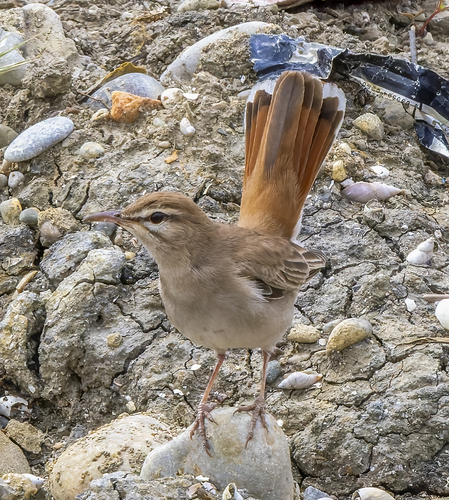 Rufous-tailed Scrub Robin
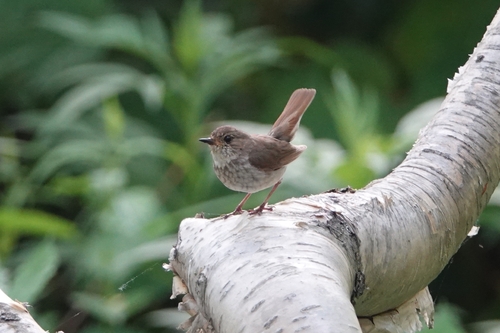 Rufous-tailed Robin
In short
The most reliable field mark to separate Rufous-tailed Scrub Robin from Rufous-tailed Robin is the strong, creamy-white supercilium (eyebrow) and dark eye-stripe of the Scrub Robin, contrasting with the Robin's less distinct facial pattern and bold throat markings. Scrub Robin is larger and leggier, with a longer, rounder tail that is often fanned and shows black and white patterning at the tip, while Rufous-tailed Robin is smaller, more compact, and plain above with a bright rufous tail but no strong tail pattern. Juveniles of both are paler, but Scrub Robin still shows the facial contrast and tail pattern. In flight or perched, focus on tail shape, facial markings, and overall structure for quick separation.
Identification tips
- Supercilium and Eye-stripe: Scrub Robin has a bold, creamy-white supercilium and a dark eye-stripe, creating a strong facial contrast. Rufous-tailed Robin has a less distinct facial pattern, with a buff cheek stripe and whitish eye-ring but no dark eye-stripe.
- Tail Pattern: Scrub Robin's tail is rufous-chestnut with broad black bands and white tips, especially obvious when fanned or flicked; Rufous-tailed Robin's tail is bright rufous but lacks black bands or white tips.
- Tail Shape and Behavior: Scrub Robin's tail is longer, rounder, and often fanned or bobbed conspicuously. Rufous-tailed Robin's tail is shorter, straighter, and only occasionally flicked.
- Size and Structure: Scrub Robin is larger, longer-legged, and more upright; Rufous-tailed Robin is smaller, more compact, and sits lower to the ground.
- Upperparts Color: Scrub Robin is rich brownish-chestnut above, with a warmer, paler back in western birds; Rufous-tailed Robin is plain greyish-brown above without chestnut tones.
- Underparts: Scrub Robin is buff-white below, paler on chin and belly; Rufous-tailed Robin is grey to white below with heavy circular pale spots on the throat and breast (especially in juveniles and fresh adults).
- Wing Pattern: Scrub Robin's wings have dark brown feathers with buff and chestnut fringes and white-tipped secondaries; Rufous-tailed Robin's wings are plain and unmarked.
- Juvenile Plumage: Both are paler than adults, but Scrub Robin juveniles retain the supercilium and tail pattern, while Rufous-tailed Robin juveniles are ochre-tinged with dark-edged upperparts and bold throat spots.
- Leg Color: Scrub Robin has pale brown legs and feet; Rufous-tailed Robin's legs are pinkish-grey.
- Bill: Both have brownish bills, but Scrub Robin's lower mandible has a greyish base, while Rufous-tailed Robin's lower mandible is slightly upturned at the tip.
- Behavior: Scrub Robin is more likely to be seen in the open, perching high or hopping on the ground; Rufous-tailed Robin is secretive, often hidden in dense cover.
- Habitat: Scrub Robin favors dry, open, bushy areas; Rufous-tailed Robin is found in damp, dense woodlands or forest edge.
- Song: Scrub Robin's song is lark-like and sad, often from an exposed perch; Rufous-tailed Robin's song is a loud, cascading trill, more nightingale-like, and can be heard at night.
- Season and Range: Scrub Robin is found around the Mediterranean and into western Asia in summer, wintering in Africa and India; Rufous-tailed Robin breeds in northeast Asia and winters in Southeast Asia. Both are rare vagrants to Europe, but context may help.
- Pitfalls: In poor light or brief views, the rufous tail of both can mislead; always check for tail pattern (black and white in Scrub Robin), facial contrast, and overall size/structure before concluding.
Size
Rufous-tailed Scrub Robin is distinctly larger (body mass ~22.7g) and longer (about 15 cm/6 in), with longer legs and a proportionally larger, rounder tail. Rufous-tailed Robin is smaller (about 14 cm/5.5 in), more compact, and closer in size to a European Robin. The Scrub Robin's size and long-legged look are often obvious in the field, especially when both are seen side by side or compared to familiar species.
Plumage
- Juveniles: Both species' juveniles resemble adults but are paler; Scrub Robin juveniles are sandy-brown with a still-prominent supercilium and tail pattern, while Rufous-tailed Robin juveniles are ochre-tinged with dark-edged upperparts and retain the bold throat spots.
- Adults: Scrub Robin is rich brownish-chestnut above, with a rufous rump and uppertail, a strong creamy-white supercilium, and a dark eye-stripe. The tail is bright rufous-chestnut with black bands and white tips, especially visible when fanned. Underparts are buff-white, paler on chin and belly. Rufous-tailed Robin is plain greyish-brown above, with a bright rufous rump and tail, but lacks the Scrub Robin's tail pattern; its underparts are grey to white with heavy circular pale spots on the throat and breast, and a pronounced buff cheek stripe and whitish eye-ring. The Scrub Robin's wing feathers are dark brown with buff and chestnut fringes and white-tipped secondaries; Rufous-tailed Robin's wings are plain, lacking strong pattern.
Behaviour
Rufous-tailed Scrub Robin is often seen in open areas, flitting between bushes, perching in exposed spots, and frequently fanning and bobbing its tail. It also hops on the ground and may droop and flick its wings. Rufous-tailed Robin is much more skulking and elusive, staying hidden among dense branches, remaining still for long periods, and only occasionally flicking its tail. Scrub Robin's behavior is more conspicuous and upright, while Rufous-tailed Robin is secretive and terrestrial.
Habitat
Rufous-tailed Scrub Robin prefers dry, open country with scattered bushes and shrubs, often in Mediterranean or semi-arid landscapes. It is found in open positions and sometimes on wires or posts. Rufous-tailed Robin breeds in damp coniferous or mixed woodlands with dense undergrowth, often in taiga or broad-leafed forests, and winters in forested or scrubby areas in Southeast Asia. Habitat context is a strong clue: Scrub Robin is rarely in dense woodland, while Rufous-tailed Robin avoids open, arid habitats.
Voice
Rufous-tailed Scrub Robin sings a lark-like, sometimes disjointed series of notes, often described as clear, loud, and with a sad tone, delivered from prominent perches. Rufous-tailed Robin's song is a series of loud, cascading trills starting high and ending lower, reminiscent of a horse's neigh, and is given both day and night in breeding season. Calls differ: Scrub Robin is less described, while Rufous-tailed Robin gives whistles and a jangling 'chok-chok' when alarmed or with young. Song structure and delivery perch can help, but are less reliable than plumage and structure.
Rufous-tailed Scrub Robin · Rufous-tailed Robin · My Tricky Birds