

Motmot

Rufous Cacholote vs Yellow-chinned Spinetail

Pseudoseisura unirufa versus Certhiaxis cinnamomeus

Play a quiz with Rufous Cacholote and Yellow-chinned Spinetail
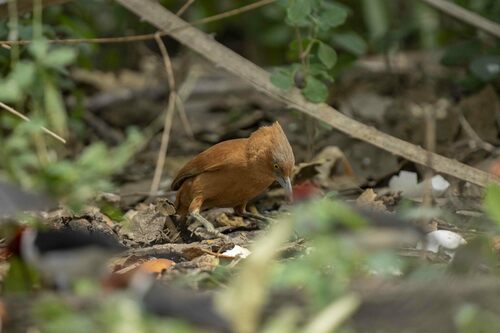
Rufous Cacholote (Pseudoseisura unirufa) Rufous Cacholote
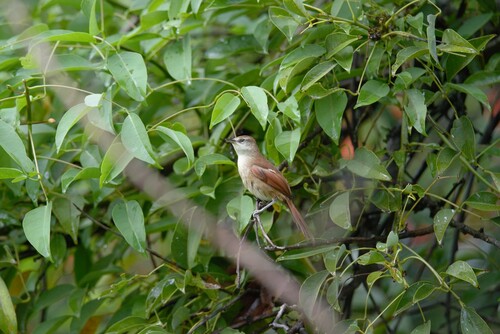
Yellow-chinned Spinetail (Certhiaxis cinnamomeus) Yellow-chinned Spinetail

Media

Loading…

In short

The most reliable field mark to separate Rufous Cacholote from Yellow-chinned Spinetail is overall structure and size: the cacholote is much larger, bulkier, and sports a prominent crest, while the spinetail is a slender, long-tailed bird with no crest. In plumage, the cacholote is a rich, mostly uniform rufous with a variable rufous-to-grayish crest and an orange-tinged throat, while the spinetail is chestnut above, whitish below, and always shows a pale yellow throat. Juvenile cacholotes have a shorter crest and less uniform color but remain bulkier than any spinetail. In the field, habitat and behavior also help: cacholotes are often seen in drier open woodlands or gallery forests, while spinetails are tied to marshes and riverside vegetation, usually low in the open. Calls differ, but structure and throat color are the fastest checks.

Identification tips

  1. Size and bulk: Rufous Cacholote is much larger and heavier than Yellow-chinned Spinetail. If the bird looks chunky or thrush-sized, it's a cacholote; if it's slim and small, it's a spinetail. This holds for all ages.
  2. Crest: Cacholote always has a prominent crest (even if shorter in juveniles), which can be rufous or grayish. Spinetail never has a crest—its head is smoothly rounded.
  3. Throat color: Spinetail always shows a pale yellow throat patch, contrasting with whitish underparts. Cacholote has an orange-tinged throat but not a discrete yellow patch; its underparts are paler rufous, not white.
  4. Overall plumage: Cacholote is uniformly bright reddish-rufous above and below, with only slight paleness on the underparts. Spinetail is chestnut above and whitish below, with a clear contrast between upper- and underparts.
  5. Bill structure: Cacholote has a thick, blue-gray to gray bill with a paler mandible; spinetail's bill is slender and less conspicuous in color.
  6. Tail: Spinetail has a long, narrow tail often flicked or cocked; cacholote's tail is broad and less expressive.
  7. Iris color: Cacholote has yellow to buff-yellow eyes; this is subtle but can help at close range. Spinetail's eye color is not distinctive.
  8. Juvenile marks: Young cacholotes have a shorter crest and less uniform color but remain rufous and bulky, never showing the spinetail's yellow throat or slim build.
  9. Flight feathers: Cacholote has fuscous tips to flight feathers, but this is rarely visible in the field; spinetail lacks any such pattern.
  10. Perched posture: Cacholote often sits upright and prominent, sometimes in pairs; spinetail is more horizontal, creeping through low vegetation.
  11. Habitat: Cacholote prefers open woodland or gallery forest, often away from water. Spinetail is almost always in marshes, reeds, or mangroves, close to water.
  12. Nest: Cacholote builds a large stick nest high in trees; spinetail's nest is a spherical stick structure low in marsh vegetation, with a vertical entrance tunnel.
  13. Voice: Spinetail gives a shrill rattling call; cacholote's call is not described here, so use structure and plumage first.
  14. Geographic overlap: Both species can occur in Brazil, Paraguay, and Bolivia, but habitat choice is a strong clue.
  15. Sexes: Both species are sexually monomorphic—males and females look alike, so do not rely on sex for ID.

Size

Rufous Cacholote is much larger and heavier (49 g, 20–21 cm) than Yellow-chinned Spinetail (15 cm, 15 g). The cacholote is a robust, big-headed bird with a thick bill and a prominent crest, giving it a chunky, upright look. The spinetail is slender, with a proportionally long tail and slim bill, lacking any crest. Even juvenile cacholotes are noticeably bulkier than adult spinetails.

Plumage

No age-specific upperwing or flight pattern is mentioned for either species, so separation relies on overall coloration and head/throat details. Adult Rufous Cacholote is bright reddish-rufous above and below, paler on the underparts, with a variable crest (rufous to grayish) and an orange-tinged throat. Juveniles have a shorter crest and less even color but are still mostly rufous. Yellow-chinned Spinetail is chestnut brown above, whitish below, with a distinctive pale yellow throat patch that is always present. Its head is chestnut, never crested, and the underparts are much paler than the upperparts. The cacholote's iris is yellow to buff-yellow, bill blue-gray to gray, and legs olive to greenish gray; the spinetail's finer details are less diagnostic in the field. The cacholote's flight feathers have fuscous tips, but this is subtle; the spinetail lacks any such pattern.

Behaviour

Rufous Cacholote is typically seen perched upright, often in pairs, sometimes in the open in trees or on prominent perches, and is less likely to be low in dense marsh vegetation. It may be seen carrying sticks for its large, stick-built nest placed several meters above ground. Yellow-chinned Spinetail is much more active and restless, usually foraging low in reeds, marshes, or mangroves, often in the open but rarely high in trees. It is confiding and noisy, often flicking its long tail. Both species are conspicuous, but the cacholote's behavior is more reminiscent of a jay or large thrush, while the spinetail is more like a small, hyperactive wren.

Habitat

Rufous Cacholote is found in open woodlands, gallery forests, and drier habitats in Bolivia, Brazil, and Paraguay. It is not tied to water and avoids marshes. Yellow-chinned Spinetail is strongly associated with marshes, river edges, and mangrove swamps across much of South America, including Brazil, Argentina, Uruguay, and Trinidad. If the bird is in dense marsh vegetation or mangroves, especially low down, it is almost certainly a spinetail. If it is in drier woodland or perched high in a tree, especially away from water, cacholote is far more likely.

Voice

Both species are noisy, but their calls differ: the spinetail gives a shrill rattling call, while the cacholote's voice is not described in detail here. In the field, structure and plumage are more reliable than voice for separating these two, unless the call is well known.

Submit a better description

Use the same sections as the comparison. Your text is published immediately.

The most reliable field mark to separate Rufous Cacholote from Yellow-chinned Spinetail is overall structure and size: the cacholote is much larger, bulkier, and sports a prominent crest, while the spinetail is a slender, long-tailed bird with no crest. In plumage, the cacholote is a rich, mostly uniform rufous with a variable rufous-to-grayish crest and an orange-tinged throat, while the spinetail is chestnut above, whitish below, and always shows a pale yellow throat. Juvenile cacholotes have a shorter crest and less uniform color but remain bulkier than any spinetail. In the field, habitat and behavior also help: cacholotes are often seen in drier open woodlands or gallery forests, while spinetails are tied to marshes and riverside vegetation, usually low in the open. Calls differ, but structure and throat color are the fastest checks.

  1. Size and bulk: Rufous Cacholote is much larger and heavier than Yellow-chinned Spinetail. If the bird looks chunky or thrush-sized, it's a cacholote; if it's slim and small, it's a spinetail. This holds for all ages.
  2. Crest: Cacholote always has a prominent crest (even if shorter in juveniles), which can be rufous or grayish. Spinetail never has a crest—its head is smoothly rounded.
  3. Throat color: Spinetail always shows a pale yellow throat patch, contrasting with whitish underparts. Cacholote has an orange-tinged throat but not a discrete yellow patch; its underparts are paler rufous, not white.
  4. Overall plumage: Cacholote is uniformly bright reddish-rufous above and below, with only slight paleness on the underparts. Spinetail is chestnut above and whitish below, with a clear contrast between upper- and underparts.
  5. Bill structure: Cacholote has a thick, blue-gray to gray bill with a paler mandible; spinetail's bill is slender and less conspicuous in color.
  6. Tail: Spinetail has a long, narrow tail often flicked or cocked; cacholote's tail is broad and less expressive.
  7. Iris color: Cacholote has yellow to buff-yellow eyes; this is subtle but can help at close range. Spinetail's eye color is not distinctive.
  8. Juvenile marks: Young cacholotes have a shorter crest and less uniform color but remain rufous and bulky, never showing the spinetail's yellow throat or slim build.
  9. Flight feathers: Cacholote has fuscous tips to flight feathers, but this is rarely visible in the field; spinetail lacks any such pattern.
  10. Perched posture: Cacholote often sits upright and prominent, sometimes in pairs; spinetail is more horizontal, creeping through low vegetation.
  11. Habitat: Cacholote prefers open woodland or gallery forest, often away from water. Spinetail is almost always in marshes, reeds, or mangroves, close to water.
  12. Nest: Cacholote builds a large stick nest high in trees; spinetail's nest is a spherical stick structure low in marsh vegetation, with a vertical entrance tunnel.
  13. Voice: Spinetail gives a shrill rattling call; cacholote's call is not described here, so use structure and plumage first.
  14. Geographic overlap: Both species can occur in Brazil, Paraguay, and Bolivia, but habitat choice is a strong clue.
  15. Sexes: Both species are sexually monomorphic—males and females look alike, so do not rely on sex for ID.

Rufous Cacholote is much larger and heavier (49 g, 20–21 cm) than Yellow-chinned Spinetail (15 cm, 15 g). The cacholote is a robust, big-headed bird with a thick bill and a prominent crest, giving it a chunky, upright look. The spinetail is slender, with a proportionally long tail and slim bill, lacking any crest. Even juvenile cacholotes are noticeably bulkier than adult spinetails.

No age-specific upperwing or flight pattern is mentioned for either species, so separation relies on overall coloration and head/throat details. Adult Rufous Cacholote is bright reddish-rufous above and below, paler on the underparts, with a variable crest (rufous to grayish) and an orange-tinged throat. Juveniles have a shorter crest and less even color but are still mostly rufous. Yellow-chinned Spinetail is chestnut brown above, whitish below, with a distinctive pale yellow throat patch that is always present. Its head is chestnut, never crested, and the underparts are much paler than the upperparts. The cacholote's iris is yellow to buff-yellow, bill blue-gray to gray, and legs olive to greenish gray; the spinetail's finer details are less diagnostic in the field. The cacholote's flight feathers have fuscous tips, but this is subtle; the spinetail lacks any such pattern.

Rufous Cacholote is typically seen perched upright, often in pairs, sometimes in the open in trees or on prominent perches, and is less likely to be low in dense marsh vegetation. It may be seen carrying sticks for its large, stick-built nest placed several meters above ground. Yellow-chinned Spinetail is much more active and restless, usually foraging low in reeds, marshes, or mangroves, often in the open but rarely high in trees. It is confiding and noisy, often flicking its long tail. Both species are conspicuous, but the cacholote's behavior is more reminiscent of a jay or large thrush, while the spinetail is more like a small, hyperactive wren.

Rufous Cacholote is found in open woodlands, gallery forests, and drier habitats in Bolivia, Brazil, and Paraguay. It is not tied to water and avoids marshes. Yellow-chinned Spinetail is strongly associated with marshes, river edges, and mangrove swamps across much of South America, including Brazil, Argentina, Uruguay, and Trinidad. If the bird is in dense marsh vegetation or mangroves, especially low down, it is almost certainly a spinetail. If it is in drier woodland or perched high in a tree, especially away from water, cacholote is far more likely.

Both species are noisy, but their calls differ: the spinetail gives a shrill rattling call, while the cacholote's voice is not described in detail here. In the field, structure and plumage are more reliable than voice for separating these two, unless the call is well known.

Discard your changes?

You have unsaved edits. If you leave now, those changes will be lost.

Rufous Cacholote · Yellow-chinned Spinetail · My Tricky Birds