
Rufous-bellied Eagle vs Booted Eagle
Lophotriorchis kienerii versus Hieraaetus pennatus
Play a quiz with Rufous-bellied Eagle and Booted Eagle
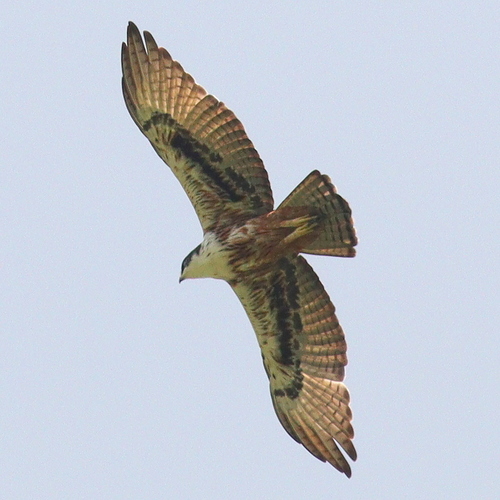 Rufous-bellied Eagle
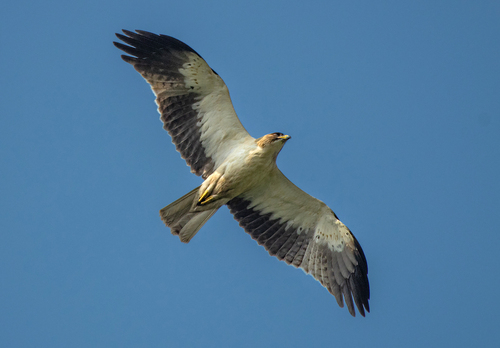 Booted Eagle
In short
The most reliable separation between Rufous-bellied Eagle and Booted Eagle—especially for immatures—is the underpart and underwing pattern in flight. Juvenile Rufous-bellied Eagles show strikingly white underparts with dark head and underwing edges, while Booted Eagles (especially pale morphs) have much less contrast and lack the black hooded look. Adults are also distinctive: Rufous-bellied Eagles have a bold black hood, chestnut underparts, and a white throat, unlike any Booted Eagle morph. Structure and behavior offer additional clues: Rufous-bellied perches upright with long wings nearly reaching the tail, and is a forest specialist, while Booted is more open-country and variable in color. Size is similar, but Booted Eagle is slightly heavier on average.
Identification tips
- Juvenile underwing pattern: In flight, juvenile Rufous-bellied Eagles show very white underparts with a dark head mask, dark markings on the sides, and a black edge to the underwing coverts. Booted Eagle juveniles (especially pale morphs) lack this strong contrast and do not have a black hood or mask.
- Adult head pattern: Adult Rufous-bellied Eagles have a bold black hood and short crest, with a white throat and breast. Booted Eagles never show a black hood or crest, regardless of morph.
- Underpart color: Rufous-bellied Eagle adults have rich chestnut underparts and wing coverts, sharply set off from the white throat. Booted Eagles (pale morph) are much paler below, and dark morphs are uniformly brownish, never chestnut.
- Perching posture: Rufous-bellied Eagle perches very upright, with wings almost reaching the tail. Booted Eagle perches less upright and appears more compact.
- Tarsi: Rufous-bellied Eagle has fully feathered tarsi; Booted Eagle also has feathered tarsi, but this is not a strong separator in the field.
- Tail pattern: Both species have barred tails, but Rufous-bellied's is darker and more distinctly barred, especially in juveniles.
- Wing shape in flight: Both are broad-winged, but Rufous-bellied may look more falcon-like due to its contrasting pattern and longer wings relative to tail.
- Color morphs: Booted Eagle comes in pale and dark morphs, but neither matches the rufous and black contrast of adult Rufous-bellied. Dark morph Booted can be confused with other raptors but not with Rufous-bellied's unique pattern.
- Habitat: Rufous-bellied is almost always in closed forest; Booted is more likely in open or edge habitats.
- Flight behavior: Rufous-bellied soars high over forest, often diving steeply; Booted Eagle flies lower and may be seen hunting over open ground.
- Vocalization: If heard, Rufous-bellied gives high-pitched 'fwick' notes; Booted Eagle gives a shrill 'kli-kli-kli'.
- Sex differences: Both species are sexually similar in plumage; female Rufous-bellied may have slightly more black on the face, but this is subtle.
- Size: Booted Eagle is slightly heavier, but this is not obvious in the field.
- Confusion risk: Juvenile Rufous-bellied Eagle can be confused with Booted Eagle, but the bold white underparts and dark head/underwing edges are diagnostic for Rufous-bellied.
- Season/context: In tropical Asia, Booted Eagle is often a migrant or winter visitor, while Rufous-bellied is resident in forested areas. Consider season and habitat when identifying.
Size
Both species are small eagles, but Booted Eagle is slightly heavier, with females averaging 840–1,025 g and males 510–770 g [wikidata]. No direct mass data is available for Rufous-bellied Eagle, but it is described as relatively small for an eagle. In the field, size alone is not a reliable separator; focus on plumage and structure instead.
Plumage
-
Juveniles/immatures: Rufous-bellied Eagle juveniles are very white below, with dark markings on the sides, a dark head mask, and a dark edge to the underwing coverts. The underwing lining is dark, with black greater coverts and thinly barred flight feathers edged in black. The tail is dark and barred. Booted Eagle juveniles (especially pale morphs) are much less contrasting, with pale underparts and less defined dark markings; dark morph Booted Eagles are browner overall and lack the black hood and white throat.
-
Adults: Rufous-bellied Eagle adults have a striking black hood and short crest, chestnut underparts and wing coverts, white throat and breast, and fully feathered tarsi. Booted Eagles come in pale and dark morphs: pale morphs are light grey with darker head and flight feathers, while dark morphs are mid-brown with dark grey flight feathers. Neither morph shows the bold black hood or chestnut belly of Rufous-bellied. Sexes are similar in both species, though female Rufous-bellied Eagles may have slightly more black on the face.
Behaviour
Rufous-bellied Eagles are typically seen soaring high over forest canopies, often diving to catch prey in the canopy or on the forest floor. They perch very upright, with wings nearly reaching the tail. Booted Eagles are usually seen flying at lower heights, often in pairs or alone, and are more likely to be found in open or edge habitats. Booted Eagles also hunt on the wing, stooping quickly with folded wings and extended feet. Both species can be seen performing display flights, but Rufous-bellied's display includes stooping and wing-quivering.
Habitat
Rufous-bellied Eagle is a forest specialist, found in forested regions of tropical Asia. It is rarely seen away from dense or mature woodland. Booted Eagle, by contrast, has a much wider habitat tolerance, breeding in the Palearctic and southern Asia, wintering in Africa and Asia, and often found in open country, woodland edges, and even semi-arid regions. In areas of overlap, Rufous-bellied is much more tied to closed forest.
Voice
Rufous-bellied Eagle gives a series of high-pitched 'fwick, fwick...' notes followed by a thin 'sweek!'. Booted Eagle's call is a shrill 'kli-kli-kli'. Vocalizations are not usually the first clue in field separation, but if heard well, the difference in tone and pattern is notable.