

Ruddy Turnstone vs Sanderling
Arenaria interpres versus Calidris alba
Play a quiz with Ruddy Turnstone and Sanderling
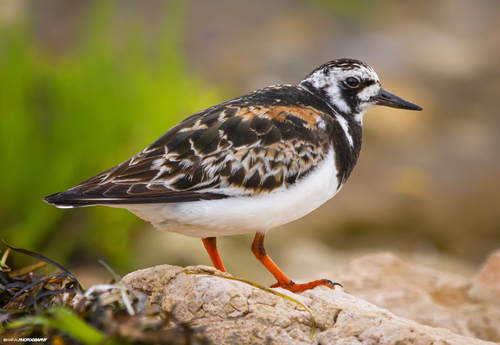 Ruddy Turnstone
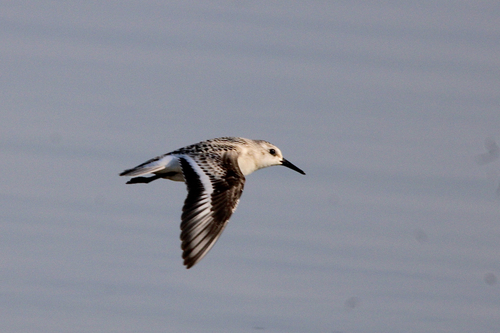 Sanderling
In short
The most reliable field mark between Ruddy Turnstone and Sanderling is the Turnstone's striking harlequin pattern of black, white, and reddish tones (especially in breeding plumage), along with its bright orange legs and short, wedge-shaped, slightly upturned bill. Sanderlings, by contrast, are much plainer in all plumages, with black legs and a straight, black bill, and lack the bold facial and breast patterns of Turnstones. In flight, both show a strong white wingbar, but Turnstone also flashes a white lower back and rump, while Sanderling is more uniformly pale below. Juvenile Turnstones have a scaly upperpart pattern, while juvenile Sanderlings are cleaner and paler. Sanderlings are most often seen running at the water's edge on sandy beaches, while Turnstones prefer rocky or mixed shorelines and are bulkier and more deliberate in movement.
Identification tips
- Leg color: Ruddy Turnstone always has bright orange legs, visible at any age or season. Sanderling's legs are black.
- Bill shape: Turnstone's bill is short, thick, slightly upturned, and wedge-shaped; Sanderling's is straight, thin, and black.
- Head and breast pattern: Adult Turnstones (especially in breeding plumage) show a bold black-and-white face and throat with a black breast band; Sanderlings are plain-faced and lack any breast band in all plumages.
- Upperparts: Turnstone has mottled or scaly upperparts in juveniles and a harlequin mix of reddish, black, and white in breeding adults. Sanderling is pale gray above in winter and mottled rufous/gray in breeding, but never as patterned as Turnstone.
- Flight pattern: Both show a white wingbar, but Turnstone also flashes a white lower back, rump, and tail with dark bands, while Sanderling is more uniformly pale below and lacks the bold tail pattern.
- Juvenile contrast: Juvenile Turnstones have a scaly look to the upperparts; juvenile Sanderlings are cleaner and paler, with less contrast.
- Size and shape: Turnstone is bulkier, with a shorter neck and legs, and a more compact body. Sanderling is smaller, slimmer, and longer-legged in appearance.
- Foraging behavior: Turnstones flip stones, seaweed, and debris, often seen manipulating objects; Sanderlings run rapidly along the surf, rarely manipulating objects.
- Habitat: Turnstone prefers rocky or mixed shores; Sanderling is almost always on open sandy beaches.
- Group size: Sanderlings are highly gregarious in winter, forming large flocks; Turnstones are more often solitary or in small groups.
- Posture: Turnstone often adopts a hunched, dominant stance when foraging; Sanderling stands more upright and moves quickly.
- Vocalization: If heard, Turnstone gives a rattling or chattering call; Sanderling's calls are not described here.
- Seasonal change: Turnstone's plumage changes dramatically between seasons, but always keeps some bold patterning; Sanderling is always plain-faced and pale below.
- Bill length: Turnstone's bill is shorter and stubbier than Sanderling's, which is relatively longer for its body size.
- Facial pattern: Only Turnstone shows a strong facial mask or pattern; Sanderling's face is always plain.
Size
Ruddy Turnstone is slightly larger and stockier, measuring 22–24 cm in length with a 50–57 cm wingspan and weighing 85–150 g [wikipedia]. Sanderling is smaller and lighter, similar in size to a Dunlin, with a more delicate build. Turnstone's short, thickset legs and body give it a compact look, while Sanderling appears daintier and more streamlined.
Plumage
- Juvenile/first-winter: Ruddy Turnstone juveniles show pale brown heads and pale-fringed upperpart feathers, giving a distinctly scaly or mottled look. Sanderling juveniles are much paler overall, lacking strong head or breast markings, and appear cleaner with less contrast on the upperparts.
- Adult non-breeding: Turnstone is duller but still shows a dark head with little white and dark grey-brown upperparts with black mottling. Sanderling in non-breeding plumage is very pale gray above and white below, with no strong head or breast pattern.
- Adult breeding: Turnstone is unmistakable with its bold black breast, white face with black mask, and rich reddish-brown upperparts. Sanderling in breeding plumage is mottled rufous and gray above but never shows the Turnstone's harlequin pattern or facial mask.
- In flight: Both species show a strong white wingbar, but Turnstone also has a white patch at the wing base, a white lower back and rump, and a white tail with dark bands. Sanderling's flight is more uniformly pale below, lacking the Turnstone's bold upper tail and back pattern.
Behaviour
Ruddy Turnstone is methodical and often seen flipping stones, seaweed, or debris with its bill, using a variety of foraging techniques including routing, flicking, and probing. It moves with a purposeful, slightly hunched gait and is less likely to run quickly. Sanderling is highly active and gregarious, typically seen in flocks running rapidly along the surf line with a 'bicycling' leg motion, frequently stopping to pick prey from the sand. Sanderling rarely manipulates objects or debris as Turnstone does.
Habitat
Ruddy Turnstone prefers rocky or mixed shorelines, jetties, and areas with seaweed or debris where it can flip objects to find food. It is less commonly found on open sandy beaches. Sanderling is strongly associated with sandy beaches and the open surf zone, rarely venturing onto rocks or into vegetated areas. During migration and winter, Sanderling forms large flocks on open sand, while Turnstone is more often seen singly or in small groups on rocks or mixed substrates.
Voice
Ruddy Turnstone gives a staccato, rattling call and a chattering alarm-call, especially in the breeding season. Sanderling's vocalizations are not described in the provided notes, so are not diagnostic here.