
Ruddy Turnstone vs Red Knot
Arenaria interpres versus Calidris canutus
Play a quiz with Ruddy Turnstone and Red Knot
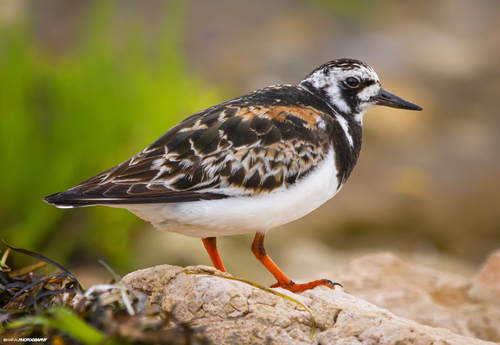 Ruddy Turnstone
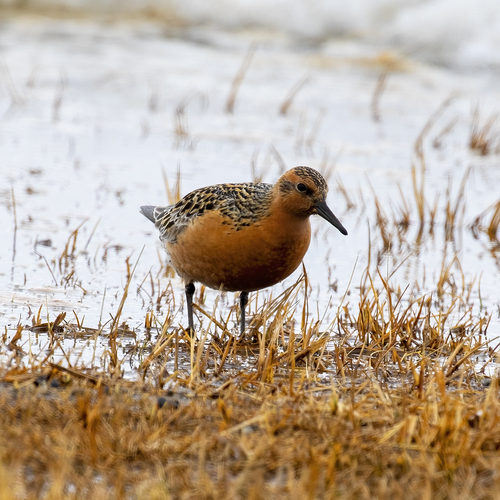 Red Knot
In short
The most reliable field mark to separate Ruddy Turnstone from Red Knot is the bold, contrasting upperwing and tail pattern in flight: adult and juvenile turnstones show a striking white wingbar, white patch at the wing base, and a white lower back, rump, and tail with dark bands, while red knots in all ages show a white wingbar but have a grey rump and tail without the turnstone's dramatic contrast. On the ground, turnstones are stockier with bright orange legs and a short, wedge-shaped, slightly upturned bill, while knots are sleeker, with short dark legs and a straight, medium-thin dark bill. Juvenile knots have a scaly look to the upperparts, but so do juvenile turnstones, so structure and wing pattern are more reliable. In breeding plumage, turnstones are harlequin-patterned with black, white, and reddish tones, while knots are mostly cinnamon below and mottled grey above. In winter, knots are pale grey and white, turnstones are darker and more mottled. Both species can occur together on coastal mudflats, but turnstones are more likely to be seen flipping stones and debris.
Identification tips
- **In flight (all ages), look for the bold white wingbar, white wing base patch, and white lower back, rump, and tail with dark bands on Ruddy Turnstone. Red Knot lacks these, showing a white wingbar but a grey rump and tail.
- On the ground, check leg color: Turnstone has bright orange legs (all ages), while Knot's legs are short and dark greenish or black.
- Bill shape: Turnstone's bill is short, wedge-shaped, slightly upturned, and dark; Knot's bill is straight, medium-thin, and about as long as the head.
- Body shape/jizz: Turnstone is compact, stocky, and upright; Knot is longer-bodied, sleeker, and often appears low-slung when feeding.
- Juvenile/first-year birds: Both can look scaly above, but structure and wing pattern in flight are more reliable than upperpart pattern.
- Breeding plumage: Turnstone is harlequin-patterned with reddish, black, and white, including a black breast band and white head with black markings; Knot is cinnamon below and mottled grey above, with a less contrasting face.
- Non-breeding (winter) plumage: Turnstone is darker and more mottled, with a dark head and less white; Knot is pale grey and white, with little contrast and no strong facial pattern.
- Tail pattern in flight: Turnstone shows a white tail with dark bands; Knot's tail is grey with no bold pattern.
- Feeding behavior: Turnstone often flips stones, seaweed, or debris; Knot probes and paces, rarely flipping objects.
- Group size: Knots often feed in tight flocks; turnstones are more likely to be seen singly or in small groups.
- Habitat: Turnstone is more likely on rocky shores or among debris; Knot prefers open mudflats and sandy beaches.
- Vocalizations: Turnstone gives rattling and chattering calls, especially when disturbed; Knot is mostly silent except for soft 'knutt' or 'knuup-knuup' in flight flocks.
- Sex differences: Both species show subtle sex differences in breeding plumage, but these are not reliable for field separation.
- Size: Knot is slightly larger and heavier, but this is subtle and best used as a supporting mark.
- **When in doubt, prioritize flight views and leg color over upperpart pattern, especially in juveniles and non-breeding birds."
Size
Red Knot is slightly larger and heavier than Ruddy Turnstone, with knots averaging around 137 g [wikidata] and measuring 23–26 cm in length with a 47–53 cm wingspan. Turnstones are 22–24 cm long with a 50–57 cm wingspan, but are stockier and more compact. The difference is subtle in the field, but knots often appear longer-bodied and more streamlined, while turnstones look chunkier with a shorter neck and tail. Knots have a smaller head and a more 'low-slung' stance due to their short, dark greenish legs, while turnstones stand more upright on bright orange legs.
Plumage
- Juvenile/First-year: Both species have scaly upperparts, but juvenile turnstones show pale fringes on the upperpart feathers and a pale brown head, while juvenile knots have brown coverts with submarginal lines. In flight, juvenile turnstones already show the bold white wingbar, wing base patch, and white rump/tail pattern, which is absent in knots.
- Adult breeding: Turnstone is harlequin-patterned: reddish-brown upperparts with black markings, white head with black streaks and facial pattern, black breast band, and white underparts. Knot is cinnamon below, mottled grey above, with a less contrasting face and a lighter rear belly; females are slightly paler.
- Adult non-breeding (winter): Turnstone is duller, with dark grey-brown upperparts, black mottling, and a dark head with little white. Knot is pale grey above and white below, with little contrast and no strong facial pattern. Both sexes look similar in winter for both species.
- Flight: Turnstone (all ages) has a white wingbar, white patch at wing base, white lower back, rump, and tail with dark bands. Knot (all ages) has a white wingbar but a grey rump and tail, lacking the turnstone's bold contrast.
Behaviour
Ruddy Turnstones are often seen actively flipping stones, seaweed, or debris with their bills, using a variety of foraging techniques including flicking, bulldozing, probing, and hammering to access prey. They are aggressive and territorial, especially adults, and may chase others with a hunched, tail-lowered posture. Red Knots feed by probing and pacing methodically, often in flocks, using their bills to find prey in mud or sand. Knots rarely flip objects and are less aggressive in foraging behavior. Turnstones are more likely to be seen alone or in small groups, while knots often feed in larger, tight-knit flocks.
Habitat
Both species frequent coastal mudflats, estuaries, and shorelines during migration and winter. Ruddy Turnstone is more likely to be found on rocky coasts, jetties, and areas with abundant debris or seaweed, where it can flip objects to find prey. Red Knot prefers open mudflats and sandy shores, especially during migration, and is less likely to forage among rocks or debris. Both can overlap in habitat, but turnstones are more versatile in substrate choice.
Voice
Turnstone gives a staccato, rattling call and a chattering alarm, especially in the breeding season. Red Knot is mostly silent when feeding singly, but in flight flocks gives a low monosyllabic 'knutt' or a disyllabic 'knuup-knuup.' Neither species is highly vocal outside the breeding season, but turnstone's calls are more likely to be heard on the ground.