

Ruddy Quail-Dove vs Key West Quail-Dove
Geotrygon montana versus Geotrygon chrysia
Play a quiz with Ruddy Quail-Dove and Key West Quail-Dove
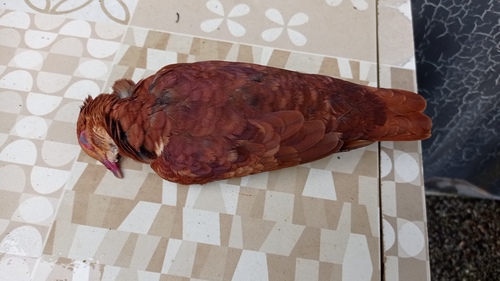 Ruddy Quail-Dove
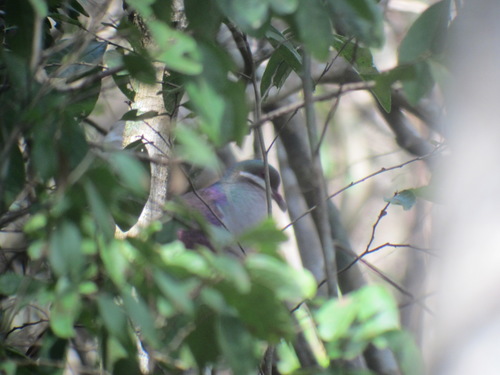 Key West Quail-Dove
In short
The most reliable field mark to separate Ruddy Quail-Dove from Key West Quail-Dove is the presence of iridescence and a bold white facial stripe on Key West, which Ruddy lacks. Both are ground-dwelling doves with similar rusty backs and wings, but Key West shows amethyst or bronze-green iridescence on the crown and neck, and a strong white face stripe, while Ruddy is plainer and more uniformly rufous. Size overlaps but Key West is generally larger and heavier. In poor light or brief views, focus on the face pattern and any neck iridescence to avoid confusion.
Identification tips
- White facial stripe: Key West Quail-Dove always shows a bold white stripe on the face, which Ruddy Quail-Dove lacks. This is the single most useful mark in all ages and conditions.
- Neck and crown iridescence: Look for amethyst or bronze-green gloss on the crown, nape, and neck of Key West, and purplish-red iridescence on the back and inner wing coverts. Ruddy is never iridescent and always matte rufous.
- Uniformity of plumage: Ruddy Quail-Dove is more evenly rust-colored across the back, wings, and face, with only a slightly lighter breast and rump. Key West is darker overall and broken up by iridescence and the white stripe.
- Face pattern: Ruddy has a plain rufous facial mask and a lighter undereye stripe, but this is subtle and never as bold as the white stripe of Key West.
- Size and structure: Key West is larger and heavier, but size overlap means this is only helpful with direct comparison or experience.
- Back and wing color: Both species are rusty above, but Key West is darker and more contrasting, especially when iridescence catches the light.
- Breast and rump: Ruddy’s breast and rump are lighter brown, while Key West’s are darker and may show a reddish or purplish gloss.
- Flight views: No distinctive upperwing or flight pattern differences are described, so rely on body color and face pattern even in flight.
- Juvenile/immature birds: No special marks are noted for young birds, so the same adult field marks apply.
- Vocalizations: If you hear a single-pitched moan, suspect Key West, but absence of voice is not helpful.
- Range and context: In the West Indies, both may occur, but in Central/South America, only Ruddy is expected. In Florida, both are rare, but Key West is the more likely vagrant.
- Lighting pitfalls: In poor light, Key West’s iridescence may be hard to see, but the white face stripe should still stand out.
- Habitat: Both species prefer dense forest floor, so habitat alone is not a separator.
- Sex and season: No sex- or season-specific differences are described, so use the same marks year-round.
- Common pitfalls: Do not rely on overall rustiness or size alone; always check for the white facial stripe and any neck iridescence to avoid confusion.
Size
Key West Quail-Dove is generally the larger of the two, with a length of 27–31 cm and a body mass of about 169 g [wikidata]. Ruddy Quail-Dove is smaller, at 19–28 cm in length, though no mass is provided. In the field, this difference is subtle and may not be obvious unless both species are seen together, but Key West tends to look bulkier and longer overall.
Plumage
No age-specific juvenile or immature upperwing patterns are described for either species, so focus is on adult and general plumage. Ruddy Quail-Dove is a uniform rust color on the back, wings, and facial mask, with a lighter brown breast, rump, and undereye stripe. It lacks any iridescence. Key West Quail-Dove, in contrast, has a dark rust back and wings but is immediately distinctive by its amethyst or bronze-green iridescence on the crown, nape, and neck, as well as purplish-red iridescence on the mantle, back, rump, and inner wing coverts. The bold white facial stripe on Key West is a key mark, contrasting with the more subdued and uniform face of Ruddy. Both species show rusty upperparts, but only Key West combines this with iridescence and a crisp white face stripe.
Behaviour
Both species are ground-dwelling doves, typically foraging quietly on the forest floor. There is no diagnostic behavioral difference noted in the sources provided. Both can be shy and elusive, often flushing at close range.
Habitat
Ruddy Quail-Dove is widespread throughout the West Indies, Central America, and tropical South America, and can appear as a vagrant in Florida and southern Texas. Key West Quail-Dove is more localized in the West Indies and rarely strays to southern Florida. In areas of overlap, habitat preferences are similar, with both favoring dense forest undergrowth, so habitat alone is not diagnostic.
Voice
Key West Quail-Dove has a single-pitched moaning call, similar to that of the White-tipped Dove. No vocal description is provided for Ruddy Quail-Dove in the notes, so voice is not a reliable separator unless the Key West's moan is heard.