

Ruddy-breasted Crake vs Baillon's Crake
Zapornia fusca versus Zapornia pusilla
Play a quiz with Ruddy-breasted Crake and Baillon's Crake
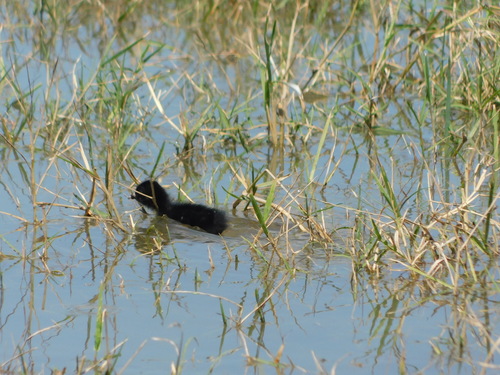 Ruddy-breasted Crake
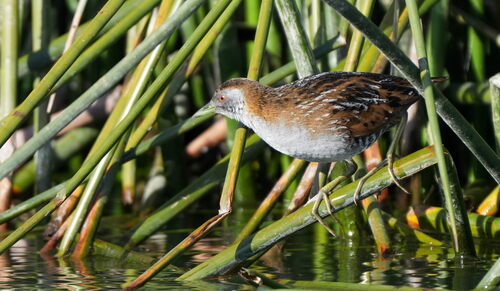 Baillon's Crake
In short
The most reliable field mark to separate Ruddy-breasted Crake from Baillon's Crake is the underparts color: Ruddy-breasted shows rich chestnut on the head and underparts, while Baillon's is pale blue-grey below. Both species have white barring on the flanks and undertail, but overall coloration and size differ. Juveniles of both are duller, but Ruddy-breasted juveniles are dark brown with white spotting, while Baillon's are barred and duller than adults. Structure also helps: Ruddy-breasted is noticeably larger and heavier, with a red eye and legs, compared to Baillon's olive-green legs and yellow/green bill. Both are secretive marsh birds, but their color and size differences are reliable in the field.
Identification tips
- Underparts color: Ruddy-breasted Crake has rich chestnut on the head, throat, and underparts; Baillon's Crake is pale blue-grey below, paler on the throat and belly. This is the most consistent field mark in all plumages except very young juveniles.
- Back and upperparts: Ruddy-breasted shows a pale brown back, while Baillon's is ochre-brown with black and white streaks. Look for the streaked effect in Baillon's, which is absent in Ruddy-breasted.
- Flank and undertail barring: Both species have black-and-white barring here; do not rely on this alone for separation.
- Bill color: Ruddy-breasted has a yellowish bill; Baillon's has a short, straight bill that is yellow or green, lacking any red at the base. Bill color is subtle but can help at close range.
- Leg and eye color: Ruddy-breasted has red eyes, legs, and feet; Baillon's has olive-green legs and no mention of red in the eye. Leg color is visible when birds are out in the open or in flight.
- Size and structure: Ruddy-breasted is much larger and heavier (22–23 cm, 60 g) than Baillon's (15–18 cm, 35 g). In direct comparison or with experience, Ruddy-breasted looks bulkier and more robust.
- Juvenile plumage: Ruddy-breasted juveniles are dark brown with white spotting, lacking chestnut; Baillon's juveniles are duller versions of adults with more extensive barring below. If you see a brownish, spotted juvenile, favor Ruddy-breasted; if barred and greyish, favor Baillon's.
- Tail and toes: Both have long toes and short tails, typical of crakes; this is not a useful separator between these two.
- Flight views: No distinctive upperwing or flight pattern differences are described for either species, so do not rely on wing pattern in flight.
- Habitat: Both use similar wetland habitats; do not use habitat alone to separate them in overlapping regions.
- Behavior: Both are secretive and skulk in dense cover, but Baillon's may be slightly more likely to be seen in the open during migration or winter.
- Voice: Baillon's has a rattling, frog-like call; Ruddy-breasted's call is not described here, so use voice with caution.
- Season and range: Ruddy-breasted is mainly resident in South and East Asia; Baillon's is more migratory and widespread. In Australia, Baillon's is regular; Ruddy-breasted is only a rare vagrant.
- Sex differences: Both species are similar in appearance between sexes; do not use sex to separate them.
- Contextual clues: If you see a crake that looks unusually large and chestnut below, it's almost certainly Ruddy-breasted. If it's small, blue-grey below, and streaked above, it's Baillon's.
Size
Ruddy-breasted Crake is significantly larger and heavier: about 22–23 cm in length and 60 g in mass, compared to Baillon's Crake at 15–18 cm and 35 g. In the field, Ruddy-breasted appears bulkier and longer-bodied, while Baillon's is distinctly small and compact, sometimes called 'tiny crake.' Size alone can be a strong clue if seen side by side, but beware of lone birds where scale is hard to judge.
Plumage
- Adults: Ruddy-breasted Crake has a pale brown back, rich chestnut head and underparts, and white barring on the flanks and undertail. Baillon's Crake is ochre-brown above, with black and white streaks, and pale blue-grey underparts, also with black-and-white barring on the flanks and undertail.
- Juveniles/Immatures: Ruddy-breasted juveniles are dark brown overall with some white spotting, lacking the rich chestnut of adults. Baillon's Crake immatures are similar to adults but with duller, more extensively barred underparts. Both have black chicks, but this is rarely relevant in the field. No distinctive upperwing or flight pattern differences are described for either species at any age.
Behaviour
Both species are highly secretive, preferring to skulk in dense marsh vegetation and rarely venturing into the open. When flushed, both may fly weakly for short distances, dropping quickly back into cover. Foraging is similar: probing mud or shallow water, picking up food by sight. Ruddy-breasted may seem slightly more robust in movement due to its larger size, but this is subtle. Both are more likely to be heard than seen, especially during the breeding season.
Habitat
Both crakes inhabit swamps, marshes, and wet areas with dense vegetation, often overlapping in suitable habitat. Ruddy-breasted Crake is widespread across South and East Asia, while Baillon's Crake has a broader range including Africa, Eurasia, and Australia. In areas of overlap, habitat alone does not reliably separate them, though Baillon's may be more likely in smaller or drier marsh patches.
Voice
Baillon's Crake is described as noisy in the breeding season, with a rattling call reminiscent of an edible frog or garganey. Ruddy-breasted Crake's voice is not detailed in the notes, but both are more often detected by sound than sight when breeding. Vocalization may help in Baillon's, but is not diagnostic without more detail for Ruddy-breasted.