
Royal Tern vs Brown Pelican
Thalasseus maximus versus Pelecanus occidentalis
Play a quiz with Royal Tern and Brown Pelican
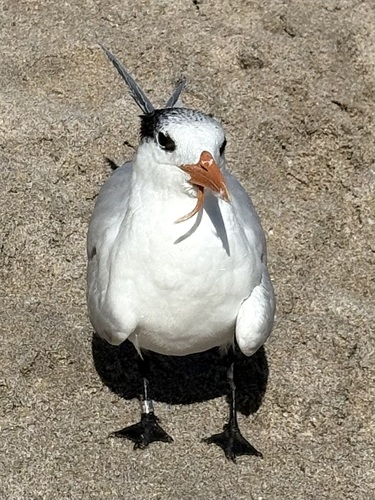 Royal Tern
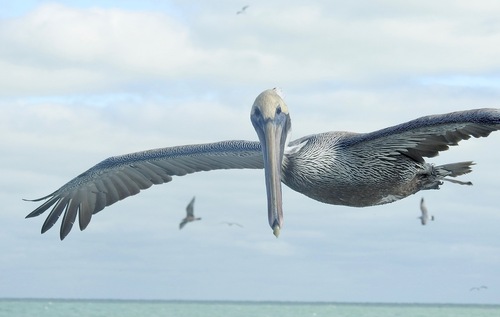 Brown Pelican
In short
The most reliable field mark between Royal Tern and Brown Pelican is overall structure: Royal Tern is a large, slim, gull-like tern with a pointed orange bill, while Brown Pelican is a massive, heavy-bodied bird with a huge bill and throat pouch. Immature Royal Terns may show dark marks on the wings and a yellowish bill, but never the brown, heavy plumage or the enormous bill of a pelican. In flight, pelicans glide with slow, deep wingbeats and often soar, whereas terns are agile, buoyant, and direct. Even at a distance, the pelican’s size and shape are unmistakable compared to any tern.
Identification tips
- Overall size and structure: Brown Pelican is enormous, with a massive bill and long neck; Royal Tern is much smaller, slender, and gull-like. This is the most reliable separation at any distance.
- Bill shape and color: Royal Tern has a stout, pointed orange-red bill (yellowish in juveniles); Brown Pelican has a huge, long, grayish bill with a large throat pouch. No tern has a bill remotely like a pelican’s.
- Juvenile/immature plumage: Juvenile Royal Tern is white below with some dark marks on the wings and a yellowish bill; juvenile Brown Pelican is brownish overall with a dull white belly and dusky-brown head and neck. The pelican always looks heavy and dark compared to the tern.
- Adult plumage: Adult Royal Tern is silvery-gray above, white below, with a black nape crest in breeding and a white forehead in non-breeding. Adult Brown Pelican has a white or yellowish head, dark maroon-brown neck in breeding, and a streaked gray-brown back and tail.
- Wing pattern in flight: Royal Tern (all ages) has pale silvery upperwings with little contrast; Brown Pelican (all ages) shows dark, broad wings with a streaky or silvery central area on the underwing and dark coverts.
- Flight style: Terns are agile, buoyant, and direct; pelicans are heavy, with slow, deep wingbeats and frequent gliding or soaring.
- Perched/roosting posture: Pelicans are often seen perched on docks or floating on water, hunched with bill resting on breast; terns stand upright on sandbars or posts, rarely float for long.
- Head and crest: Royal Tern has a shaggy black nape crest in breeding; pelican has a short, reddish-brown crest in breeding but never a pointed nape crest like a tern.
- Leg color: Royal Tern has black legs; Brown Pelican has black legs and feet, but this is rarely diagnostic given the size difference.
- Voice: Royal Tern is frequently noisy with sharp, shrill calls; Brown Pelican is mostly silent, with only grunts or croaks in display.
- Habitat use: Both species overlap on coasts, but pelicans are more likely to be seen swimming or perched on structures, while terns are usually flying, hovering, or standing on open sand.
- Feeding behavior: Both plunge-dive, but pelican dives from higher and is bulkier; tern dives with a lighter, more agile motion.
- Crown pattern (seasonal): In non-breeding, Royal Tern’s crown becomes extensively white, while pelican’s head remains white or yellowish depending on season.
- Group behavior: Royal Terns often gather in tight flocks on sandbars; Brown Pelicans may roost in groups but are more spread out and often float together on water.
- Confusion risk: Only possible at great distance or in poor light; even then, the pelican’s size and proportions are distinctive.
Size
Brown Pelican is vastly larger and heavier than Royal Tern. The pelican’s body mass is over 3400 g [wikidata], while Royal Tern is only 350–500 g [wikipedia]. In the field, pelicans appear massive, with a long neck and huge bill, easily dwarfing any tern. Royal Tern, although large for a tern, is still much smaller and more streamlined, with a wingspan (125–135 cm) that is less than half that of a pelican. Side-by-side, confusion is impossible; at a distance, the pelican’s bulk and proportions are still obvious.
Plumage
Juvenile Royal Terns resemble non-breeding adults but have darker gray to blackish marks on the wings and a yellower bill. They never show the all-over brown or streaked appearance of juvenile Brown Pelican, which is grayish-brown above with paler underparts and a dull white belly. Immature pelicans have dusky-brown heads and necks, and their upperwing coverts are short and brown, often darker on the greater coverts, with a broad, silver-gray central area on the underwing. Adult Royal Terns have silvery-gray upperparts, white underparts, and a black nape crest in breeding season, which becomes patchy and then white on the crown in non-breeding plumage. Brown Pelicans, in adult plumage, have a white head with a yellowish wash and a dark maroon-brown neck in breeding, and a white head and neck in non-breeding. The pelican’s bill is always huge and grayish, with a large pouch, while the tern’s is slender, pointed, and bright orange-red.
Behaviour
Brown Pelicans are often seen gliding low over the water, soaring, or plunge-diving from height. Their flight is heavy and slow, with deep wingbeats and frequent gliding. On land, they are clumsy walkers. Royal Terns are agile, buoyant fliers, often hovering or making quick, direct flights over the surf, and plunge-diving for fish but from a lower height and with a much lighter build. Terns perch on posts or sandbars but are rarely seen swimming or floating like pelicans.
Habitat
Both species occur along coasts, beaches, and estuaries, but Brown Pelican is more often seen perched on pilings, docks, or floating on the water, and is common in harbors and bays. Royal Tern prefers open sandy beaches, barrier islands, and sandbars, and is rarely seen floating for long periods. Overlap is frequent along the Atlantic and Pacific coasts of the Americas, but their behavior and microhabitat preferences differ.
Voice
Royal Tern gives short, clear shrills, such as 'kree' or 'tsirr', and occasionally a longer, rolling whistle. Brown Pelican is mostly silent as an adult, but may give low, grunting 'hrrraa-hrra' sounds during displays or a rare low croak; young pelicans squeal. In the field, terns are much more vocal and their calls are sharper and more frequent.