
Rook vs Large-billed Crow
Corvus frugilegus versus Corvus macrorhynchos
Play a quiz with Rook and Large-billed Crow
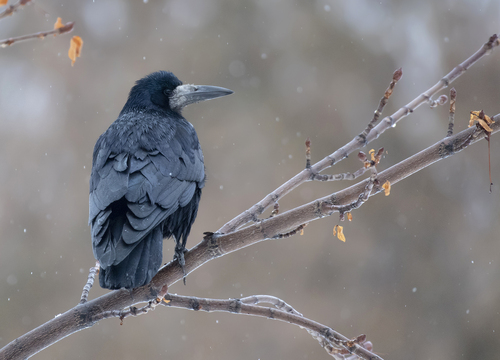 Rook
 Large-billed Crow
In short
The most reliable way to separate Rook from Large-billed Crow is the presence of a pale, bare patch of skin at the base of the bill in adult Rooks—a feature completely absent in Large-billed Crow of any age. Juvenile Rooks lack this patch, making them much more similar to crows, but they show a thinner, more pointed bill and shaggier thigh feathering. In flight, Rook has proportionally longer, narrower wings and a more domed head profile, while Large-billed Crow appears heavier-billed and deeper-headed. Both are large, all-black corvids, but careful attention to face pattern, bill structure, and jizz will usually clinch the identification.
Identification tips
- Adult Rook's pale, bare facial skin: Look for the whitish, featherless patch at the base of the bill and in front of the eye—present only in adult Rooks, never in Large-billed Crow. This is the single best field mark.
- Juvenile Rook lacks bare patch: Young Rooks have a fully feathered face like crows, so do not rely on the facial patch for immatures. Instead, check for a thinner, more pointed bill and shaggier thigh feathering.
- Bill structure: Large-billed Crow has a much larger, deeper, and more arched bill, with prominent black bristles at the base that often obscure the nostrils. Rook's bill is thinner, straighter, and appears longer due to the bare skin, but is actually less massive.
- Head shape and jizz: Rook's head appears more domed and the face more elongated, especially in adults with the bare patch. Large-billed Crow has a heavier, deeper head and a more menacing profile.
- Wing shape in flight: Rook has proportionally longer, narrower wings, giving a more buoyant, almost rook-like flight. Large-billed Crow appears broader-winged and more powerful in flight.
- Plumage gloss: Rook's black feathers show a blue or bluish-purple sheen in sunlight, while Large-billed Crow has a purple gloss. Juvenile Rook may show a greenish gloss and brownish-black tones on the body.
- Throat and neck feathers: Large-billed Crow has elongated, hackled throat feathers and pale grey feather bases on the neck (visible at close range). Rook's head and neck feathers are dense and silky, but not hackled.
- Leg feathering: Rook has shaggier, laxer feathering around the legs, especially visible when perched. Large-billed Crow's legs are less obviously feathered.
- Iris color in juveniles: Large-billed Crow juveniles have smoky blue irises, while Rook juveniles have dark brown.
- Social behavior: Rook is highly gregarious, often in large flocks and colonies. Large-billed Crow is more often in pairs or small groups, especially in urban areas.
- Habitat: Rook prefers open farmland and rural areas; Large-billed Crow is more likely in woodlands, parks, gardens, and cities.
- Vocalizations: Large-billed Crow's calls are deeper and more resonant; Rook is noisier in flocks but less deep-voiced.
- Geographic range: Rook is Palearctic (Europe to Siberia); Large-billed Crow is Asian (east to south and southeast Asia). Overlap is limited.
- Pitfalls with immatures: Juvenile Rooks are the most likely confusion risk—look for thinner bill, shaggier thighs, and flocking behavior. If the bird is solitary, heavily built, and has a massive bill with bristles, suspect Large-billed Crow.
- Season and molt: The bare facial patch in Rook develops after about six months; before that, young birds can be very crow-like. In late summer and autumn, check for subtle differences in bill shape and leg feathering if the facial patch is absent.
Size
Both species are large corvids and can overlap in size, but Large-billed Crow is generally the heavier and longer bird. Rook averages about 44–46 cm in length and 453.5 g in mass [wikidata], while Large-billed Crow ranges from 46–59 cm in length and can weigh from 450 up to 1,000 g depending on subspecies [wikipedia]. In the field, size alone is unreliable due to overlap, but Large-billed Crow often looks bulkier, especially in the bill and head.
Plumage
Adult Rooks are unique among these two in having a conspicuous pale, featherless patch of skin around the base of the bill and in front of the eye. This is the single best plumage mark and is present year-round in adults. Juvenile Rooks, however, lack this bare patch and have a fully feathered face, making them superficially similar to Large-billed Crow. Juvenile Rooks show a thinner, more pointed bill and a slight greenish gloss to their black plumage, with brownish-black tones on the hindneck, back, and underparts. Large-billed Crow of all ages has a fully feathered, all-black face, a large, arched bill with prominent bristles at the base, and a purple gloss to the plumage. The throat feathers of Large-billed Crow are elongated and hackled, and the bases of the neck feathers are pale grey (usually only visible at close range or when feathers are fluffed). Both species have dark brown irises and black legs, but Large-billed Crow juveniles have smoky blue irises. In flight, Rook's wings are longer and narrower than those of Large-billed Crow, which appears broader-winged and heavier overall.
Behaviour
Rooks are highly gregarious, often seen in large, noisy flocks, especially around farmland and open country. They frequently nest in colonies (rookeries) and are rarely seen alone. Large-billed Crow is also social but tends to be less colonial, often seen in pairs or small groups, and is more adaptable to urban environments. Both species are bold and opportunistic feeders, but Large-billed Crow is especially notorious for its adaptability and persistence in urban areas, sometimes becoming a nuisance. Rook's shaggier plumage around the legs and more upright posture can be visible when perched.
Habitat
Rook is a bird of the Palearctic, favoring open countryside, farmland, and rural areas from western Europe to eastern Siberia. It is rarely found in dense forests or urban centers. Large-billed Crow has a much broader Asian range, from northeastern Asia through South and Southeast Asia, and is highly adaptable, thriving in woodlands, parks, gardens, cultivated regions, and even urban areas. In areas of overlap (e.g., far eastern Russia), habitat preference may help, with Rook sticking to open areas and Large-billed Crow being more generalist.
Voice
Vocalizations are not a primary field mark for separation, but Large-billed Crow has a deeper, more resonant 'caa-haa-caa' call, sometimes described as more complex and varied than the typical Rook calls. Rook is generally noisier in flocks, but its calls are less deep and lack the resonance of Large-billed Crow. In practice, calls may be difficult to distinguish unless you are familiar with both species.