

Rock Dove vs Yellow-eyed Pigeon
Columba livia versus Columba eversmanni
Play a quiz with Rock Dove and Yellow-eyed Pigeon
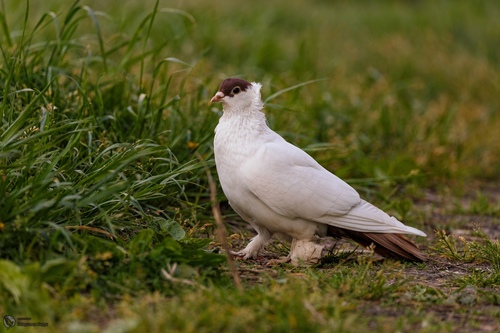 Rock Dove
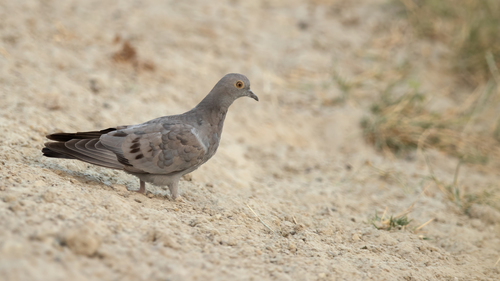 Yellow-eyed Pigeon
In short
The most reliable field mark to separate Rock Dove from Yellow-eyed Pigeon is the eye color and surrounding bare skin: Rock Dove has a red-brown iris with a narrow bluish-grey to grey-white eye ring, while Yellow-eyed Pigeon shows a distinctive yellow iris and yellowish bare skin around the eye. In flight, Rock Dove adults show two bold black wing bars and a sharply defined black tail band with white outer tail edges, whereas Yellow-eyed Pigeon has only one less prominent wing bar and a more diffuse, less sharply defined tail band. Both are medium-sized grey pigeons, but Rock Dove is heavier and bulkier. Careful attention to head and eye details, wing pattern, and tail banding is essential, especially for birds in flight or at a distance.
Identification tips
- Iris and bare skin color: Rock Dove has a red-brown iris with a narrow bluish-grey to grey-white eye ring; Yellow-eyed Pigeon has a striking yellow iris and yellowish bare skin around the eye. This is the most reliable mark at close range or in good light.
- Number of wing bars: Rock Dove shows two bold black wing bars on each wing (all ages); Yellow-eyed Pigeon has only one, which is less prominent. This is best seen in flight or on perched birds with wings folded.
- Tail band: Rock Dove has a sharply defined black tail band with white outer tail edges; Yellow-eyed Pigeon’s tail band is diffuse and less sharply defined. Look for this in flight or when the tail is spread.
- Lower back color: Rock Dove has a conspicuous white lower back (rump), especially visible in flight; Yellow-eyed Pigeon’s lower back and rump are white or pale grey but less contrasting with the rest of the body.
- Head and neck iridescence: Rock Dove shows strong greenish to reddish-purple iridescence on the neck (especially males), while Yellow-eyed Pigeon has a more pinkish-purple sheen on the crown, throat, and breast. Female and juvenile Rock Doves have less iridescence.
- Bill color: Rock Dove’s bill is grey-black with a small off-white cere; Yellow-eyed Pigeon’s bill is yellowish. This is subtle but can help at close range.
- Feet color: Both have pinkish feet, but Rock Dove’s are often a deeper red to pink, while Yellow-eyed Pigeon’s are pink.
- Body structure: Rock Dove is bulkier and heavier (average 280.5 g) than Yellow-eyed Pigeon (183–234 g). In direct comparison, Rock Dove appears more robust, especially around the chest and neck.
- Flight style: Rock Dove often takes off with noisy wing claps and glides frequently; Yellow-eyed Pigeon’s flight is less described but likely similar. Use with caution.
- Vocalizations: Rock Dove is more vocal, with soft coos and grunts; Yellow-eyed Pigeon is generally silent. If you hear a typical pigeon coo, it is more likely Rock Dove.
- Habitat: Rock Dove (especially feral forms) is common in urban and rural areas worldwide; Yellow-eyed Pigeon is restricted to steppe and semi-desert habitats in Central Asia and is not found in cities.
- Sex and age differences: Female and juvenile Rock Doves are duller with less neck iridescence, but still show the double wing bars and tail pattern. Yellow-eyed Pigeon’s age and sex differences are not well described, but main field marks (eye color, wing bar, tail band) are consistent.
- Pitfalls with feral pigeons: Many feral Rock Doves show variable plumage, but wild-type birds always have two wing bars, a sharp tail band, and red-brown eyes. Beware of domestic pigeons with odd colors, but eye and wing pattern remain key.
- Seasonal context: Both species are present year-round in their respective ranges, but only Rock Dove is likely in urban areas outside Central Asia. If in steppe or semi-desert in Central Asia, consider Yellow-eyed Pigeon, but check eye and wing pattern.
- When in doubt: Prioritize iris color and number of wing bars. If you cannot see the eye, use the combination of wing pattern and tail band sharpness, but beware of poor light or molt.
Size
Rock Dove is notably heavier, with an average adult mass of about 280.5 g [wikidata], compared to Yellow-eyed Pigeon’s reported range of 183–234 g [wikipedia]. Both species are similar in length (about 30–35 cm), but Rock Dove is generally bulkier and more robust, with a slightly longer wingspan (62–68 cm for Rock Dove vs. unspecified for Yellow-eyed Pigeon). In the field, Rock Dove may appear stockier, especially when perched, while Yellow-eyed Pigeon is a bit slimmer.
Plumage
-
Juveniles/immatures: No specific age-unique upperwing pattern is described for either species, but both show the main adult differences from a young age. Juvenile Rock Doves are duller overall, with less iridescence and less contrast, but still show the double wing bars and tail pattern. Young Yellow-eyed Pigeons are not described in detail, but likely resemble adults, with a single wing bar and less contrast overall.
-
Adults: Rock Dove is pale bluish-grey with two bold black wing bars, a white lower back, and a sharply defined black tail band with white outer tail edges. The head, neck, and chest are dark bluish-grey with greenish to reddish-purple iridescence, especially in males. The iris is red-brown, with a narrow bluish-grey to grey-white eye ring. Yellow-eyed Pigeon is mostly grey with a brownish tinge above, a pinkish-purple sheen on the crown, throat, and breast, and only one black wing bar. The tail band is diffuse, not sharply defined, and the lower back, rump, and underwings are white or pale grey. The iris and bare skin around the eye are yellow, the bill is yellowish, and the feet are pink.
Behaviour
Both species are gregarious, often forming flocks outside the breeding season. Rock Doves are known for their noisy, clapping take-off and frequent gliding in flight. They may display foot-stamping, wing-clapping, and bill-snapping, especially during display or alarm. Yellow-eyed Pigeon is described as generally silent and less is noted about its display or flight behavior, but it is likely similar in general pigeon jizz. Rock Dove’s display behaviors (bowing, tail-fanning, strutting) are more frequently observed, especially in urban or semi-urban settings.
Habitat
Rock Dove (in its wild form) is native to rocky cliffs and coastal areas, but feral and domestic forms are ubiquitous in urban and rural settings worldwide. Pure wild birds are now rare and mostly restricted to remote areas of northern and western Scotland. Yellow-eyed Pigeon breeds in steppe and semi-desert regions of Central Asia, wintering in northern South Asia. It is not found in urban settings and is much more localized and habitat-specific than the cosmopolitan Rock Dove.
Voice
Rock Dove gives a soft, slightly wavering coo (“crruoo-u”) and a grunt-like alarm call. Its vocalizations are typical of Columba pigeons and can be heard in both wild and feral birds. Yellow-eyed Pigeon is generally silent, but may give a faint “oo-oo-oo” during the breeding season. In practice, vocalizations are not a strong field mark for separating these two, but Rock Dove is more likely to be heard vocalizing.