

Riverside Wren vs Bay Wren
Cantorchilus semibadius versus Cantorchilus nigricapillus
Play a quiz with Riverside Wren and Bay Wren
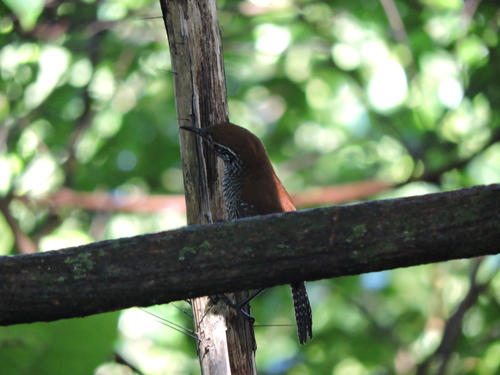 Riverside Wren
 Bay Wren
In short
The most reliable field mark to separate Riverside Wren from Bay Wren is the color and pattern of the head and underparts: Riverside Wren shows a bright orange-brown crown and chestnut back with a boldly streaked black-and-white face, while Bay Wren has a black crown and nape, a mostly black face with a narrow white supercilium, and a white patch behind the cheek. Both have barred tails and underparts, but Riverside Wren's barring is finer and extends over pale gray underparts, whereas Bay Wren's barring is bolder and set against white and rufous underparts. Juveniles of both are duller, but the head and underpart patterns remain distinctive. Bay Wren is also noticeably heavier and bulkier. Both species prefer dense vegetation near water, but their ranges overlap only in parts of Costa Rica and Panama.
Identification tips
- Head color and pattern (all ages): Riverside Wren has a bright orange-brown crown and chestnut nape/back, with a boldly streaked black-and-white face and a black-over-white supercilium. Bay Wren has a black crown and nape, a mostly black face with a narrow white supercilium, and a white patch behind the cheek. This is the most reliable field mark.
- Underpart color and barring: Riverside Wren shows pale gray underparts with fine, narrow black barring throughout, becoming buffier toward the vent. Bay Wren has white throat and breast, rufous brown belly/flanks, and bold black barring from breast to vent. The contrast between white and rufous in Bay Wren is distinctive.
- Juvenile plumage: Juvenile Riverside Wren is duller, with fine black scaling on the crown and less crisp barring below, but still shows the orange-brown crown and streaked face. Juvenile Bay Wren is paler and less well-marked, but retains the black crown and white cheek patch.
- Tail pattern: Both have barred tails, but Riverside Wren's tail is blackish with buff-white bars, while Bay Wren's is rich brown with bold black bars. The tail color matches the back in Bay Wren, but contrasts more in Riverside Wren.
- Facial contrast: Riverside Wren's face is heavily streaked and spotted, giving a 'busy' look; Bay Wren's face is mostly black with a clean white patch and narrow supercilium, appearing more 'masked.'
- Size and structure: Bay Wren is noticeably heavier (23.9 g vs. 17.0 g) and often appears bulkier and more robust. Riverside Wren is more slender and slightly shorter. This is most useful if you have experience with both or see them together.
- Song: Riverside Wren gives repeated, loud ringing phrases, each followed by a different phrase. Bay Wren's song is a rapid, complex series of whistles, trills, and warbles, often antiphonal. If you hear trilled or warbled phrases, suspect Bay Wren.
- Habitat in overlap zones: Both prefer dense vegetation near water, but Riverside Wren is more restricted to riversides and steep banks, while Bay Wren can be found in a broader range of dense, tangled habitats, including overgrown clearings and roadsides.
- Supercilium: Riverside Wren's supercilium is black over white and stands out against the streaked face; Bay Wren's is a narrow white line above a black face, less prominent overall.
- Cheek patch: Bay Wren has a distinct white patch behind the cheek, lacking in Riverside Wren.
- Back color: Riverside Wren's back is chestnut, blending into the orange-brown crown; Bay Wren's back is rich chestnut but sharply separated from the black crown and nape.
- Underpart transition: Riverside Wren's underparts are pale gray throughout, becoming buffy to the rear; Bay Wren transitions from white to rufous brown, with a clear color boundary.
- Group behavior: Both may be seen in pairs or family groups, but Riverside Wren is more likely to join mixed flocks at ant swarms.
- Nest shape (not field-diagnostic): Riverside Wren builds globular, two-chambered nests, often over water; Bay Wren's nests are usually elbow-shaped with an entrance tube. This is rarely useful in the field.
- Range: If outside Costa Rica and western Panama, Bay Wren is much more likely. Riverside Wren is restricted to the Pacific slope in these countries.
Size
Bay Wren is consistently larger and heavier than Riverside Wren. Bay Wren averages about 23.9 g, compared to Riverside Wren's 17.0 g [wikidata], and is slightly longer at maximum (up to 15.6 cm vs. Riverside's 14 cm). In the field, Bay Wren often appears bulkier and more robust, while Riverside Wren is more slender. This size difference is most apparent when both are seen together or with direct comparison to other wrens in the area.
Plumage
Juvenile and adult plumages in both species are similar in pattern to their respective adults, but duller and with less sharply defined markings. For Riverside Wren (all ages), look for the bright orange-brown crown, chestnut nape and back, and a face that is boldly streaked and spotted black and white with a black-over-white supercilium. The underparts are pale gray with narrow black bars, becoming buffier toward the vent. Juveniles are duller, with fine black scaling on the crown and less crisp barring below. Bay Wren (all ages) has a black crown and nape, black face with a narrow white supercilium and a white patch behind the cheek, and rich chestnut upperparts. Its tail is rich brown with bold black bars. Underparts are white on the throat and breast, shading to rufous brown on the belly and flanks, with bold black barring from breast to vent. Juveniles are paler and less well-marked but retain the overall pattern. The head color and face pattern are the most consistent differences at all ages.
Behaviour
Both species forage low in dense vegetation, often near the ground. Riverside Wren is usually seen in pairs or family groups and sometimes joins mixed-species flocks at army ant swarms. Bay Wren forages by gleaning from foliage and probing tangles, and is also often found in pairs or small groups. Both are active and secretive, but Bay Wren may appear more robust and deliberate in its movements, while Riverside Wren can seem more agile and slender. Both construct elaborate nests, but nest shape is not a reliable field mark.
Habitat
Both species are closely tied to dense, low vegetation near water. Riverside Wren is found along the Pacific slope of Costa Rica and western Panama, favoring dense riverside thickets, swampy woodland edges, or steep vegetated slopes, from sea level up to 1,200 m. Bay Wren has a broader range, from Nicaragua to Ecuador, and is found in similar dense vegetation along watercourses, overgrown clearings, roadsides, and forest understory with sufficient undergrowth. In regions of overlap (Costa Rica and Panama), check for subtle differences in microhabitat: Riverside Wren is more restricted to water edges and steep banks, while Bay Wren can occur in a wider variety of dense, tangled habitats.
Voice
Both species are highly vocal. Riverside Wren's song consists of repeated loud, ringing phrases, each followed by a different phrase, and calls include harsh churrs and clear tinkling notes. Bay Wren's song is a rapid series of clear, rich-toned, slurred whistles, trills, and warbles, often given antiphonally. While both can sound similar to the untrained ear, Bay Wren's song is more complex and varied, with more trills and warbling elements, whereas Riverside Wren's song is more phrase-based and ringing. Both sexes sing in Riverside Wren; Bay Wren also sings in pairs.