

Ringed Teal vs Yellow-billed Pintail
Callonetta leucophrys versus Anas georgica
Play a quiz with Ringed Teal and Yellow-billed Pintail
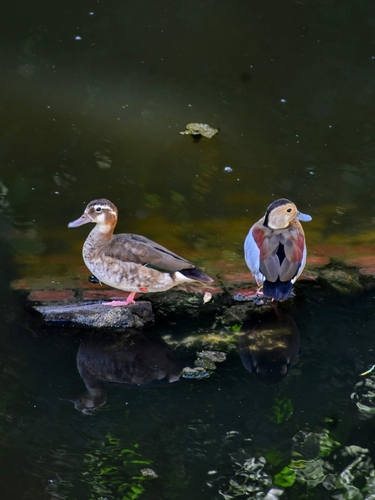 Ringed Teal
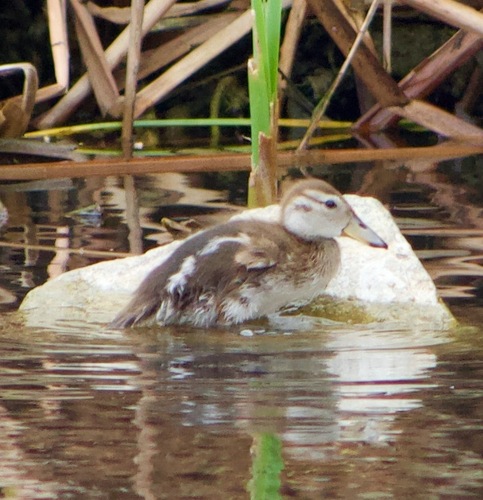 Yellow-billed Pintail
In short
The most reliable field mark between Ringed Teal and Yellow-billed Pintail is the bill: Ringed Teal always shows a plain grey bill, while Yellow-billed Pintail has a striking yellow bill with a black tip and central stripe. In flight or on the water, Ringed Teal displays a distinctive white wing patch and a pale rump, contrasting with the pintail's dark greenish-black secondaries and lack of a white wing panel. Structure also helps: Ringed Teal is a compact, short-tailed duck, while Yellow-billed Pintail is longer, slimmer, and has a pointed tail. Females and immatures of both can be confusing, but the combination of bill color, wing pattern, and body shape will separate them in almost all field situations.
Identification tips
- Bill color is diagnostic: Ringed Teal always has a plain grey bill, while Yellow-billed Pintail shows a bright yellow bill with a black tip and a black stripe down the middle. This works for all ages and sexes.
- Wing pattern in flight or at rest: Ringed Teal of all ages shows a bold white patch on the wing and a pale rump, easily seen in flight or when preening. Yellow-billed Pintail never shows white in the wing, instead displaying grayish-brown upperwings with blackish-green secondaries.
- Tail shape: Ringed Teal has a short, dark tail with a contrasting pale rump, while Yellow-billed Pintail has a pointed, brownish tail that extends well beyond the undertail coverts, especially obvious in flight or when swimming.
- Body structure and jizz: Ringed Teal is compact, short-necked, and often appears round-bodied. Yellow-billed Pintail is longer, slimmer, and has a more stretched-out look, with a longer neck and tail.
- Plumage details (male): Male Ringed Teal shows a rich chestnut back, pale grey flanks, salmon-pink breast with black spots, and a black stripe from crown to nape. Yellow-billed Pintail males lack these colors, being more uniformly buff-brown with black spots.
- Plumage details (female): Female Ringed Teal is olive-brown above, pale and finely barred below, with a white face pattern. Female pintails are more uniformly buff-brown with black spots and lack the white face and barring.
- No eclipse plumage in Ringed Teal: Both sexes retain their basic pattern year-round, so you won't see a dull eclipse male as in some ducks.
- Perching behavior: Ringed Teal may be seen perched in trees or on branches, thanks to its long claws. Yellow-billed Pintail is almost never seen perching.
- Habitat context: In well-wooded, forested wetlands or small, secluded pools, suspect Ringed Teal. In open lakes, marshes, or highland wetlands, Yellow-billed Pintail is more likely.
- Group structure: Ringed Teal often appears in pairs or small family groups, while pintails can be more solitary or loosely associated, but this is not always reliable.
- Voice: If you hear a cat-like 'mee-oowing' or a lingering 'peewoo', it's Ringed Teal. Pintail vocalizations are not distinctive in the notes.
- Juvenile confusion: Even young Ringed Teal show the white wing patch and pale rump, while juvenile pintails do not.
- Pitfall—female confusion: Female Ringed Teal and Yellow-billed Pintail can both appear brownish and barred, but the bill color and wing patch will always separate them.
- Pitfall—distant views: At a distance, focus on bill color and overall shape; the white wing patch of Ringed Teal can flash even in poor light.
- Season and sex: No strong seasonal or sexual dimorphism in Ringed Teal; pintails may show slight subspecies variation, but the main marks remain consistent.
Size
Ringed Teal is a noticeably smaller and more compact duck, with a body mass around 372 g and a length of 35–38 cm. Yellow-billed Pintail is larger and longer, with a more elongated body and a pointed tail, though exact mass is not given here. In mixed flocks, Ringed Teal will look distinctly daintier and shorter-necked, while pintails appear sleeker and more stretched out.
Plumage
Juvenile and adult Ringed Teal of both sexes show a bold white patch on the wing (visible in flight and often at rest), a pale rump, and a dark tail. Males have a rich chestnut back, pale grey flanks, and a salmon-pink breast with black spots, plus a black nape stripe. Females are more subdued, with olive-brown backs and pale, finely barred underparts, but still show the white wing patch and pale rump. Yellow-billed Pintail of all ages lacks any white in the wing; instead, the upperwing is grayish-brown with blackish-green secondaries. The body is buff-brown with black spots, and the tail is brownish and pointed. The head and neck are brown, and the bill is always yellow with black markings. No eclipse plumage is present in Ringed Teal; both sexes keep their basic pattern year-round. In summary, the white wing patch and pale rump of Ringed Teal are unique, while the pintail's wing is darker and lacks white.
Behaviour
Ringed Teal is more likely to be seen perching in trees or on branches, thanks to its long, pointed claws and webbed toes. It often sits above water or along the edges of wooded wetlands. Yellow-billed Pintail is a classic dabbling duck, usually found swimming or feeding in open water or marshes, rarely perching. In flight, Ringed Teal appears compact and short-tailed, while Yellow-billed Pintail is longer, sleeker, and shows a pointed tail. Both are dabblers, but Ringed Teal may be seen in smaller, more secluded groups, sometimes paired, while pintails can be more dispersed.
Habitat
Ringed Teal prefers tropical, swampy forests, marshy clearings, and secluded pools in well-wooded lowlands. It is often found in areas with overhanging trees or dense cover. Yellow-billed Pintail ranges more widely, from high-elevation lakes and marshes to lowland rivers and open country wetlands, including coasts and islands. If you find a small, tree-lined pool, Ringed Teal is more likely; in open marshes or lakes, especially at higher elevations or in open country, Yellow-billed Pintail is the default.
Voice
Ringed Teal gives a cat-like 'mee-oowing' call (female) and a lingering 'peewoo' (male). No distinctive vocalization is described for Yellow-billed Pintail in the provided notes, so voice is not a primary separator.