

Rifleman vs Bush Wren
Acanthisitta chloris versus Xenicus longipes
Play a quiz with Rifleman and Bush Wren
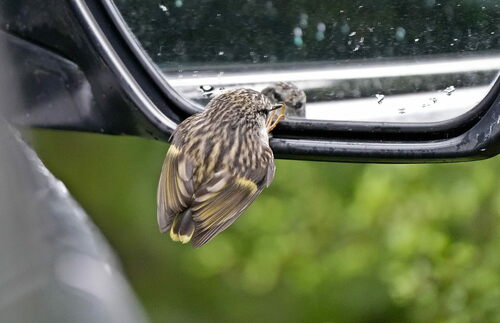 Rifleman
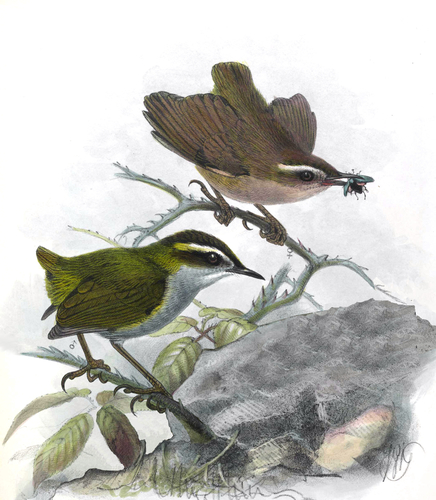 Bush Wren
In short
The most reliable way to separate Rifleman from Bush Wren is by looking for the Rifleman's distinctive white eyebrow stripe and brighter greenish upperparts, especially in males. Rifleman also shows a short, stubby tail and a rapid, hummingbird-like flight, while Bush Wren was nearly flightless and much duller overall. If you see a tiny, active bird climbing tree trunks in New Zealand forests with a white supercilium and a quick, hovering flight, it's a Rifleman. Bush Wren, now extinct, would have appeared browner, more subdued, and moved clumsily or hopped rather than flying. Both are small, but Rifleman is the smallest New Zealand bird and noticeably more vibrant in color.
Identification tips
- Eyebrow stripe: Rifleman of all ages and sexes shows a clear white eyebrow (supercilium), which Bush Wren lacked. This is the single best field mark, especially in shaded forest.
- Upperparts color: Male Rifleman is bright green above with a yellow-green rump, while Bush Wren was always dull brownish-olive. Female Rifleman is browner but still greener than Bush Wren and retains the eyebrow.
- Wing pattern: Rifleman has black, green, and white wings with a yellow band across the flight feathers. Bush Wren's wings were plain and lacked any strong pattern or color contrast.
- Tail: Rifleman has a very short, stubby tail with a whitish tip; Bush Wren's tail was also short but not as distinctly stubby or tipped white.
- Bill shape: Rifleman has a long, thin, slightly upturned bill, especially noticeable in females. Bush Wren's bill was shorter and straighter.
- Flight style: Rifleman flies rapidly between trees with a humming sound; Bush Wren was nearly flightless, moving by hopping or short, weak flights only. If you see a bird flying energetically, it's a Rifleman.
- Foraging behavior: Rifleman climbs up tree trunks and branches in a spiral, like a treecreeper, then glides to the next tree. Bush Wren foraged lower, more clumsily, and did not show the same vertical climbing.
- Underparts: Rifleman is white below, sometimes with a yellow wash and yellowish flanks; Bush Wren was paler below but less clean white, often appearing dingier overall.
- Size: Both are tiny, but Rifleman is the smallest New Zealand bird. In direct comparison, Rifleman is slightly more compact and round-bodied.
- Sex differences: Female Rifleman is browner and could be confused with Bush Wren, but still shows the eyebrow and some greenish tones. Bill is longer in female Rifleman.
- Habitat: Today, only Rifleman remains in New Zealand forests. Any similar bird seen now is a Rifleman.
- Context: Bush Wren is extinct; any confusion is historical or in museum skins. In the field, all sightings are Rifleman.
- Tail movement: Rifleman may flick its short tail; Bush Wren's tail movement was less distinctive.
- Nest sites: Rifleman nests in tree holes, branches, or even ground cavities, but this is rarely visible in the field.
- Vocalization: No diagnostic vocal differences are described in the sources; rely on visual and behavioral marks.
Size
Rifleman is New Zealand's smallest endemic bird, measuring 7–9 cm in length and weighing 6–7 g depending on sex [wikipedia]. Bush Wren was also very small and similarly diminutive, but Rifleman is generally considered the smallest. Both species are tiny, but Rifleman is especially compact with a shorter tail and rounder body. The difference is subtle in the hand, but in the field, Rifleman's smaller, more delicate structure and shorter tail are useful clues.
Plumage
For all ages, Rifleman males are bright green above with a yellow-green rump, black and white wings with a yellow band, and a white eyebrow stripe. Females are browner above but still show the eyebrow and some greenish tones. Both sexes have white underparts, sometimes with a yellow wash, and yellowish flanks. The tail is black with a whitish tip. Bush Wren, by contrast, was much duller overall: brownish-olive above, lacking the Rifleman's bright green or yellow tones and without a white eyebrow. Bush Wren's underparts were pale but less clean white, and the plumage was more uniformly drab. No age-specific upperwing or flight marks are described for either species, but the Rifleman's wing pattern (black, green, white with a yellow band) is more striking than anything on Bush Wren. Female Rifleman can be mistaken for Bush Wren due to their browner tones, but the eyebrow and wing contrast remain useful.
Behaviour
Rifleman is highly active, often seen climbing up tree trunks and branches in a spiral, similar to a treecreeper, and then gliding quickly to the base of the next tree. Its flight is rapid and produces a humming sound. Bush Wren was nearly flightless, moving clumsily or hopping rather than flying, and would not have been seen making long or rapid flights between trees. Rifleman pairs are territorial and cover the same ground daily, while Bush Wren's behavior was more secretive and less energetic. The difference in flight ability is a major behavioral separator.
Habitat
Both species were endemic to New Zealand and favored forested habitats. Rifleman is still widespread on the main islands, found in lowland tawa forests (North Island) and high-altitude beech or lowland podocarp forests (South Island). Bush Wren was formerly present on all three main islands and some offshore islands but is now extinct. In the present day, any tiny, tree-trunk-foraging bird in New Zealand forests is almost certainly a Rifleman. Bush Wren was more restricted in recent times to predator-free offshore islands before extinction.