
Richard's Pipit vs Tawny Pipit
Anthus richardi versus Anthus campestris
Play a quiz with Richard's Pipit and Tawny Pipit
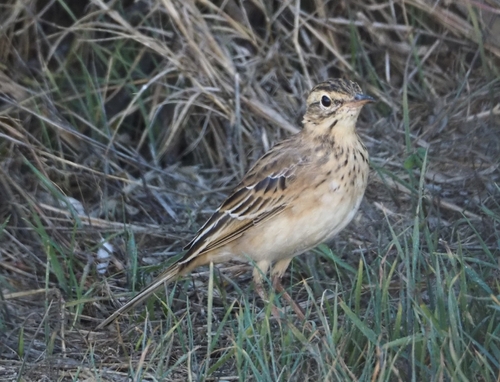 Richard's Pipit
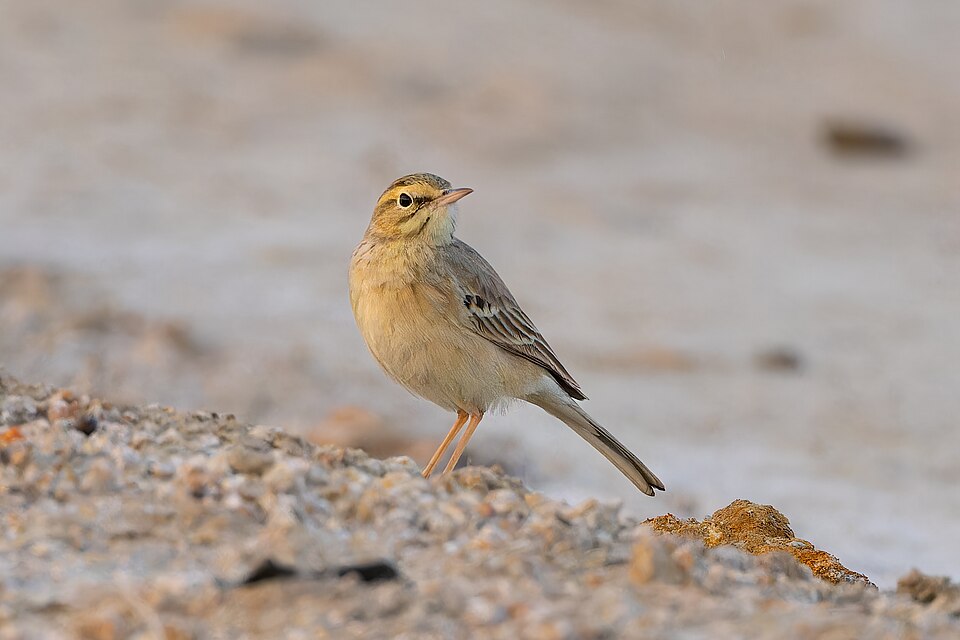 Tawny Pipit
In short
The most reliable field mark between Richard's Pipit and Tawny Pipit is overall structure: Richard's Pipit is noticeably larger, longer-legged, and longer-tailed, with a heavier, longer bill and a more upright stance. Tawny Pipit is smaller, with shorter wings and tail, a narrower bill, and a more horizontal posture. Both are plain, sandy-brown pipits with subtle streaking, but Richard's Pipit shows more streaking above and on the breast, and has a stronger, more contrasting face pattern. In flight, Richard's Pipit appears lankier and gives a harsher, lower-pitched call, while Tawny Pipit is more compact with a higher-pitched call. Separating them is challenging, especially in autumn and winter, but careful attention to structure, face pattern, and call will usually resolve the ID.
Identification tips
- Structure is key: Richard's Pipit is larger, longer-legged, and longer-tailed, with a heavier, longer bill and a more upright stance. Tawny Pipit is smaller, with shorter wings and tail, a narrower bill, and a more horizontal posture. This is often the most reliable difference in the field.
- Face pattern: Richard's Pipit has a strongly marked face, with a pale supercilium and lores, and bold dark eyestripe, moustachial, and malar stripes. Tawny Pipit's face is plainer, with less contrast and weaker markings.
- Streaking: Richard's Pipit shows more obvious dark streaking on the upperparts and breast, while Tawny Pipit is sandier and less streaked, especially on the breast and mantle.
- Bill shape and color: Richard's Pipit has a longer, heavier, and darker bill with a yellowish base to the lower mandible; Tawny Pipit's bill is narrower, shorter, and darker overall.
- Leg color and length: Both have pale legs, but Richard's are longer and more yellow-brown, contributing to its upright look.
- Tail pattern: Richard's Pipit has a long tail with white outer feathers, which may be visible in flight or when flicked; Tawny's tail is shorter and less strikingly marked.
- Wingbars: Both species can show two pale wingbars, but this is not a strong separator; focus on structure and streaking instead.
- Jizz in flight: Richard's Pipit appears lankier and more undulating in flight, with a longer tail and legs trailing; Tawny Pipit is more compact and direct in flight.
- Call: Richard's Pipit gives a loud, harsh, explosive 'shreep'; Tawny Pipit's 'schip' is higher-pitched and softer. Call is often the clincher in ambiguous views.
- Song: If heard, Richard's is a monotonous series of buzzy notes; Tawny's is a short, loud, disyllabic 'chir-ree chir-ree'.
- Habitat context: In western Europe, Richard's Pipit is a rare vagrant, usually on coastal headlands and islands in autumn; Tawny Pipit is a local breeder in open, dry country.
- Seasonal confusion: Both species can occur together in winter in South Asia, and both are plain pipits; always prioritize structure and call when plumage is ambiguous.
- Beware of overlap with other large pipits: Both can be confused with Blyth's Pipit and Paddyfield Pipit; if unsure, focus on the combination of size, structure, face pattern, and call.
- No distinctive age-specific wing pattern: Neither species has a unique juvenile or first-winter upperwing mark to separate them; all ages must be identified on structure, plumage, and voice.
- Variation: Richard's Pipit subspecies vary in size and streaking, but always remain larger and more robust than Tawny Pipit.
Size
Richard's Pipit is the larger and heavier of the two, with a length of 17–20 cm and a wingspan of 29–33 cm, compared to Tawny Pipit's 16 cm length and 25–28 cm wingspan. The only available mass figure is for Tawny Pipit (22 g), but Richard's Pipit is consistently described as heavier (25–36 g). In the field, Richard's Pipit looks longer-legged and longer-tailed, with a more robust, longer bill, while Tawny Pipit is more compact and lighter overall.
Plumage
No age-specific upperwing or flight pattern marks are described for either species, so separation relies on overall plumage and structure. Richard's Pipit is browner above with more obvious dark streaking on the upperparts and breast, and has two pale wingbars formed by the tips of the wing-coverts. Its face is strongly marked, with a pale supercilium, lores, and contrasting dark eyestripe, moustachial, and malar stripes. Tawny Pipit is plainer and sandier above, with less streaking overall, especially on the upperparts and breast. Its face pattern is weaker, lacking the strong contrasts of Richard's. Both are pale below, but Richard's Pipit typically looks more streaked on the breast, while Tawny Pipit is cleaner and more uniform. Bill color can help: Richard's Pipit has a yellowish base to the lower mandible, while Tawny's bill is narrower and darker overall.
Behaviour
Richard's Pipit often stands very upright, accentuating its long legs and tail, and can appear lanky or stretched when walking or running. Its flight is described as strong and undulating. Tawny Pipit is more likely to appear horizontal and compact, both when perched and on the ground. In flight, Tawny Pipit is strong and direct, but less undulating than Richard's. Both species feed mainly on the ground, taking insects and some seeds, and both may make short flights to catch prey.
Habitat
Both species favor open country, but Richard's Pipit prefers flat lowland grasslands, steppe, and fertile, moist cultivated land, especially in the East Palearctic and as a migrant in South and Southeast Asia. Tawny Pipit breeds across a broader swath of the Palearctic, including drier open habitats from northwest Africa and Portugal to Central Siberia and Inner Mongolia, and winters in tropical Africa and the Indian subcontinent. In Europe, Richard's Pipit is a rare but regular vagrant, often found on coastal headlands and islands, while Tawny Pipit is a breeding bird in suitable open country.
Voice
Richard's Pipit gives a loud, explosive 'shreep' call, which is harsh and lower-pitched, somewhat reminiscent of a House Sparrow's chirp. Its song is a series of monotonous buzzy notes delivered in an undulating song-flight. Tawny Pipit's call is a higher-pitched 'schip', less harsh than Richard's, and its song is a short, loud, disyllabic 'chir-ree chir-ree'. In the field, call is a key separator: Richard's is harsher and lower, Tawny's is softer and higher.