
Redwing vs Fieldfare
Turdus iliacus versus Turdus pilaris
Play a quiz with Redwing and Fieldfare
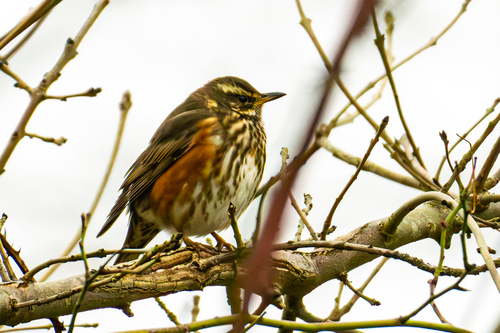 Redwing
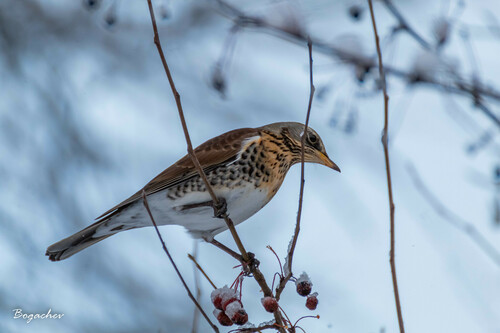 Fieldfare
In short
The most reliable field mark to separate Redwing from Fieldfare is the Redwing’s bold creamy-white supercilium (eyebrow) and the bright reddish flanks and underwing, versus the Fieldfare’s distinctive slate-grey head, rump, and nape, and its lack of any red in the plumage. In flight, Fieldfare shows striking white underwing coverts and axillaries, while Redwing flashes red underwing. Juvenile Fieldfares are duller but still lack the Redwing’s red. Redwing is distinctly smaller and more delicate in build, with a plain brown back, while Fieldfare is bulkier with a dark brown back and heavily spotted breast. Both are northern thrushes, but Fieldfare is much larger and often appears in noisy flocks.
Identification tips
- Redwing’s creamy-white supercilium is bold and always present; Fieldfare never shows a strong eyebrow. Use this mark on perched or ground birds of all ages.
- Redwing’s red flanks and underwing are diagnostic in all plumages; Fieldfare never shows any red. Look for this especially in flight or when the bird fluffs its feathers.
- Fieldfare’s slate-grey head, nape, and rump are unique; Redwing’s head and rump are plain brown. This is visible in all adult and juvenile Fieldfares.
- Fieldfare’s white underwing coverts and axillaries flash in flight, contrasting with Redwing’s red underwing. Use this for birds flushed from the ground or flying overhead.
- Fieldfare’s breast is heavily spotted and creamy-buff, while Redwing’s is white with smaller, dark spots. Redwing’s spots are more restricted to the upper breast.
- Redwing is smaller and slimmer, with a shorter wingspan and more delicate build. Fieldfare is noticeably bulkier and longer-tailed.
- Fieldfare’s back is dark brown with chestnut tones, while Redwing’s back is plain brown with no chestnut or grey.
- Juvenile Fieldfares are duller but still show grey head and lack red; juvenile Redwings look like adults but may be slightly duller, always with the supercilium and red flanks.
- Fieldfare’s facial pattern includes black lores and under-eye, but lacks the Redwing’s strong eyebrow. Redwing’s face is plainer apart from the supercilium.
- Fieldfare’s tail is blackish and rounded, with a subtle white border on the outer feathers; Redwing’s tail is brown and less contrasting.
- Fieldfare’s call is a harsh "tsak tsak", often given in flight or by flocks; Redwing’s flight call is a clear whistle. Listen for these when birds are flying overhead.
- Fieldfare often appears in large, noisy flocks, especially in winter; Redwing is more often solitary or in small groups.
- Fieldfare stands upright and looks robust, while Redwing is more horizontal and delicate in posture.
- In mixed flocks, check for red and supercilium for Redwing, and grey head and white underwing for Fieldfare.
- Habitat overlap is common in winter, so rely on plumage and structure, not location, for separation.
Size
Redwing is considerably smaller and lighter, with an average mass of 62 g compared to Fieldfare’s 105 g. Redwing measures 20–24 cm in length and has a wingspan of 33–34.5 cm, while Fieldfare is larger at about 25 cm long with a wingspan of 39–42 cm. In the field, Fieldfare appears bulkier and longer-tailed, with a more robust, upright stance. Redwing is more compact and slim, often looking more delicate and agile.
Plumage
Juvenile and adult Fieldfares always lack red in the plumage, while all ages of Redwing show red flanks and underwing. In flight, Fieldfare’s white underwing coverts and axillaries are obvious, contrasting with Redwing’s red underwing. Adult Fieldfares have a slate-grey head, nape, and rump, a dark brown back, and a boldly speckled breast, while Redwing has a plain brown back, white underparts with dark spots, and a strong creamy-white supercilium. Juvenile Fieldfares are duller than adults, with pale streaks on the feathers, but still show the grey head and lack of red. Both species have spotted breasts, but Fieldfare’s is more heavily marked and the throat and upper breast are creamy-buff with bold dark streaks. Redwing’s supercilium is always present and diagnostic, while Fieldfare’s facial markings are more diffuse, with black lores and under-eye but no strong eyebrow.
Behaviour
Fieldfares are often seen in large, noisy flocks, especially in winter, and are more likely to feed in open fields or perched high in trees. Their upright posture and tendency to gather in groups make them conspicuous. Redwings are more secretive, often found singly or in small groups, and may forage lower or in denser cover. Both species are migratory and can be seen together in mixed flocks, but Fieldfare’s social, bold behavior contrasts with the Redwing’s more retiring habits.
Habitat
Both species breed in northern Europe and the Palearctic, often in woodland and scrub. In winter, both move south and may be found in similar habitats such as fields, hedgerows, and woodland edges. Fieldfare is more likely to be seen in open country and larger flocks, while Redwing may prefer denser cover and is often less conspicuous.
Voice
Fieldfare’s flight call is a harsh, repeated "tsak tsak" or "tsuk", often given by flocks in flight or perched birds. Redwing’s flight call is a whistling note, and its song is a short, varied series of clear or trilled notes, less harsh than Fieldfare’s calls. Fieldfare’s song is weak and rarely heard, while Redwing’s song is more musical but still not as rich as Song Thrush. In mixed flocks, the Fieldfare’s harsh calls stand out.