

Redhead vs Common Pochard
Aythya americana versus Aythya ferina
Play a quiz with Redhead and Common Pochard
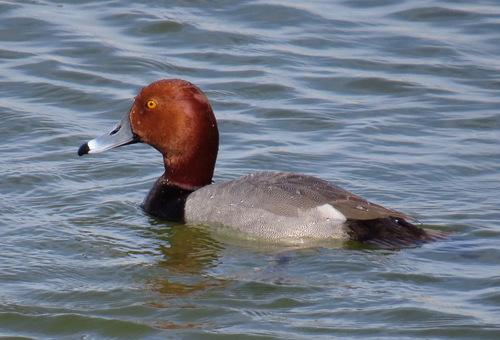 Redhead
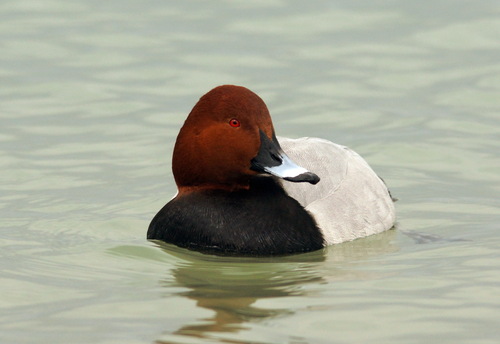 Common Pochard
In short
The most reliable field mark to separate Redhead from Common Pochard is the eye color in adult males: Redhead males have bright yellow eyes, while Common Pochard males show orange-red to red irises in the breeding season. Both species are medium-sized diving ducks with similar chestnut heads and black breasts, but Redhead males have a more rounded head and shorter bill, while Common Pochard males show a sloping forehead and longer bill. Female and immature birds are much trickier, but subtle differences in head shape and bill pattern can help. In flight or at a distance, back color and overall jizz may offer supporting clues, but beware of overlap and seasonal variation.
Identification tips
- Adult male eye color is the single best field mark: Redhead males have bright yellow eyes; Common Pochard males show orange-red to red irises, especially in breeding season. This is visible at moderate range in good light.
- Head shape is a strong structural clue: Redhead males and females have a distinctly rounded head profile, while Common Pochard shows a sloping forehead and more angular head. This is most obvious in profile or when the birds are alert.
- Bill shape and pattern: Redhead has a shorter, more triangular bill with a pale blue base, thin black ring, and black tip. Common Pochard's bill is longer, with a wide blue-gray band across the middle and a darker tip, but lacks the thin black ring.
- Back and body color: Redhead males have a plain gray back and sides; Common Pochard males have a paler gray body with fine vermiculations (subtle speckling), though this can be hard to see at distance.
- Female separation is subtle: Both are brownish with pale faces, but Redhead females tend to look warmer and more uniform, with a more rounded head and shorter bill. Common Pochard females may show a slightly paler cheek and more sloping forehead.
- Nonbreeding males can be confusing: Redhead males lose their copper head and become browner, making them resemble females and female pochards. Use head shape and bill pattern as fallback marks.
- Iris color in females and immatures: Redhead females have yellowish eyes, while Common Pochard females and juveniles have brown to yellow-brown (or yellow-olive in juveniles) eyes. This is subtle and not always reliable.
- Tail and rump: Both species have black tails and rumps in males, not a strong separator.
- Flight and flocking: No distinctive upperwing pattern is described for either species, so flight views rely on overall shape and head/bill profile.
- Habitat and range: If seen in North America, Redhead is vastly more likely; in Eurasia, Common Pochard dominates. Only consider both where vagrancy or captive birds are possible.
- Voice: Not diagnostic for separation in the field per available notes.
- Beware hybrids and eclipse plumage: Both species can hybridize with other Aythya ducks, and eclipse (molting) males can be very drab. Always check multiple features.
- Seasonal effects: Eye color in Common Pochard males intensifies in breeding season; Redhead male's eye remains yellow year-round.
- Contextual clues: Redhead often migrates in pairs, while Common Pochard is more likely in single-species flocks in Eurasia.
- When in doubt: Prioritize eye color and head shape, then bill pattern. If these are ambiguous, separation may not be possible without better views.
Size
Both species are very close in size and bulk, with Redhead averaging about 1045 g in body mass [wikidata]. Redhead length is 40–56 cm (16–22 in) with a 74–84 cm (29–33 in) wingspan, while Common Pochard is 42–49 cm (17–19 in) long with a 72–82 cm (28–32 in) wingspan [wikipedia]. Any difference in size is negligible in the field, and both appear as stocky, medium-sized diving ducks.
Plumage
No distinctive juvenile or immature upperwing pattern is described for either species, so focus falls on head, bill, and body coloration.
-
Adult males (breeding): Redhead males show a rich coppery head, yellow eyes, pale blue bill with a black tip and thin black ring, gray back, black breast, and white belly. Common Pochard males have a chestnut head (slightly less coppery), red to orange-red eyes, a dark gray bill with a wide blue-gray band, pale gray body with fine vermiculations, and black breast and tail.
-
Females: Both are brownish and similar overall, but Redhead females have a more rounded head and shorter bill, while Common Pochard females have a sloping forehead and longer bill. Eye color is brown in both, but Common Pochard's can be yellowish-brown.
-
Immatures/Juveniles: No detailed wing or body pattern differences are noted for these ages; iris color in Common Pochard juveniles is yellow-olive, turning adult by first winter.
-
Nonbreeding males: Redhead males lose the copper tone and become browner-headed, further resembling females and making separation more challenging.
Behaviour
Both species are diving ducks, often seen in mixed flocks on open water. Redhead tends to migrate in pairs, while unpaired birds form 'courting parties.' No specific behavioral difference is highlighted that is useful for field separation between these two species.
Habitat
Redhead is a North American species, while Common Pochard is Palearctic, so overlap is rare except in vagrancy or captivity. Both favor lakes and large bodies of water. In areas where both might occur, habitat choice is not a reliable separator.