

Red-necked Stint vs Semipalmated Sandpiper
Calidris ruficollis versus Calidris pusilla
Play a quiz with Red-necked Stint and Semipalmated Sandpiper
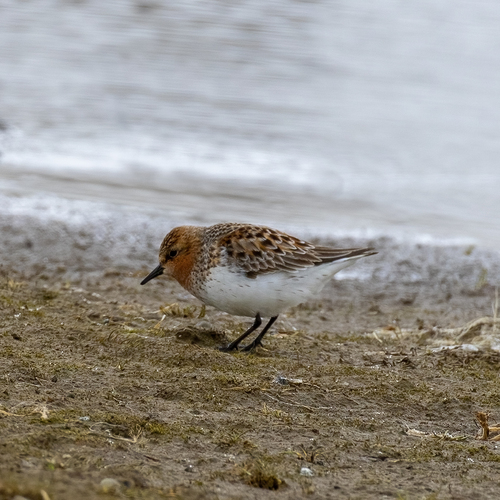 Red-necked Stint
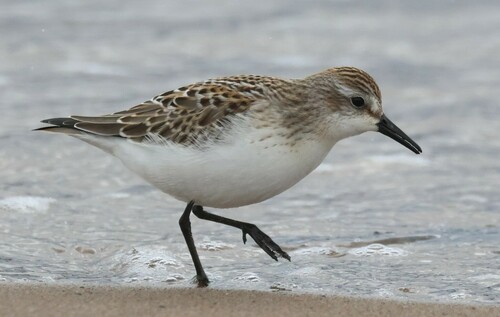 Semipalmated Sandpiper
In short
Red-necked Stint and Semipalmated Sandpiper are both tiny, dark-legged shorebirds that can be extremely challenging to separate, especially in non-breeding or juvenile plumages. The most reliable field mark is the presence of partial webbing between the toes on Semipalmated Sandpiper, which Red-necked Stint lacks, but this is rarely visible without close views or photos. In the field, focus on bill shape and length, leg length, and subtle differences in structure and movement. Breeding Red-necked Stint shows a distinctive orange breast and white V on the back, but most confusion arises in duller plumages, where careful attention to size, bill, and primary projection is needed.
Identification tips
- Toe webbing: Semipalmated Sandpiper has partial webbing between the bases of the toes; Red-necked Stint does not. This is the single most definitive mark but requires close views or photos of the feet.
- Bill shape and length: Red-necked Stint has a fine, thin, and straight bill with a delicate tip; Semipalmated Sandpiper's bill is short, stout, and straight, often looking blunter and thicker. This difference is subtle but important, especially in profile views.
- Leg length: Red-necked Stint is shorter-legged than Semipalmated Sandpiper. In direct comparison, look for a lower, more horizontal stance in Red-necked Stint.
- Primary projection: Red-necked Stint has a longer primary projection (wing tips extending well beyond the tail) compared to Semipalmated Sandpiper. This makes Red-necked Stint look more attenuated and less compact when at rest.
- Breeding plumage: Only Red-necked Stint shows an unstreaked orange breast and a white V on the back, bordered below by dark markings. Semipalmated Sandpiper never shows this combination.
- Juvenile upperparts: Juvenile Red-necked Stint has more contrasting mantle feathers and weaker white lines down the back than juvenile Semipalmated Sandpiper. Look for a crisp, scaly look in Red-necked Stint juveniles.
- Non-breeding/winter plumage: Both species become plain grey-brown above and white below, but Red-necked Stint tends to appear cleaner, with less breast and flank streaking than Semipalmated Sandpiper.
- Face pattern: Subtle and not always reliable, but Red-necked Stint may show a slightly plainer face, while Semipalmated Sandpiper can show a faint supercilium and more diffuse head markings.
- Movement and jizz: Red-necked Stint is often described as quicker and more frenetic in its feeding action, while Semipalmated Sandpiper is steadier and bulkier. Use this only as supporting evidence.
- Size: Red-necked Stint is slightly smaller and lighter, but there is overlap; use only in direct comparison.
- Location and context: In North America, a stint among Semipalmated Sandpipers is likely to be a vagrant Red-necked Stint; in Australasia, the reverse is true. Always confirm with structural and plumage marks.
- Call: Red-necked Stint gives a hoarse "stit"; Semipalmated Sandpiper's call is not distinctive in this context.
- Flock association: Both species may mix with other small Calidris, so flock composition is not diagnostic.
- Sex and age: No strong sexual dimorphism; focus on age-related plumage and structure as above.
- Pitfalls: Beware of dull juveniles and non-breeding birds, where most marks are subtle and overlap is high. Prioritize bill, toe webbing, and primary projection when possible.
Size
Both species are among the smallest shorebirds, but Red-necked Stint is slightly smaller and more delicate overall. Red-necked Stint measures 13–17 cm in length with a typical mass around 26 g [wikidata], while Semipalmated Sandpiper is 15–18 cm long and can weigh up to 51.5 g [wikipedia]. In mixed flocks, Red-necked Stint may appear a touch shorter-legged and more compact, but size overlap is considerable and not always reliable for single birds.
Plumage
Juvenile and non-breeding plumages are most often confused. Juvenile Red-necked Stint shows more contrasting mantle feathers and weaker white lines down the back compared to similar-aged Semipalmated Sandpiper. Breeding adult Red-necked Stint is unique among these two for its unstreaked orange breast and a white V on the mantle, bordered below by dark markings—features not shown by Semipalmated Sandpiper. In winter, both species become drab grey-brown above and white below, but Red-necked Stint tends to look cleaner and paler, with less streaking on the breast and flanks. Semipalmated Sandpiper in all plumages has a short, stout, straight dark bill, and the upperparts are dark grey-brown with a light grey-brown wash on the head and neck. The webbing between the toes is a structural difference, not a plumage mark, but is a key separation point if visible.
Behaviour
Red-necked Stint is described as quicker moving and more active, often feeding with rapid, darting movements. Semipalmated Sandpiper also forages actively but may appear slightly bulkier and less frenetic. Both species are highly gregarious and may form large mixed flocks with other small Calidris, so behavior alone is rarely diagnostic but can add context when combined with other marks.
Habitat
Red-necked Stint breeds in northeast Russia and winters along Southeast Asian and Australasian coastlines, while Semipalmated Sandpiper breeds in the southern tundra of Canada and Alaska and winters in coastal South America, the southern US, and the Caribbean. Both species use mudflats and coastal wetlands on migration and in winter. In North America, Red-necked Stint is a rare vagrant, while Semipalmated Sandpiper is common. In Australasia, the reverse is true.
Voice
Red-necked Stint gives a hoarse "stit" call. No distinctive vocal differences are noted for Semipalmated Sandpiper in the provided sources, and voice is not a reliable field mark for separating these two in most field situations.