

Motmot

Red-necked Nightjar vs Common Swift

Caprimulgus ruficollis versus Apus apus

Play a quiz with Red-necked Nightjar and Common Swift
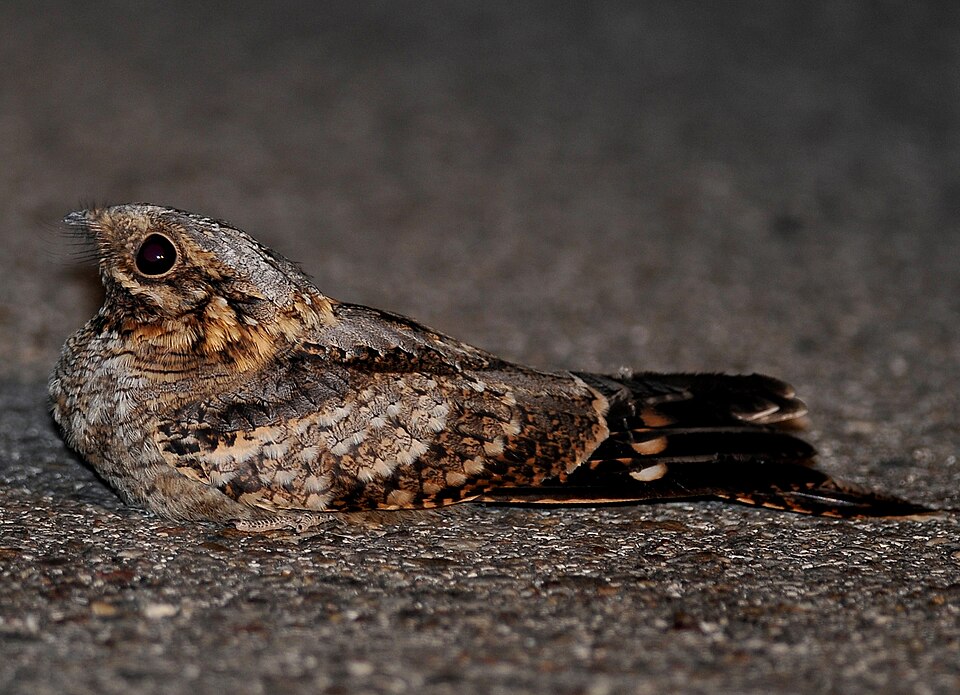
Red-necked Nightjar (Caprimulgus ruficollis) Red-necked Nightjar
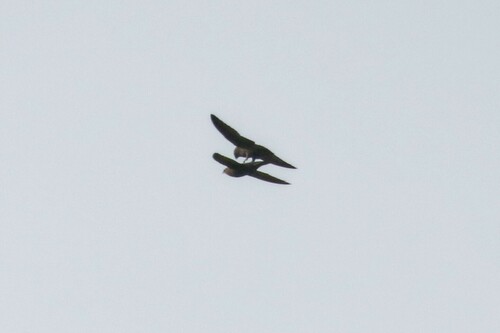
Common Swift (Apus apus) Common Swift

Media

Loading…

In short

The most reliable field mark is structural: Red-necked Nightjar is much larger and bulkier than Common Swift, with a longer tail and broader, rounded wings, while the swift is compact, crescent-winged, and never perches exposed during the day. In flight, nightjar shows a slow, moth-like, buoyant flight with white patches on the wings and tail sides, whereas the swift is fast, scythe-winged, and uniformly dark. Nightjars have a striking rufous neck collar and barred underparts, contrasting with the swift’s all-dark plumage and only a tiny pale chin patch. If perched, the nightjar sits horizontally on the ground or a branch; swifts almost never perch visibly. Calls are also very different: mechanical churring or clapping for nightjar, loud screaming for swift.

Identification tips

  1. Size and structure: Nightjar is much larger, with a robust body, long tail, and broad, rounded wings; swift is compact, slender, and crescent-winged. This is obvious even at a distance.
  2. Flight style: Nightjar has a slow, buoyant, moth-like flight with alternating strong wingbeats and glides; swift is fast, direct, and agile, rarely gliding, with constant rapid wingbeats.
  3. Wing shape: Nightjar’s wings are broad and rounded; swift’s are long, narrow, and swept back like a boomerang or crescent.
  4. Tail: Nightjar has a long, straight or slightly rounded tail with white corners (in both sexes); swift’s tail is short and deeply forked, with no white.
  5. Plumage pattern: Nightjar is mottled grey, buff, chestnut, and black, with a conspicuous rufous neck collar and barred underparts; swift is uniform blackish-brown with no barring or rufous tones.
  6. White markings: Nightjar shows white spots on the wings and tail sides (both sexes, all ages); swift has no white in wings or tail, only a tiny pale chin patch.
  7. Perched appearance: Nightjar perches horizontally on the ground or a branch, blending in with bark or leaf litter; swift almost never perches visibly except at the nest, and never sits exposed.
  8. Bill and gape: Nightjar has a short bill with a very wide gape for catching insects; swift has a tiny bill and less obvious gape.
  9. Voice: Nightjar’s call is a repetitive mechanical kyok-kyok-kyok and a churring song; swift’s call is a loud, high-pitched scream, often in flocks. If you hear a scream, it’s a swift; if you hear churring or mechanical clicks, it’s a nightjar.
  10. Habitat context: Nightjar is found in open sandy heaths with scattered trees/bushes, usually on the ground by day; swift is seen flying high over towns, fields, or water, never on the ground.
  11. Activity period: Nightjar is crepuscular/nocturnal, most active at dusk and dawn; swift is diurnal, active all day.
  12. Camouflage: Nightjar is extremely well-camouflaged when perched, resembling bark or lichen; swift is never camouflaged, as it is almost always in flight.
  13. Seasonal presence: Nightjar breeds in Iberia/North Africa, winters in tropical West Africa; swift breeds across Europe and migrates to sub-Saharan Africa, but is present in a wider range of habitats during migration.
  14. Common pitfalls: At dusk, a distant nightjar in flight could be mistaken for a swift due to long wings, but the slow, buoyant flight and white wing/tail patches are diagnostic. Swifts never show white in the wings/tail and never perch exposed.
  15. Sex/age differences: Both nightjar sexes show white in wings/tail and rufous collar; swift sexes and ages look alike, always dark with no white except tiny chin patch.

Size

Red-necked Nightjar is dramatically larger and heavier (body mass ~84g, length 32 cm, wingspan 64 cm [wikidata, wikipedia]) compared to the Common Swift (length 16–17 cm, wingspan 38–40 cm [wikipedia]). The nightjar is the largest European nightjar, with a longer tail and much more robust body. The swift is medium-sized for a swift but less than half the nightjar’s mass, appearing slender and lightweight in direct comparison.

Plumage

No age-specific upperwing patterns are described for either species, so focus is on adult and general plumage. Red-necked Nightjar is lichen-grey, barred and streaked with buff, chestnut, and black, with a distinctive rufous neck collar and barred underparts. Both sexes show white spots on the wings, tail sides, and throat, visible in flight and sometimes at rest. Common Swift is entirely blackish-brown, with only a small pale chin patch (not visible at distance) and no white in the wings or tail. The swift’s plumage is uniform and lacks any barring, rufous tones, or obvious patterning. In flight, the nightjar’s white patches and rufous collar can be diagnostic, while the swift remains plain and dark.

Behaviour

Red-necked Nightjar is crepuscular and nocturnal, flying at dusk with slow, buoyant, moth-like wingbeats, often alternating strong flaps with glides. By day, it lies motionless on the ground or a branch, perfectly camouflaged. Common Swift is almost always airborne, with rapid, direct, and highly maneuverable flight, rarely landing except at the nest. Swifts are active all day, often in screaming flocks, and are never seen perched in the open. Nightjars can be seen perched horizontally; swifts are not.

Habitat

Red-necked Nightjar breeds in open sandy heaths with scattered trees or bushes in Iberia and North Africa, wintering in tropical West Africa. It is a ground-dweller by day. Common Swift breeds across Europe, favoring urban or rural areas with suitable nesting sites (often buildings), and spends most of its life in the air, foraging over a wide range of habitats, especially near water. Swifts are rarely seen on the ground or perched.

Voice

Red-necked Nightjar gives a repetitive mechanical kyok-kyok-kyok call, rising and falling as the bird turns its head, and a churring song when perched or crouched. It also produces a sharp wing-clap during courtship. Common Swift’s call is a loud, piercing scream, often given in flight in flocks, with two pitch types (higher from females). The two vocalizations are entirely different and diagnostic if heard.

Submit a better description

Use the same sections as the comparison. Your text is published immediately.

The most reliable field mark is structural: Red-necked Nightjar is much larger and bulkier than Common Swift, with a longer tail and broader, rounded wings, while the swift is compact, crescent-winged, and never perches exposed during the day. In flight, nightjar shows a slow, moth-like, buoyant flight with white patches on the wings and tail sides, whereas the swift is fast, scythe-winged, and uniformly dark. Nightjars have a striking rufous neck collar and barred underparts, contrasting with the swift’s all-dark plumage and only a tiny pale chin patch. If perched, the nightjar sits horizontally on the ground or a branch; swifts almost never perch visibly. Calls are also very different: mechanical churring or clapping for nightjar, loud screaming for swift.

  1. Size and structure: Nightjar is much larger, with a robust body, long tail, and broad, rounded wings; swift is compact, slender, and crescent-winged. This is obvious even at a distance.
  2. Flight style: Nightjar has a slow, buoyant, moth-like flight with alternating strong wingbeats and glides; swift is fast, direct, and agile, rarely gliding, with constant rapid wingbeats.
  3. Wing shape: Nightjar’s wings are broad and rounded; swift’s are long, narrow, and swept back like a boomerang or crescent.
  4. Tail: Nightjar has a long, straight or slightly rounded tail with white corners (in both sexes); swift’s tail is short and deeply forked, with no white.
  5. Plumage pattern: Nightjar is mottled grey, buff, chestnut, and black, with a conspicuous rufous neck collar and barred underparts; swift is uniform blackish-brown with no barring or rufous tones.
  6. White markings: Nightjar shows white spots on the wings and tail sides (both sexes, all ages); swift has no white in wings or tail, only a tiny pale chin patch.
  7. Perched appearance: Nightjar perches horizontally on the ground or a branch, blending in with bark or leaf litter; swift almost never perches visibly except at the nest, and never sits exposed.
  8. Bill and gape: Nightjar has a short bill with a very wide gape for catching insects; swift has a tiny bill and less obvious gape.
  9. Voice: Nightjar’s call is a repetitive mechanical kyok-kyok-kyok and a churring song; swift’s call is a loud, high-pitched scream, often in flocks. If you hear a scream, it’s a swift; if you hear churring or mechanical clicks, it’s a nightjar.
  10. Habitat context: Nightjar is found in open sandy heaths with scattered trees/bushes, usually on the ground by day; swift is seen flying high over towns, fields, or water, never on the ground.
  11. Activity period: Nightjar is crepuscular/nocturnal, most active at dusk and dawn; swift is diurnal, active all day.
  12. Camouflage: Nightjar is extremely well-camouflaged when perched, resembling bark or lichen; swift is never camouflaged, as it is almost always in flight.
  13. Seasonal presence: Nightjar breeds in Iberia/North Africa, winters in tropical West Africa; swift breeds across Europe and migrates to sub-Saharan Africa, but is present in a wider range of habitats during migration.
  14. Common pitfalls: At dusk, a distant nightjar in flight could be mistaken for a swift due to long wings, but the slow, buoyant flight and white wing/tail patches are diagnostic. Swifts never show white in the wings/tail and never perch exposed.
  15. Sex/age differences: Both nightjar sexes show white in wings/tail and rufous collar; swift sexes and ages look alike, always dark with no white except tiny chin patch.

Red-necked Nightjar is dramatically larger and heavier (body mass ~84g, length 32 cm, wingspan 64 cm [wikidata, wikipedia]) compared to the Common Swift (length 16–17 cm, wingspan 38–40 cm [wikipedia]). The nightjar is the largest European nightjar, with a longer tail and much more robust body. The swift is medium-sized for a swift but less than half the nightjar’s mass, appearing slender and lightweight in direct comparison.

No age-specific upperwing patterns are described for either species, so focus is on adult and general plumage. Red-necked Nightjar is lichen-grey, barred and streaked with buff, chestnut, and black, with a distinctive rufous neck collar and barred underparts. Both sexes show white spots on the wings, tail sides, and throat, visible in flight and sometimes at rest. Common Swift is entirely blackish-brown, with only a small pale chin patch (not visible at distance) and no white in the wings or tail. The swift’s plumage is uniform and lacks any barring, rufous tones, or obvious patterning. In flight, the nightjar’s white patches and rufous collar can be diagnostic, while the swift remains plain and dark.

Red-necked Nightjar is crepuscular and nocturnal, flying at dusk with slow, buoyant, moth-like wingbeats, often alternating strong flaps with glides. By day, it lies motionless on the ground or a branch, perfectly camouflaged. Common Swift is almost always airborne, with rapid, direct, and highly maneuverable flight, rarely landing except at the nest. Swifts are active all day, often in screaming flocks, and are never seen perched in the open. Nightjars can be seen perched horizontally; swifts are not.

Red-necked Nightjar breeds in open sandy heaths with scattered trees or bushes in Iberia and North Africa, wintering in tropical West Africa. It is a ground-dweller by day. Common Swift breeds across Europe, favoring urban or rural areas with suitable nesting sites (often buildings), and spends most of its life in the air, foraging over a wide range of habitats, especially near water. Swifts are rarely seen on the ground or perched.

Red-necked Nightjar gives a repetitive mechanical kyok-kyok-kyok call, rising and falling as the bird turns its head, and a churring song when perched or crouched. It also produces a sharp wing-clap during courtship. Common Swift’s call is a loud, piercing scream, often given in flight in flocks, with two pitch types (higher from females). The two vocalizations are entirely different and diagnostic if heard.

Discard your changes?

You have unsaved edits. If you leave now, those changes will be lost.

Red-necked Nightjar · Common Swift · My Tricky Birds