

Red-necked Grebe vs Great Crested Grebe
Podiceps grisegena versus Podiceps cristatus
Play a quiz with Red-necked Grebe and Great Crested Grebe
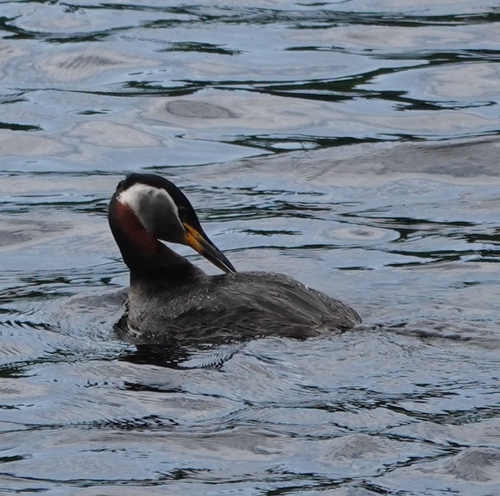 Red-necked Grebe
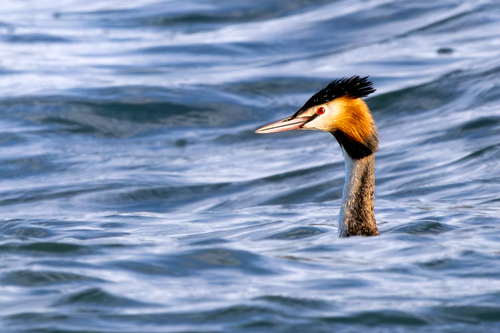 Great Crested Grebe
In short
In winter and immature plumages, Red-necked Grebe and Great Crested Grebe can be confusing, but the most reliable field mark is the head and face pattern: Great Crested Grebe always shows a sharp white area above the eye, while Red-necked Grebe has a duskier, less defined cap merging into a grey face with a pale rear crescent. Structurally, Great Crested Grebe is longer-necked and slightly heavier, with a more contrasting head pattern and a pink bill in winter. Juveniles of both species are striped, but Red-necked Grebe juveniles have a paler red neck and more yellow on the bill. In flight, Red-necked Grebe appears more stretched out, with a long neck and trailing feet, while Great Crested Grebe is bulkier and longer overall. Both species are expert divers, but their habitat preferences and overall jizz can help separate them when plumage is ambiguous.
Identification tips
- Head and face pattern in winter: Great Crested Grebe always shows a sharp white area above the eye, while Red-necked Grebe has a duskier, less defined dark grey cap merging into a grey face with a pale rear crescent. This is the most reliable field mark in non-breeding plumage.
- Neck length and posture: Great Crested Grebe is longer-necked and appears more elongated and stately, especially when swimming. Red-necked Grebe is slightly shorter-necked and more compact.
- Bill color in winter: Great Crested Grebe has a pink bill in winter, while Red-necked Grebe's bill is darker with less obvious yellow than in summer.
- Juvenile plumage: Both have striped chicks, but Red-necked Grebe juveniles show a diffuse blackish cap, pale red neck, and more yellow on the bill. Great Crested Grebe juveniles have bold black-and-white head stripes that fade in their first winter.
- Breeding plumage: Red-necked Grebe has a rich red neck and black cap with a pale grey face, while Great Crested Grebe is unmistakable with ornate black and orange-brown head plumes and a sharply contrasting white face.
- Flight silhouette: Red-necked Grebe flies with its long neck extended and large feet trailing, giving a stretched-out look. Great Crested Grebe is bulkier and longer, but less stretched in flight.
- Wing pattern: Both show grey wings with white secondaries in flight, but no unique upperwing pattern is noted for separation.
- Size: Great Crested Grebe is slightly heavier and longer, but this can be subtle unless seen side by side.
- Habitat in winter: Red-necked Grebe is more likely on coastal waters just beyond the surf, while Great Crested Grebe favors large lakes and reservoirs.
- Behavior: Both dive to escape danger, but Red-necked Grebe is especially reluctant to fly and needs a long run across water to take off.
- Courtship display: Great Crested Grebe performs elaborate synchronized dances; Red-necked Grebe also has an elaborate display but is less ornate.
- Vocalizations: Red-necked Grebe is more vocal during the breeding season, with loud wailing calls; Great Crested Grebe's calls are less described in the sources.
- Chick-carrying: Both species carry chicks on their backs, but Great Crested Grebe is noted for teaching young to swim by diving and leaving them to follow.
- Bill structure: Red-necked Grebe's bill is relatively larger and heavier compared to the more slender bill of Great Crested Grebe.
- Cap contrast: In winter, Red-necked Grebe's cap is less sharply defined, blending into the face, while Great Crested Grebe's cap and face contrast is always strong.
Size
Great Crested Grebe is the larger of the two, with an average adult mass of 875 g compared to Red-necked Grebe's 829 g [wikidata]. Great Crested Grebe is also longer (46–51 cm) and has a broader wingspan (59–73 cm), giving it a more elongated and stately appearance on the water. Red-necked Grebe is still a large grebe, but is slightly more compact and less elongated, especially in the neck. In the field, this size difference can be subtle, but Great Crested Grebe's longer neck and heavier build are often apparent when seen side by side.
Plumage
Juvenile and immature plumages are key for separation. Both species' chicks are boldly striped on the head, but Red-necked Grebe juveniles show a diffuse blackish cap, a paler red neck, and more extensive yellow on the bill, while Great Crested Grebe juveniles have strong black-and-white head stripes that fade as they mature. In winter, Red-necked Grebe is overall duskier, with a less defined dark grey cap that merges into the grey face, and a pale crescent behind the face. The front of the neck is whitish or light grey, and the bill's yellow is subdued. Great Crested Grebe in winter is whiter-faced, always showing white above the eye and a pink bill. In breeding plumage, both are distinctive: Red-necked Grebe has a rich red neck and black cap, while Great Crested Grebe sports ornate black and orange-brown head plumes and a sharply contrasting face. In flight, Red-necked Grebe shows grey wings with white secondaries, but no unique upperwing pattern is noted for either species in the sources.
Behaviour
Both species are excellent divers and swimmers, using their feet for propulsion underwater. Red-necked Grebe is more likely to respond to danger by diving rather than flying, and is awkward on land due to its rear-placed feet. In flight, Red-necked Grebe looks stretched out, with its long neck extended and large feet trailing behind, and requires a lengthy run across water to take off. Great Crested Grebe is also a strong diver and swimmer, but appears more elegant and elongated on the water, and is known for its elaborate courtship displays involving synchronized dances. Both species carry their chicks on their backs, but Great Crested Grebe is especially noted for teaching its young to swim and dive by diving and leaving the chicks to float and swim back.
Habitat
Both species breed on vegetated freshwater lakes, but Red-necked Grebe is more migratory, wintering mainly on calm coastal waters just beyond the surf, though some remain on large lakes. Great Crested Grebe is more likely to be resident in milder climates, but also winters on lakes, reservoirs, or coastal waters. In overlapping ranges, Red-necked Grebe may be found on more open or coastal waters in winter, while Great Crested Grebe favors larger, vegetated lakes year-round.
Voice
Red-necked Grebe is among the most vocal grebes in the breeding season, giving a loud, wailing or howling call (uooooh), often in duets, as well as a variety of quacking, clucking, hissing, rattling, and purring calls. It is mostly silent outside the breeding season. Great Crested Grebe is also known for its elaborate courtship displays, but the sources do not provide detailed information on its calls for comparison. In general, vocalizations are unlikely to be diagnostic outside the breeding season.