

Red-legged Partridge vs Pin-tailed Sandgrouse
Alectoris rufa versus Pterocles alchata
Play a quiz with Red-legged Partridge and Pin-tailed Sandgrouse
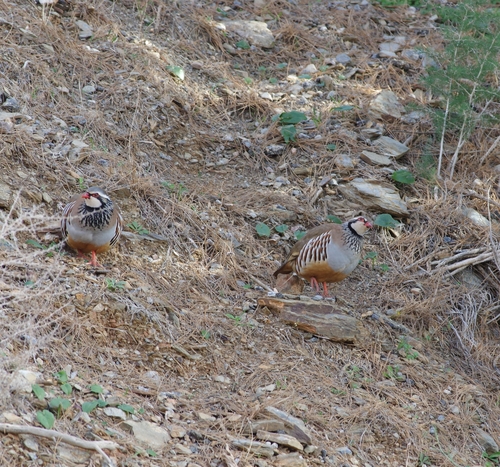 Red-legged Partridge
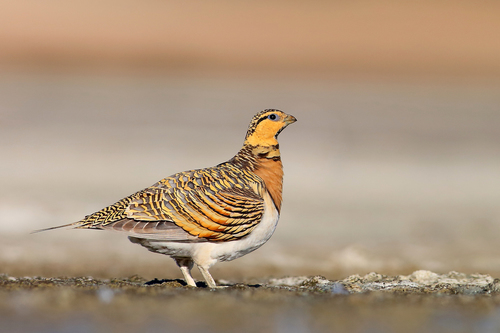 Pin-tailed Sandgrouse
In short
The most reliable field mark to separate Red-legged Partridge from Pin-tailed Sandgrouse is the strong, boldly patterned face and flanks of the partridge versus the sandgrouse's more uniform, yellowish-green upperparts and distinctive long, pointed tail. In flight, Pin-tailed Sandgrouse show strikingly white underwings and long central tail streamers, while Red-legged Partridge lacks these features and appears more compact with short tail and rounded wings. The partridge has a prominent black-and-white face pattern and rufous-barred flanks, while the sandgrouse has a smaller, pigeon-like head and a broad chestnut breast band. Habitat and behavior also differ: partridges are usually found in farmland or scrub, sandgrouse on open, dry plains.
Identification tips
- Tail shape and length: Pin-tailed Sandgrouse has long, pointed central tail feathers (especially in males), creating a pin-tailed look in flight and at rest. Red-legged Partridge has a short, rounded tail with no streamers.
- Underwing color in flight: Sandgrouse shows bright white underwings and underparts in all ages and sexes; partridge underwings are not white and appear duller.
- Face pattern: Red-legged Partridge has a bold black-and-white face with a cream throat bordered by a solid black gorget, a red bill, and a red eye-ring. Sandgrouse has a much plainer face: yellowish or golden-buff cheeks, a narrow black eye-stripe, and a slate-grey bill.
- Flank pattern: Partridge has bold rufous and black bars on the flanks, separated by off-white and pale grey; sandgrouse lacks any flank barring, instead showing a clean white belly separated from the greenish neck by a broad chestnut breast band.
- Crown and nape: Partridge shows a warm pinkish-brown crown with pale blue-grey edges and a narrow off-white supercilium; sandgrouse has a yellowish-green crown in males, more golden-buff in females, with no supercilium.
- Upperparts: Partridge is plain sandy-brown above; sandgrouse is yellowish-green with dull yellow spots (male breeding), or barred black and brownish-yellow (non-breeding and female).
- Bill color: Partridge has a bright red bill; sandgrouse's bill is slate-grey.
- Leg color: Partridge has pinkish-red legs; sandgrouse legs are not described as distinctive.
- Body shape: Partridge is compact and chicken-like, with a rounded body and short tail; sandgrouse is more elongated, with a small pigeon-like head, long pointed wings, and a long tail.
- Flight style: Partridge flies with whirring, rounded wings and short, direct glides; sandgrouse flies fast and directly, often in flocks, with long pointed wings and tail streamers.
- Vocalizations: Listen for the partridge's chattering 'chuck-chuck-chuck' on the ground versus the sandgrouse's loud 'kattar-kattar' or 'ga-ga-ga' in flight.
- Habitat: Partridge in farmland, grassy fields, or scrub; sandgrouse on dry, open plains or semi-desert.
- Sex and season: Male sandgrouse in breeding plumage are brighter with yellowish-green upperparts and yellow cheeks; females are duller and more camouflaged, but both sexes retain the long tail and white underwing.
- Group behavior: Sandgrouse are often seen in flocks, especially flying to water at dawn; partridges are usually in small coveys on the ground.
- Potential pitfalls: In poor light or at distance, the sandgrouse's long tail and white underwing are the best marks; beware of assuming all sandy-brown birds in open country are partridges—check for tail shape and underwing color.
Size
Pin-tailed Sandgrouse is slightly larger and more elongated in appearance, with a body mass around 237.5g [wikidata]. Red-legged Partridge is stockier and more compact, with a shorter tail and rounder body. The sandgrouse's long, pointed wings and tail streamers make it look sleeker and more aerodynamic, especially in flight, while the partridge appears heavier and more chicken-like.
Plumage
Juvenile and immature plumages are not described in detail for either species, but in all ages, Pin-tailed Sandgrouse shows a distinctive white underwing in flight, long central tail feathers (especially in males), and a barred rump and tail. The Red-legged Partridge, regardless of age, lacks white underwings and tail streamers, instead showing a plain sandy-brown back, bold rufous and black flank bars, and a striking black-and-white face pattern. Adult male sandgrouse in breeding plumage have yellowish-green upperparts with yellow cheeks and a black eye-stripe, while females are duller and better camouflaged, with golden-buff cheeks and neck. The partridge always shows a cream throat bordered by a black gorget and triangular black streaks on the lower throat. In non-breeding sandgrouse, upperparts are more barred and the throat becomes whitish, but the long tail and white underwing remain distinctive.
Behaviour
Red-legged Partridge is usually seen walking or running on the ground in small groups, often in farmland, hedgerows, or open scrub. They are reluctant fliers, taking to the air only when disturbed, flying with whirring, rounded wings and short glides. Pin-tailed Sandgrouse is highly gregarious, often in flocks, and is adapted for long, fast, direct flights to watering holes at dawn. On the ground, sandgrouse are more secretive and blend into open, stony plains, rarely seen in the lush or structured habitats preferred by partridges.
Habitat
Red-legged Partridge favors farmland, grassy fields, and scrubby areas, often near hedges or woodland edges. Pin-tailed Sandgrouse is a specialist of dry, open, treeless plains and semi-desert, rarely found in cultivated or lush areas. If you see the bird in a dry, barren landscape, sandgrouse is more likely; in farmland or mixed agricultural land, partridge is the default.
Voice
Red-legged Partridge gives a series of chattering, repeated calls, often described as 'chuck-chuck-chuck' or 'kerr-kerr-kerr', usually from the ground. Pin-tailed Sandgrouse is mostly silent on the ground but in flight gives a loud, rolling 'kattar-kattar', a nasal 'ga-ga-ga', and a low 'gang gang'. Sandgrouse calls are more resonant and carry over long distances, especially when flocks fly to water.
Red-legged Partridge · Pin-tailed Sandgrouse · My Tricky Birds